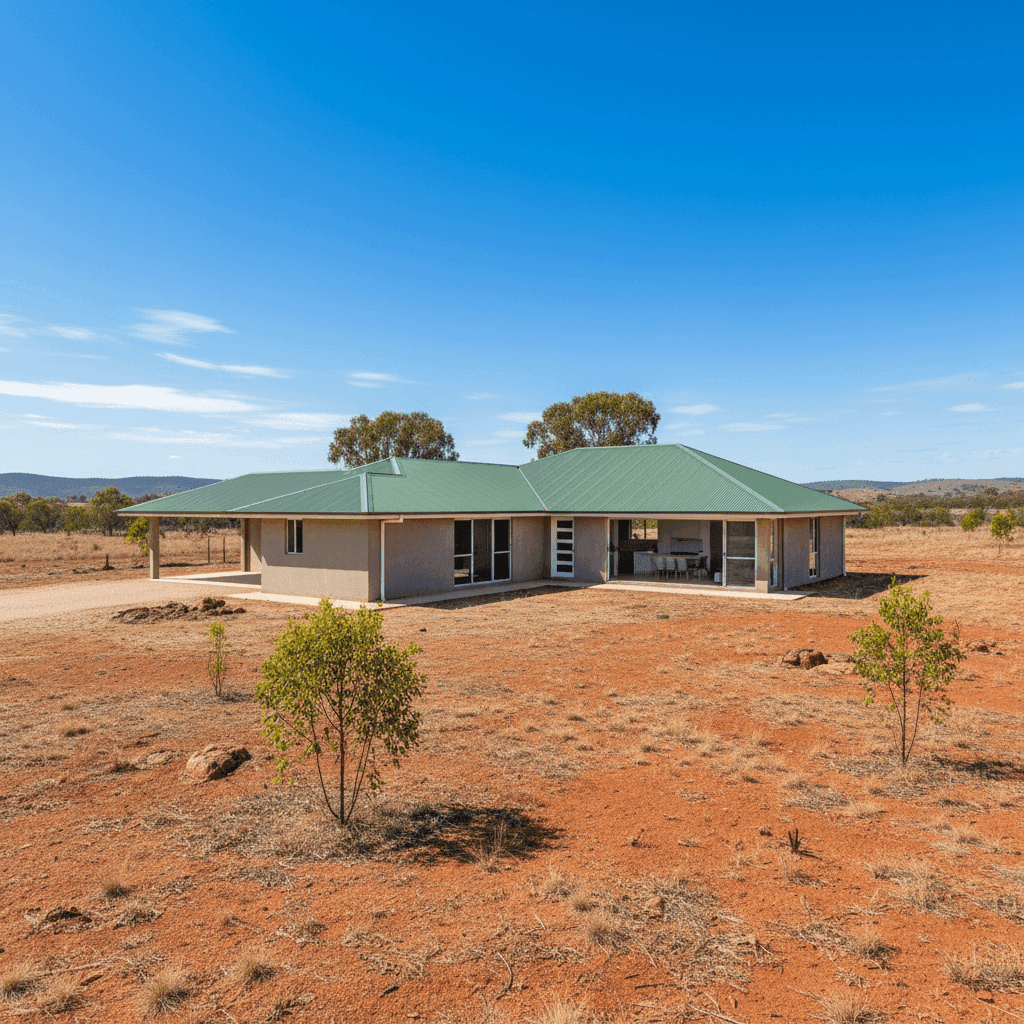
If you own a free standing home in Pioneer, QLD 4825, you already know that insuring property in outback Queensland can come with some surprises. This article breaks down a recent building insurance quote for a four-bedroom, two-bathroom home in Pioneer — and puts that number in context against suburb, state, and national benchmarks so you can judge whether you're getting a fair deal.
---
Is This Quote Fair?
The quote in question comes in at $1,806 per year (or roughly $173 per month) for building-only cover on a 205 sqm concrete-walled, Colorbond-roofed home built in 1977, with a sum insured of $680,000 and a $1,000 building excess.
Our price rating for this quote is CHEAP — below average — and the data backs that up convincingly.
To put it plainly: this premium is a genuine standout. The suburb average for Pioneer (4825) sits at $7,025 per year, with a median of $6,508. That means this quote is coming in at roughly 74% below the suburb average — an enormous gap. Even compared to the suburb's 25th percentile (the cheapest quarter of quotes sampled), which sits at $5,435, this premium is still dramatically lower.
So yes — by any reasonable measure, this is an exceptionally competitive quote for the area.
---
How Pioneer Compares
Pioneer is a small locality in the Carpentaria LGA in far north-west Queensland, and insurance premiums in the region reflect the challenges of insuring remote outback property. Here's how the numbers stack up across different levels:
| Benchmark | Annual Premium |
|---|---|
| This Quote | $1,806 |
| Pioneer (4825) Suburb Average | $7,025 |
| Pioneer (4825) Suburb Median | $6,508 |
| Carpentaria LGA Average | $5,871 |
| QLD State Average | $4,547 |
| QLD State Median | $3,931 |
| National Average | $2,965 |
| National Median | $2,716 |
What's immediately striking is that even the national average of $2,965 is well above this quote. Queensland as a whole tends to attract higher premiums than the national norm — the state average of $4,547 is about 53% above the national figure — largely due to the elevated risk of extreme weather events including floods, storms, and in many parts of the state, cyclones.
The Carpentaria LGA average of $5,871 reinforces just how expensive this pocket of Queensland can be to insure. Remote location, limited emergency services access, and the cost of sourcing building materials and labour in outback areas all contribute to higher premiums across the board. Against that backdrop, a quote under $1,900 is remarkable.
It's worth noting the suburb sample size here is relatively small (9 quotes), so the averages should be interpreted with some caution — but the directional story is clear.
---
Property Features That Affect Your Premium
Several characteristics of this particular property likely contribute to its competitive premium:
Concrete external walls are one of the most insurer-friendly construction types available. Concrete is highly resistant to fire, termites, and wind damage, and typically attracts lower premiums compared to timber-framed or clad homes. In a region where extreme heat and the occasional severe storm are real considerations, this is a meaningful advantage.
Steel/Colorbond roofing is similarly well-regarded by insurers. It's durable, low-maintenance, and performs well in high-wind and high-temperature environments. Compared to older tile roofs or fibrous cement, Colorbond is generally seen as a lower-risk material.
Slab foundation and tile flooring round out a construction profile that is solid and relatively low-risk from an insurance perspective. Slab homes don't carry the underfloor risks associated with raised timber stumps, and tiles are non-combustible and easy to repair.
The 1977 construction year is worth flagging. Homes of this era can sometimes attract loading due to older electrical systems, plumbing, or roofing materials — but with a concrete and steel construction, the risk profile remains manageable.
The absence of a pool, solar panels, and ducted climate control also keeps the insured risk profile clean. Each of those additions can incrementally increase premiums, so a straightforward home without extras is easier and cheaper to price.
Finally, Pioneer is not classified as a cyclone risk area, which is a significant factor. Much of coastal and far-north Queensland carries cyclone risk that can dramatically inflate premiums. Being outside that zone is a meaningful saving for Pioneer homeowners.
---
Tips for Homeowners in Pioneer
1. Don't assume your sum insured is set and forget. A $680,000 sum insured on a 205 sqm home in a remote area is substantial, but building costs in outback Queensland can be higher per square metre than in cities due to freight and labour. Review your sum insured annually and consider using a building cost calculator to ensure you're not underinsured — or paying for more cover than you need.
2. Compare quotes regularly — the market moves. As this quote demonstrates, there can be enormous variation between insurers for the same property. The gap between this premium and the suburb average is striking. Use a comparison service like CoverClub to shop the market each renewal rather than simply rolling over your existing policy.
3. Ask about your excess options. This quote carries a $1,000 building excess. In many cases, opting for a higher excess (say, $2,000 or $2,500) can reduce your annual premium meaningfully. If your property is well-maintained and you're unlikely to make small claims, a higher excess can be a smart trade-off.
4. Keep documentation of your home's construction. Concrete-walled, Colorbond-roofed homes can sometimes be misclassified by insurers if the details aren't clearly provided at quote time. Keeping photos and any available building records ensures your policy accurately reflects your home's construction — which matters both for pricing and for claims.
---
Ready to Compare Your Own Quote?
Whether you're a Pioneer local or own property anywhere across Queensland, it pays to know where your premium sits relative to the market. CoverClub makes it easy to compare home insurance quotes and understand exactly what you're paying for.
Get a quote and see how your premium compares →
You can also explore detailed premium data for Pioneer and the 4825 postcode, the broader Queensland market, or national benchmarks to put your own policy in perspective.