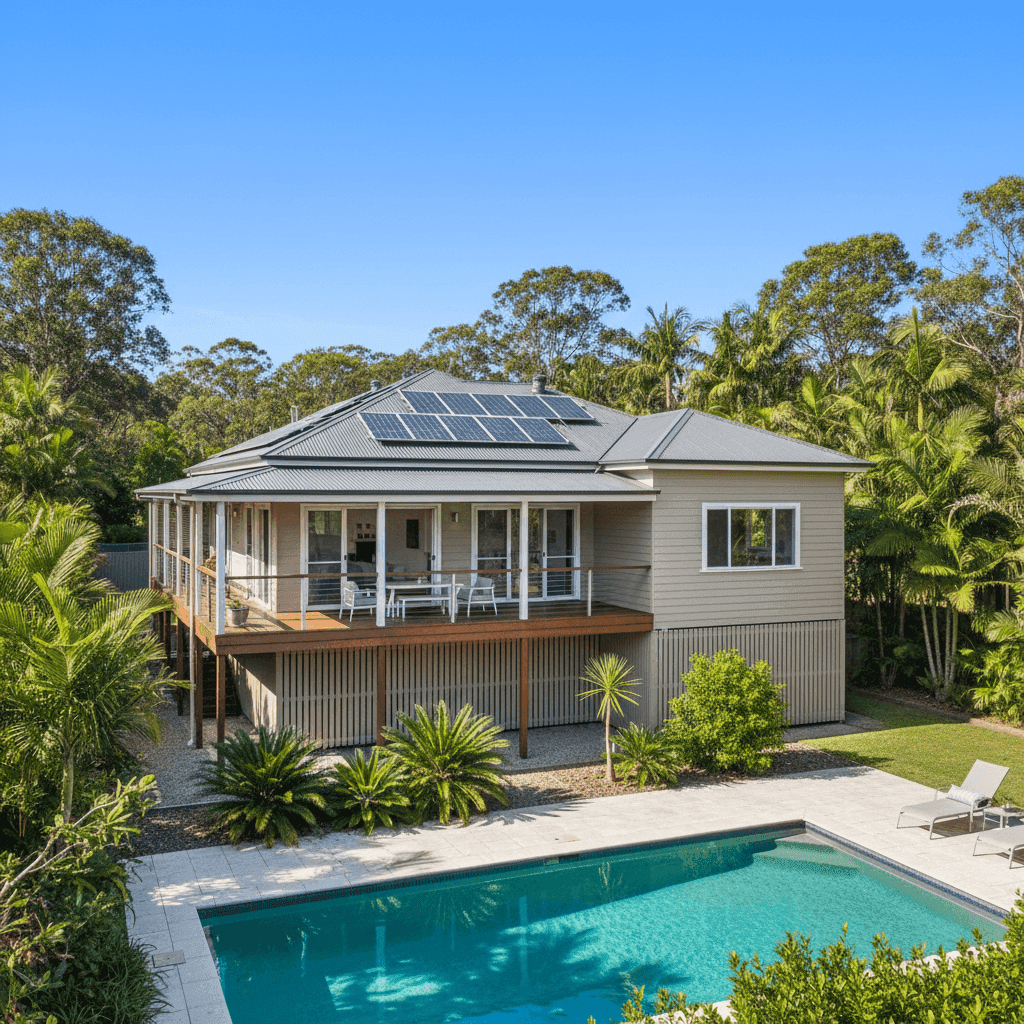
If you own a free standing home in Pottsville, NSW 2489, you've probably noticed that insurance premiums aren't exactly cheap. Sitting on the far north coast of New South Wales — just a short drive from the Queensland border — Pottsville is a sought-after coastal suburb where property values are strong and insurers pay close attention to local risk factors. This article breaks down a real home and contents insurance quote for a 4-bedroom, 3-bathroom free standing home in the area, and puts the numbers into context so you can judge whether you're getting a fair deal.
---
Is This Quote Fair?
The quote in question comes in at $4,366 per year (or $418/month), covering a building sum insured of $874,000 and $90,000 in contents, with a $2,000 excess on both building and contents claims.
Our pricing analysis rates this quote as Expensive — Above Average for the Pottsville area. That's a meaningful signal worth unpacking.
Based on 27 quotes collected for the Pottsville 2489 postcode, the suburb average sits at $3,135/yr and the median is $2,936/yr. This particular quote lands above the 75th percentile for the area (which is $4,000/yr), meaning it's pricier than roughly three-quarters of comparable quotes in the suburb.
That said, context matters. The building sum insured of $874,000 is on the higher end, and the property has several features — elevated construction, a pool, solar panels, and above-average fittings — that all influence the final premium. We'll dig into those shortly.
---
How Pottsville Compares
To understand whether this quote is truly out of step, it helps to zoom out and look at the broader picture.
| Benchmark | Average Premium | Median Premium |
|---|---|---|
| Pottsville (2489) | $3,135/yr | $2,936/yr |
| NSW State | $9,528/yr | $3,770/yr |
| National | $5,347/yr | $2,764/yr |
| Tweed LGA | $26,089/yr | — |
A few things stand out here. The NSW state average of $9,528/yr is heavily skewed by high-risk coastal and flood-prone areas — the median of $3,770/yr is a far more representative number for most NSW homeowners. Similarly, the national average of $5,347/yr is pulled upward by cyclone-prone regions in Queensland and Western Australia, while the national median of $2,764/yr tells a more grounded story.
The Tweed LGA average of $26,089/yr is extraordinarily high and almost certainly reflects a small number of very high-risk or high-value properties distorting the mean — don't let that number alarm you unduly.
Measured against the Pottsville suburb median of $2,936/yr, this quote is about 49% higher. However, when you account for the above-average sum insured and the property's specific features, some of that gap is explainable. The question is whether a competing insurer might price those same features more favourably.
---
Property Features That Affect Your Premium
Several characteristics of this property have a direct bearing on the premium, and it's worth understanding each one.
Weatherboard timber walls are a key factor. While timber weatherboard homes have a classic coastal aesthetic, insurers consider them a higher fire risk than brick or rendered concrete. Repair costs can also be higher, particularly for quality timber cladding, which pushes up the building sum insured.
Elevated construction (at least 1 metre off the ground) is a double-edged sword. On one hand, it provides meaningful protection against surface flooding — a genuine concern in low-lying coastal areas. On the other, elevated homes can be more vulnerable to wind events, and the sub-floor space adds complexity to certain repairs.
Steel/Colorbond roofing is generally viewed positively by insurers. It's durable, fire-resistant, and performs well in high-wind conditions compared to terracotta tiles. This may be partially offsetting the timber wall risk.
Above-average fittings quality directly increases the cost to rebuild. Premium kitchens, stone benchtops, quality bathroom fixtures, and high-end flooring all raise the replacement value — and the insurer's exposure.
A swimming pool adds liability and structural complexity. Pool surrounds, pumps, filtration equipment, and fencing all need to be factored into coverage, and some insurers load premiums accordingly.
Solar panels are increasingly common on Australian rooftops, but they add replacement cost to the building sum insured and can complicate roof repairs after storm or hail damage.
Ducted climate control is another above-average inclusion that adds to the building's replacement value and, by extension, the appropriate sum insured.
Taken together, this is a well-appointed, modern home (built in 2016) with a solid slab foundation and 235 sqm of living space. The premium reflects that.
---
Tips for Homeowners in Pottsville
Whether you're reviewing an existing policy or shopping for a new one, here are some practical steps to ensure you're not overpaying.
1. Compare quotes from multiple insurers. The single most effective thing you can do is get competing quotes. Insurers price risk differently, and a property with timber walls, a pool, and solar panels might be rated more generously by one underwriter than another. Even a 10–15% difference in premium adds up to hundreds of dollars over a few years.
2. Review your sum insured carefully. Over-insuring is a common and costly mistake. Use a reputable building cost calculator to verify that your sum insured reflects the actual rebuild cost — not the market value of your land and home combined. Equally, under-insuring can leave you badly exposed at claim time, so aim for accuracy rather than a low number.
3. Consider a higher excess to reduce your premium. If you have the financial buffer to absorb a larger out-of-pocket cost in a claim scenario, increasing your excess from $2,000 to $3,000 or more can meaningfully reduce your annual premium. Just make sure the saving justifies the added risk.
4. Ask about discounts for home security and safety features. Some insurers offer discounts for monitored alarm systems, deadbolts, and smoke detectors. Given this home was built in 2016, it likely meets modern building standards — make sure your insurer is aware, as newer builds can sometimes attract better rates.
---
Ready to Find a Better Rate?
If this quote feels steep, you don't have to accept it. CoverClub makes it easy to compare home and contents insurance options for your Pottsville property in minutes. Enter your address, answer a few questions about your home, and see how different insurers price your specific risk profile — side by side.
Get a quote at CoverClub today and find out whether you could be paying less for the same level of cover.
You can also explore Pottsville suburb insurance data to see how your premium stacks up against your neighbours, or browse NSW-wide insurance statistics for broader context.