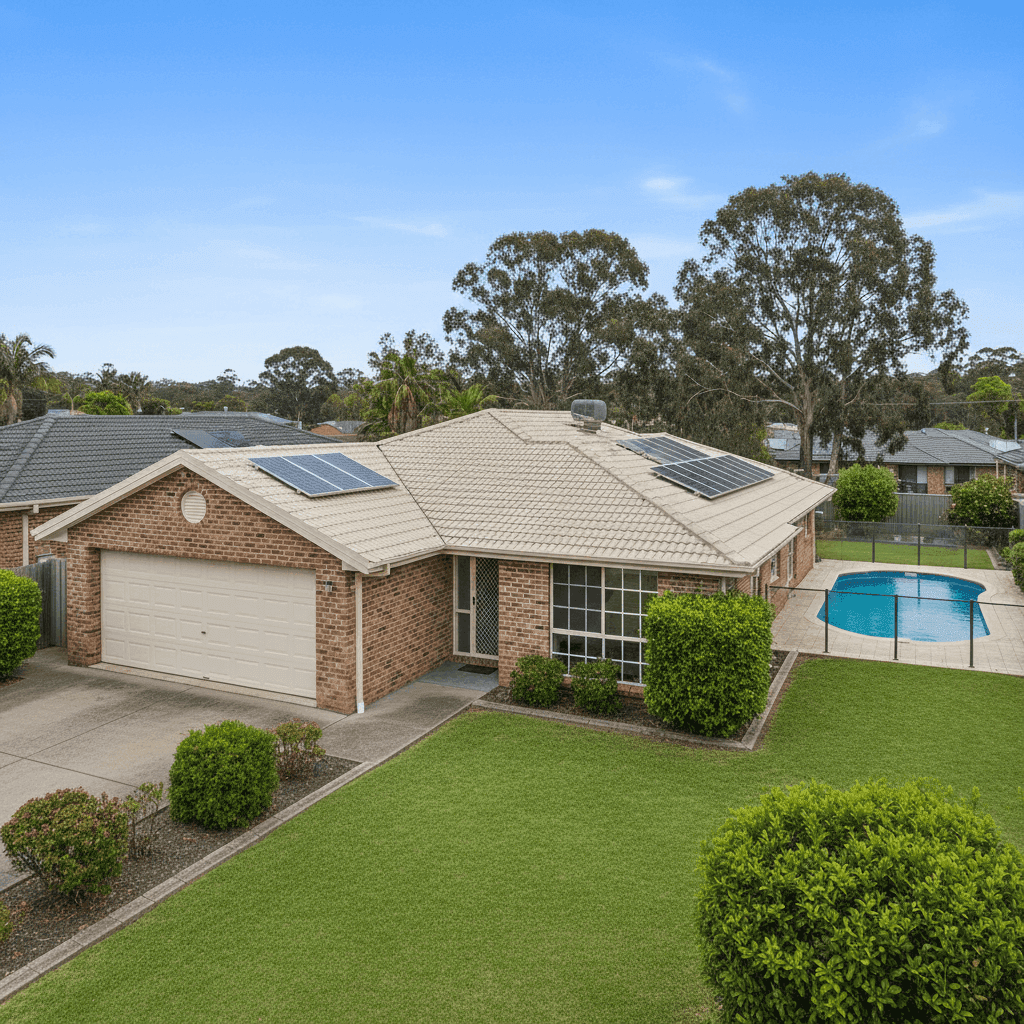
If you own a four-bedroom free standing home in Raymond Terrace, NSW 2324, you've probably wondered whether your home insurance premium is reasonable — or whether you're quietly overpaying. Raymond Terrace sits in the Hunter Region, roughly 25 kilometres north of Newcastle, and is a popular suburb for families drawn to its river setting, affordable housing, and proximity to major employment hubs. Like many regional NSW towns, it comes with its own unique insurance risk profile that's worth understanding before you renew.
This article breaks down a recent home and contents insurance quote for a brick veneer, four-bedroom home in Raymond Terrace, and puts it in context against suburb, state, and national benchmarks.
---
Is This Quote Fair?
The quote in question comes in at $3,207 per year (or $307 per month) for combined home and contents cover, with a building sum insured of $756,000 and contents valued at $180,000. Both the building and contents excess are set at $2,000.
Our rating for this quote is FAIR — Around Average.
That assessment holds up when you look at the numbers. The suburb median premium for Raymond Terrace sits at $3,444 per year, meaning this quote lands about $237 below the local median — a modest but meaningful saving. It also falls comfortably within the interquartile range for the suburb: the 25th percentile is $2,227 and the 75th percentile is $4,613, so a premium of $3,207 is solidly in the middle of what locals are paying.
In short, this isn't a bargain, but it's not a rip-off either. For a property of this size and specification, it represents reasonable value — though there's still room to do better if you shop around.
---
How Raymond Terrace Compares
One figure that jumps out immediately is the suburb average premium of $31,460 per year. That's an extraordinarily high number compared to the median of $3,444, which tells us the suburb average is being skewed significantly by a small number of very high-value or high-risk properties in the dataset (based on 43 quotes). When averages diverge this dramatically from medians, the median is almost always the more useful benchmark for typical homeowners.
Here's how Raymond Terrace stacks up against broader benchmarks:
| Benchmark | Premium |
|---|---|
| This quote | $3,207/yr |
| Raymond Terrace median | $3,444/yr |
| NSW median | $3,770/yr |
| National median | $2,764/yr |
| NSW average | $9,528/yr |
| National average | $5,347/yr |
| Maitland LGA average | $13,875/yr |
The quote sits below both the NSW and Maitland LGA medians, which is a positive sign. It's worth noting that the NSW state average of $9,528 and the Maitland LGA average of $13,875 are again pulled upward by outliers — coastal flood zones, high-value rural properties, and acreage estates can all inflate these figures considerably.
Compared to the national median of $2,764, this quote is about $443 higher, which is not unusual for a regional NSW property with a pool, solar, and ducted air conditioning — all features that add to replacement costs and, in turn, to premiums.
---
Property Features That Affect Your Premium
Several characteristics of this property have a direct bearing on what insurers charge. Understanding them can help you have more informed conversations with your insurer.
Brick veneer construction and concrete roof Brick veneer walls are generally viewed favourably by insurers — they're more fire-resistant than timber weatherboard and hold up well in storms. A concrete tile roof similarly offers good durability and weather resistance. Together, these construction materials tend to attract more competitive premiums than, say, a fibro home with a corrugated iron roof.
Built in 1975 on a slab foundation Homes from the mid-1970s are old enough that insurers may factor in the age of plumbing, electrical wiring, and roofing materials. A slab foundation is generally considered stable and low-risk for subsidence, which is a positive. However, the age of the home means that full replacement costs — reflected in the $756,000 sum insured — need to account for bringing the building up to current standards and codes, which can be more expensive than replacing a newer home like-for-like.
Swimming pool A pool increases both the replacement value of the property and the liability exposure for insurers. If the pool or its surrounds are damaged — by a storm, a falling tree, or a structural event — repairs can be costly. Expect this to contribute a few hundred dollars to your annual premium.
Solar panels Solar panels are an increasingly common feature in Australian homes, but they do add to the insured value of a property. At current prices, a decent solar system can cost $8,000–$15,000 to replace, and panels can be damaged by hail, storms, or falling debris. Make sure your sum insured adequately accounts for your system's replacement value.
Ducted climate control Ducted air conditioning is a significant fixed asset. A full ducted system can cost $10,000–$20,000 or more to replace, and it's typically covered under building insurance. This is another reason why ensuring your sum insured is accurate matters — underinsurance is one of the most common and costly mistakes homeowners make.
Timber and laminate flooring Flooring type matters for contents and building cover alike. Timber and laminate floors can be damaged by water ingress, flooding, or burst pipes, and replacement costs can be substantial across a 205 sqm home. Confirm with your insurer whether flooring is covered under building or contents — the answer varies between policies.
---
Tips for Homeowners in Raymond Terrace
1. Check your sum insured annually Building costs have risen sharply in recent years. A sum insured set three years ago may no longer reflect what it would actually cost to rebuild your home today. Use an independent building calculator or ask your insurer to reassess, and factor in features like your pool, solar system, and ducted air conditioning.
2. Compare quotes — not just at renewal Many Australians only shop around when their renewal notice arrives, but premiums can shift throughout the year. Using a comparison tool like CoverClub lets you benchmark your current premium at any time, not just when your insurer is nudging you to renew.
3. Consider your excess carefully This policy carries a $2,000 excess on both building and contents. A higher excess typically reduces your premium, but make sure the excess is an amount you could genuinely afford to pay at short notice. For many households, $2,000 is manageable — but going higher just to shave a few dollars off the premium may not be worth the financial stress in a claim situation.
4. Review your contents sum insured $180,000 in contents cover is a reasonable figure for a four-bedroom home, but it's worth doing a room-by-room audit every couple of years. Electronics, appliances, furniture, clothing, and jewellery all add up — and many homeowners find they're underinsured when they actually sit down and tally it up.
---
Find a Better Deal with CoverClub
Whether you're reviewing an existing policy or shopping for cover on a new property, CoverClub makes it easy to see how your premium stacks up. Get a home insurance quote today and compare it against real data from your suburb, your state, and across Australia. You might be paying a fair price — or you might find there's a better deal waiting.