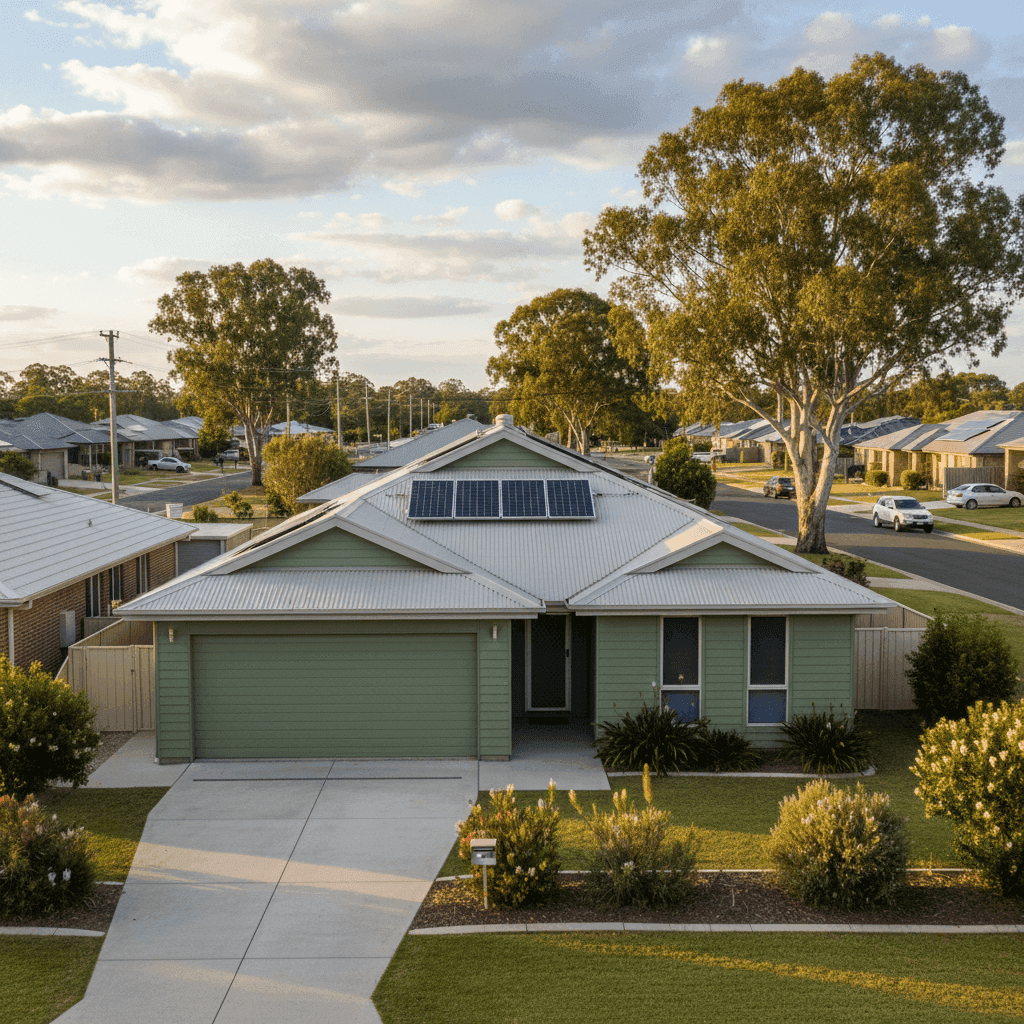
If you own a free standing home in Redbank Plains, QLD 4301, you've probably noticed that insurance costs in South East Queensland can vary wildly depending on who you ask. This article breaks down a real home and contents insurance quote for a three-bedroom weatherboard property in the suburb — and puts it into context against local, state, and national benchmarks so you can judge whether you're getting a fair deal.
---
Is This Quote Fair?
The quote in question comes in at $1,101 per year (or roughly $105 per month) for combined home and contents cover — $324,000 in building sum insured and $50,000 in contents. CoverClub's pricing engine rates this as CHEAP, meaning it sits well below the average for the area.
To put that in perspective: the suburb average for Redbank Plains is $3,384 per year, and the median sits at $2,005 per year. Even the cheapest quarter of quotes in the suburb (the 25th percentile) comes in at $1,373 — meaning this particular quote is priced below what most budget-conscious shoppers are finding. That's a meaningful saving, and for a homeowner on a tight budget, the difference between $1,101 and $2,005 per year is nearly $900 back in your pocket.
Of course, price alone doesn't tell the whole story. Excess levels matter too — both the building and contents excess on this policy sit at $2,000, which is on the higher side. A higher excess is one of the most common levers insurers use to bring premiums down, so it's worth being comfortable with the idea that you'd need to cover the first $2,000 of any claim yourself before the insurer steps in.
---
How Redbank Plains Compares
Redbank Plains sits within the City of Ipswich, and this is where the numbers get particularly eye-opening. The LGA average premium for Ipswich is a staggering $8,901 per year — more than eight times this quote, and more than double the suburb average. That figure is heavily influenced by flood-prone properties across the broader Ipswich council area, which is one of the most flood-affected regions in Queensland.
Here's a quick snapshot of how premiums compare across different levels:
| Benchmark | Annual Premium |
|---|---|
| This Quote | $1,101 |
| Redbank Plains 25th Percentile | $1,373 |
| Redbank Plains Median | $2,005 |
| Redbank Plains Average | $3,384 |
| Redbank Plains 75th Percentile | $2,500 |
| QLD State Average | $4,547 |
| QLD State Median | $3,931 |
| National Average | $2,965 |
| National Median | $2,716 |
| Ipswich LGA Average | $8,901 |
At $1,101, this quote sits dramatically below every single benchmark — local, state, and national. You can explore the full breakdown of Redbank Plains insurance statistics, compare it against Queensland-wide data, or see how it stacks up against the national picture.
The relatively low premium for this property likely reflects its position within Redbank Plains specifically — a suburb that, while part of the flood-sensitive Ipswich LGA, has pockets of land that sit at lower flood risk than many nearby areas. Location within a suburb matters enormously.
---
Property Features That Affect Your Premium
Several characteristics of this property play a role in how insurers price the risk:
Weatherboard timber walls are a key factor. Older timber-framed homes can attract higher premiums from some insurers due to perceived fire risk and the cost of repair or replacement — timber is labour-intensive to restore. However, weatherboard homes built in the 1980s are generally well-understood by insurers, and many offer competitive rates for them.
Steel/Colorbond roofing is viewed favourably. It's durable, low-maintenance, and performs well in high-wind events — a significant consideration in Queensland. Colorbond is also non-combustible, which can reduce fire risk assessments.
Slab foundation is generally considered a stable and lower-risk foundation type, particularly compared to homes on stumps or piers, which can be more susceptible to movement or flooding ingress.
Timber and laminate flooring can be more expensive to replace than carpet in a claim scenario, but this is typically reflected in the contents and building sum insured rather than dramatically shifting the base premium.
Solar panels are worth noting — the $324,000 building sum insured should account for the cost of replacing the solar system if damaged. Many homeowners underestimate this. A standard 6.6kW system can cost $5,000–$10,000 to replace, so it's worth confirming with your insurer that solar panels are explicitly covered under your policy.
The 1985 construction year places this home in a generation of Queensland builds that predate some modern cyclone-resistant construction standards — though the property is not in a designated cyclone risk area, which helps keep premiums lower.
---
Tips for Homeowners in Redbank Plains
1. Check your flood risk status carefully. Even within Redbank Plains, flood risk can vary street by street. Use the Queensland Government's flood mapping tools or your insurer's flood risk checker before assuming you're in the clear. If your property is classified as low flood risk, make sure your insurer knows — it can significantly affect your premium.
2. Confirm your solar panels are covered. Ask your insurer directly: are the solar panels on the roof covered under the building policy, and up to what value? Some policies include them automatically; others require you to list them separately or increase your sum insured.
3. Review your sum insured annually. Building costs in Queensland have risen sharply in recent years. A $324,000 sum insured for a 130 sqm weatherboard home may be appropriate today, but it's worth using a building cost calculator each year to make sure you wouldn't be underinsured if you needed to rebuild from scratch.
4. Don't let a cheap premium stop you from shopping around. Even if your current quote is already below average, the insurance market is competitive. Comparing multiple quotes annually takes only a few minutes and could reveal equivalent or better cover at an even lower price — or uncover a policy with a lower excess that gives you better value overall.
---
Compare Your Own Quote
Whether you're a first-time buyer in Redbank Plains or a long-time homeowner wondering if you're overpaying, CoverClub makes it easy to see what the market looks like for your specific property. Get a personalised home insurance quote in minutes and compare it against real suburb and state data — so you always know where you stand.