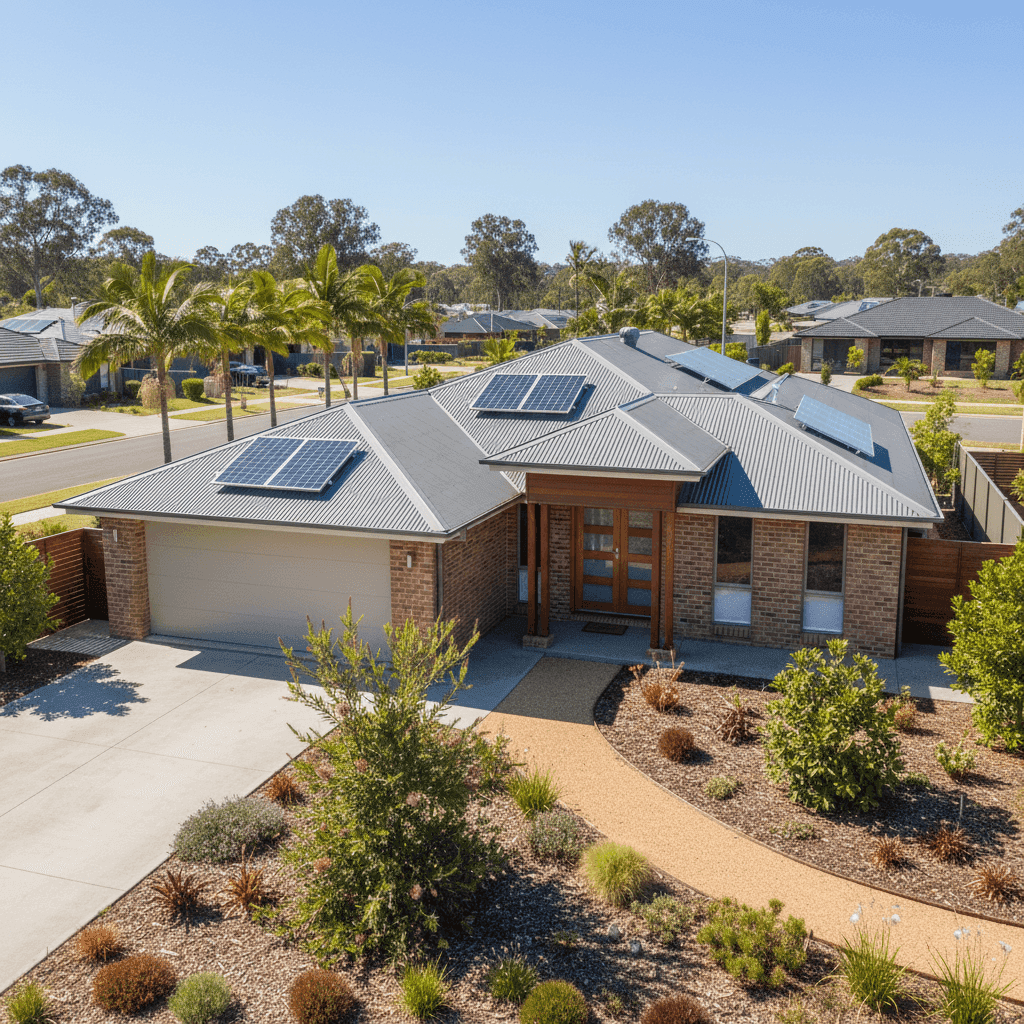
If you own a free standing home in Redland Bay, QLD 4165, you've likely noticed that insurance premiums in South-East Queensland can vary enormously from one street to the next. This article breaks down a real building insurance quote for a four-bedroom, two-bathroom brick veneer home in Redland Bay — and puts the numbers in context so you can judge whether your own premium is competitive.
---
Is This Quote Fair?
The quote in question comes in at $2,204 per year (or roughly $211 per month) for building-only cover, with a $1,000 building excess and a sum insured of $580,000. Our analysis rates this as CHEAP — below the suburb average — which is genuinely good news for the homeowner.
To put that in perspective: the suburb average for Redland Bay sits at $3,184 per year, meaning this quote is approximately $980 cheaper than what most comparable homes in the area are paying. That's a saving of around 31% against the local benchmark — not trivial when household budgets are under pressure.
It's worth noting that a "cheap" rating doesn't mean the cover is inadequate. The sum insured of $580,000 for a 214 sqm home built in 2005 is a reasonable rebuild figure for the area, and the $1,000 excess is standard across most Australian insurers. What this rating tells us is that, relative to the market, this particular quote represents strong value.
---
How Redland Bay Compares
Redland Bay sits within the Redland City LGA, a coastal fringe area south-east of Brisbane that includes waterfront suburbs, bushland interfaces, and established residential streets. Understanding the local pricing landscape is important before you accept any quote.
Here's how the numbers stack up across different benchmarks:
| Benchmark | Annual Premium |
|---|---|
| This quote | $2,204 |
| Redland Bay suburb average | $3,184 |
| Redland Bay suburb median | $3,132 |
| Redland Bay 25th percentile | $2,378 |
| Redland LGA average | $3,178 |
| QLD state median | $3,903 |
| QLD state average | $9,129 |
| National median | $2,764 |
| National average | $5,347 |
(Based on 89 quotes sampled for postcode 4165. View the full [Redland Bay suburb stats](https://coverclub.com.au/stats/QLD/4165/redland-bay) or the [QLD state overview](https://coverclub.com.au/stats/QLD).)
A few things stand out here. First, the QLD state average of $9,129 is dramatically higher than both the suburb average and the national average. This is largely driven by high-risk postcodes in Far North Queensland — cyclone-prone areas around Cairns and Townsville — which pull the mean upward significantly. The median is a more reliable indicator for most QLD homeowners, and at $3,903, Redland Bay's suburb median of $3,132 still compares favourably.
Second, this quote of $2,204 actually sits below the national median of $2,764, which is a strong result for a Queensland property. You can explore how this compares nationally at the CoverClub national stats page.
---
Property Features That Affect Your Premium
Several characteristics of this property work in the homeowner's favour when it comes to pricing.
Brick veneer construction is generally viewed positively by insurers. While not as robust as full double-brick, brick veneer offers solid fire resistance and structural durability compared to weatherboard or lightweight cladding. Combined with a tiled roof, this home sits in a construction category that attracts lower risk loadings from most insurers.
Slab foundation is the norm for homes of this era in South-East Queensland and doesn't carry the subsidence concerns sometimes associated with older stumped or pier-and-beam foundations. It's a neutral-to-positive factor in premium calculations.
The 2005 construction year places this home in a relatively modern bracket. Post-2000 homes in Queensland were built under updated building codes that improved cyclone and storm resistance standards — even in non-cyclone zones like Redland Bay. Insurers often price newer builds more favourably than homes from the 1970s or 1980s.
Solar panels are worth a mention. While they add value to the property, they also represent an additional insurable asset. Some insurers include solar panels under building cover automatically; others may require you to confirm this is the case. It's worth checking your Product Disclosure Statement (PDS) to ensure your panels are explicitly covered for storm damage, hail, and accidental breakage.
Ducted climate control is a higher-value fitting that could influence your sum insured, as it forms part of the building's fixed infrastructure. At $580,000, the sum insured appears to account for this appropriately for a 214 sqm home in this area.
Notably, this property is not located in a cyclone risk zone, which is a meaningful premium advantage for a Queensland home. Cyclone loading can add hundreds — sometimes thousands — of dollars to annual premiums in higher-risk postcodes.
---
Tips for Homeowners in Redland Bay
1. Review your sum insured annually. Construction costs in South-East Queensland have risen sharply over the past few years. A rebuild cost estimate that was accurate in 2022 may be understated today. Use a building cost calculator or speak with a quantity surveyor to ensure your $580,000 sum insured keeps pace with current labour and materials costs.
2. Confirm solar panel coverage in your PDS. As mentioned above, solar panels are a common source of claim disputes. Before your next renewal, call your insurer and ask specifically whether your rooftop system is covered under the building policy — and for what events. If it's not clearly included, consider whether a different policy better suits your needs.
3. Shop the market at renewal time. This quote is already priced below the suburb average, but that doesn't mean it will remain competitive at renewal. Insurers frequently apply automatic premium increases year-on-year. Set a calendar reminder to compare quotes at CoverClub two to three weeks before your renewal date so you have time to switch if needed.
4. Consider whether building-only cover is sufficient. Building-only cover protects the structure of your home but not your furniture, appliances, or personal belongings. If you're an owner-occupier, it's worth getting a combined building and contents quote to see whether the additional cost is worthwhile — particularly given the ducted climate control system and any high-value items inside the home.
---
Compare Your Own Quote
Whether you're renewing soon or simply curious about what the market looks like, CoverClub makes it easy to see how your current premium stacks up. Enter your address, answer a few questions about your property, and get an instant comparison across multiple insurers — no phone calls, no obligation.