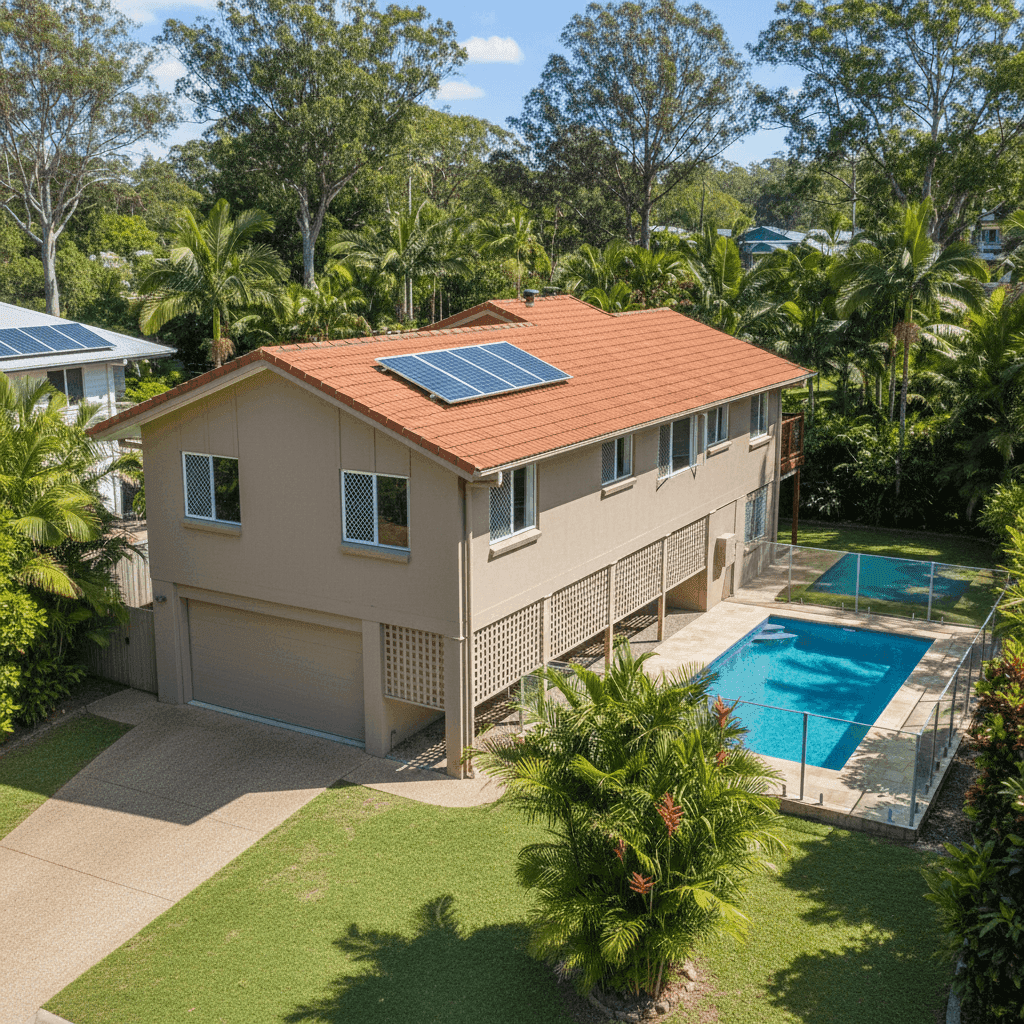
If you own a free standing home in Redlynch, QLD 4870, you already know that insurance isn't a simple line item. Nestled in the foothills of the Wet Tropics just west of Cairns, Redlynch is a popular family suburb — but its location in Far North Queensland means insurers pay close attention to cyclone exposure, rainfall intensity, and local building characteristics when pricing your policy. This article breaks down a real building-only insurance quote for a four-bedroom, three-bathroom home in the area and puts it in context using suburb, state, and national benchmarks.
---
Is This Quote Fair?
The quote in question comes in at $5,233 per year (or $502 per month) for building-only cover on a 235 sqm concrete-walled, tile-roofed home with a sum insured of $1,140,000. The excess is set at $1,000.
Our price rating for this quote is FAIR — Around Average, and the data backs that up. At $5,233 per year, this premium sits comfortably within the middle range of what Redlynch homeowners are paying. It's above the suburb median of $3,855 but well below the suburb's 75th percentile of $8,430 — meaning roughly a quarter of comparable properties in the area are paying even more.
For a home with a sum insured of over $1.1 million in a designated cyclone risk zone, this is a reasonable outcome. It's not a bargain-basement price, but it reflects the genuine risk profile of the area without veering into the eye-watering territory that some Far North Queensland homeowners face.
---
How Redlynch Compares
Understanding where your premium sits relative to broader benchmarks is one of the most useful things you can do as a homeowner. Here's how this quote stacks up:
| Benchmark | Premium |
|---|---|
| This Quote | $5,233/yr |
| Redlynch Suburb Median | $3,855/yr |
| Redlynch Suburb Average | $57,957/yr |
| Cairns LGA Average | $12,404/yr |
| QLD State Median | $3,903/yr |
| QLD State Average | $9,129/yr |
| National Average | $5,347/yr |
| National Median | $2,764/yr |
A few things stand out here. First, the Redlynch suburb average of $57,957 is dramatically higher than the median of $3,855 — a clear sign that a small number of very high-cost quotes (likely for larger or more exposed properties) are skewing the average upward. The median is almost always the more meaningful figure when assessing what's "typical" for a suburb.
Second, this quote is almost exactly in line with the national average of $5,347 — which is notable given that Redlynch sits in one of Australia's highest-risk cyclone corridors. That's a positive outcome for the homeowner.
Third, the Cairns LGA average of $12,404 is a useful reality check. Across the broader Cairns region, many homeowners are paying more than double this quote, which reinforces the "fair" rating.
You can explore more local data on the Redlynch suburb stats page, compare it against the Queensland state overview, or see how it measures up on the national stats page.
---
Property Features That Affect Your Premium
Several characteristics of this property directly influence how insurers price the risk. Understanding them helps you anticipate why your quote looks the way it does.
Cyclone Risk Zone This is the single biggest factor. Redlynch falls within a designated cyclone risk area, and insurers apply significant loadings to reflect the potential for wind damage, storm surge, and debris impact. Cyclone cover in Far North Queensland is not optional — it's baked into standard policies — but it comes at a cost.
Elevated Foundation The home is elevated by at least one metre, which is actually a positive feature in this context. Elevation reduces flood inundation risk and can improve airflow, both of which insurers view favourably. It may be contributing to a more competitive premium than a ground-level slab home might attract in the same street.
Concrete External Walls and Tile Roof Concrete construction is generally regarded as more resilient to cyclone-force winds than timber framing, and tiles — while heavier — are considered a durable roofing material. This combination typically attracts better pricing than, say, a weatherboard home with a metal sheet roof.
Swimming Pool and Solar Panels Both features add to the replacement cost of the property and are reflected in the $1,140,000 sum insured. Solar panels in particular can be expensive to replace and are increasingly common in insurance claims following hail or cyclone events. Ensuring they're explicitly covered under your building policy is worth confirming with your insurer.
Ducted Climate Control Ducted air conditioning systems are a significant fixed asset and are typically included in building cover. Given the climate in Far North Queensland, these systems work hard year-round, so confirming your policy covers mechanical breakdown or storm damage to the unit is a sensible step.
---
Tips for Homeowners in Redlynch
1. Review your sum insured annually Construction costs in Queensland have risen sharply over the past few years. A sum insured of $1,140,000 for a 235 sqm home may be appropriate today, but it's worth recalculating every year — especially if you've made improvements. Underinsurance is one of the most common and costly mistakes homeowners make.
2. Ask specifically about cyclone excess clauses Many policies in cyclone-prone areas apply a separate, higher excess for cyclone-related claims. This can be $2,500, $5,000, or more — well above the standard $1,000 excess on this policy. Read the Product Disclosure Statement carefully and ask your insurer to clarify what applies in a cyclone event.
3. Confirm solar panel and pool equipment coverage Don't assume these are automatically covered to their full replacement value. Some policies cap coverage for solar systems or exclude pool equipment as standard. A quick call to your insurer can save a very unpleasant surprise at claim time.
4. Compare quotes before renewal The insurance market in Far North Queensland is competitive but also volatile. Premiums can shift significantly between renewal periods. Using a comparison tool like CoverClub at least once a year ensures you're not paying more than you need to for equivalent cover.
---
Ready to Compare?
Whether you're reviewing an existing policy or shopping for the first time, getting multiple quotes is the best way to make sure you're paying a fair price for the right cover. Get a home insurance quote through CoverClub and see how your options stack up — it only takes a few minutes and could save you hundreds of dollars a year.