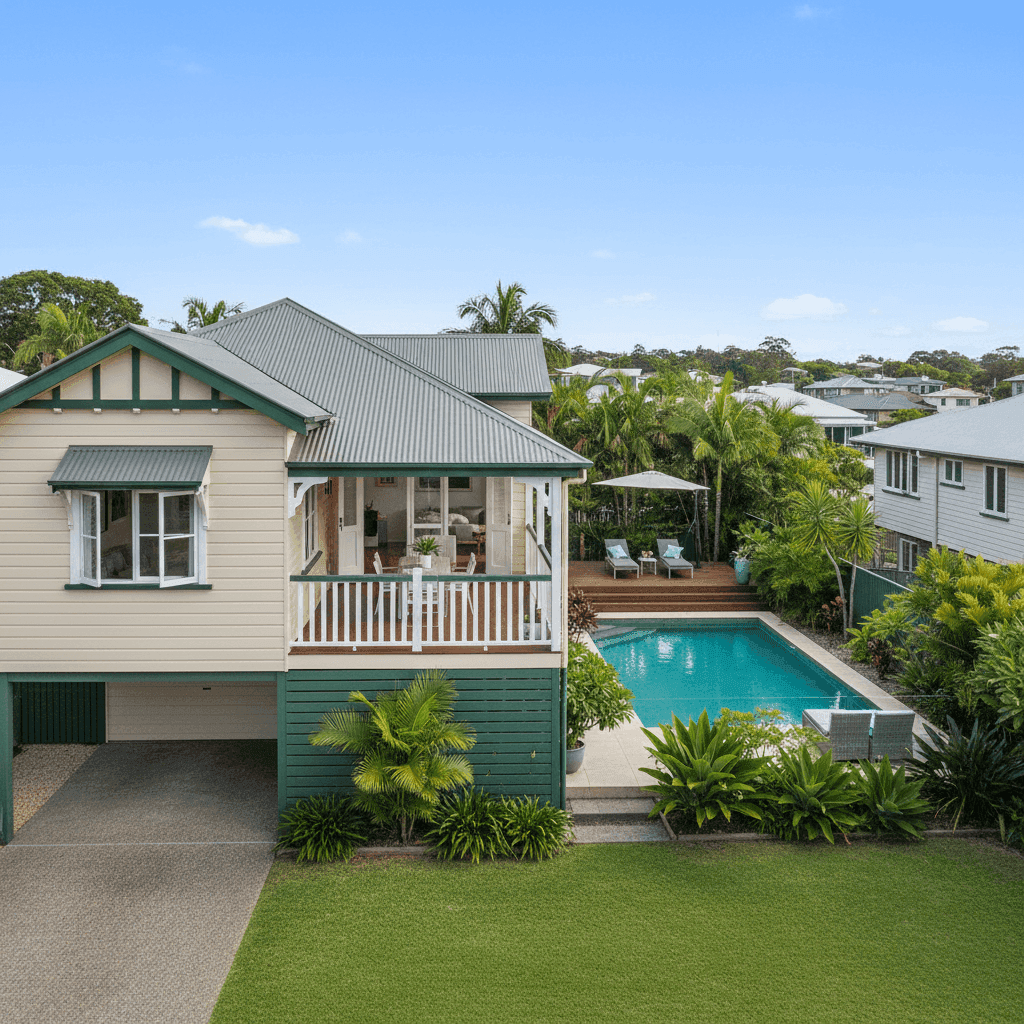
If you own a free standing home in Riordanvale, QLD 4800, you already know that insurance isn't cheap — and for good reason. Sitting in the Mackay region of North Queensland, Riordanvale sits squarely in one of Australia's most challenging insurance environments, where cyclone risk, tropical weather events, and building replacement costs all weigh heavily on what you pay each year. In this article, we break down a real building insurance quote for a three-bedroom, three-bathroom weatherboard home in the area, compare it against local and national benchmarks, and share practical tips to help you get better value on your cover.
---
Is This Quote Fair?
The quote in question comes in at $4,904 per year (or $470/month) for building-only cover on a 169 sqm free standing home, with a sum insured of $796,000 and a building excess of $5,000.
Our price rating for this quote is EXPENSIVE — above average for the Riordanvale area.
To put that in context: the suburb average premium sits at $4,118/year, and the median is even lower at $3,898/year. This quote lands above the 75th percentile for the suburb ($4,687/year), meaning it's pricier than at least three-quarters of comparable quotes we've seen in postcode 4800. That's a meaningful gap — roughly $786 more per year than the suburb average, and nearly $1,000 above the median.
That said, "expensive" is relative. Several property-specific factors — which we'll cover below — justify a higher-than-average premium for this particular home. The question isn't just whether the price is high, but whether it's appropriately high given the risk profile. Based on the features involved, there's a reasonable case that this quote reflects genuine risk pricing, but there's also room to shop around.
---
How Riordanvale Compares
Understanding your premium means looking beyond your street. Here's how Riordanvale stacks up against broader benchmarks:
| Benchmark | Average Premium | Median Premium |
|---|---|---|
| Riordanvale (4800) | $4,118/yr | $3,898/yr |
| LGA – Mackay | $8,458/yr | — |
| Queensland | $9,129/yr | $3,903/yr |
| National | $5,347/yr | $2,764/yr |
A few things stand out here. First, the QLD state average of $9,129/year is extraordinarily high — but the median of $3,903 tells a more nuanced story. Queensland's average is skewed upward by extremely high-risk properties (think beachfront homes and those in severe cyclone zones), while the median reflects what most Queensland homeowners actually pay. Riordanvale's median of $3,898 is almost identical to the state median, suggesting the suburb is broadly in line with typical Queensland pricing.
Compared to the national average of $5,347, this quote of $4,904 is actually below the country-wide figure — a useful reminder that "expensive for Riordanvale" doesn't necessarily mean expensive in absolute terms. The national median of $2,764, however, highlights just how much more North Queensland homeowners pay compared to their counterparts in lower-risk states like Victoria or South Australia.
You can explore detailed local data on the Riordanvale insurance stats page, compare it against Queensland-wide trends, or take a look at the national insurance benchmarks for broader context.
> Note: The suburb sample size for this analysis is 7 quotes, so while directionally useful, these figures should be interpreted with some caution. A larger dataset would provide even greater confidence.
---
Property Features That Affect Your Premium
Several characteristics of this property have a direct bearing on its insurance cost. Here's what's likely influencing the figure:
🌀 Cyclone Risk Area
This is the single biggest factor. Riordanvale falls within a designated cyclone risk zone, which triggers significantly higher premiums across all insurers. Cyclone cover typically includes wind, storm surge, and associated water damage — all of which are expensive to underwrite in North Queensland.
🏠 Weatherboard Timber Walls
Weatherboard construction, while charming and common in older Queensland homes, is considered a higher-risk wall type by insurers compared to brick veneer or double brick. Timber is more susceptible to wind damage, fire, and pest-related deterioration, which pushes premiums upward.
🏗️ Construction Era (1985)
A home built in 1985 predates many of the modern cyclone-resistant building standards introduced after Cyclone Tracy and refined through the 1990s and 2000s. Older homes may lack the structural reinforcements now required by code, making them more vulnerable — and more costly to insure.
💧 Swimming Pool
The presence of a pool adds to the insured value of the property and introduces additional liability considerations. Most insurers factor pool infrastructure into building replacement costs, which can nudge the sum insured — and therefore the premium — higher.
❄️ Ducted Climate Control
Ducted air conditioning systems are a meaningful inclusion in the building sum insured. These systems are expensive to replace and can be damaged in storm events, so their presence reasonably contributes to a higher insured value and premium.
🪵 Timber and Laminate Flooring
While flooring is more relevant to contents cover, in a building-only policy it can still influence the replacement cost calculation, particularly where timber flooring is integrated into the structure of the home.
---
Tips for Homeowners in Riordanvale
Living in a cyclone-prone area means insurance is non-negotiable — but that doesn't mean you have to overpay. Here are four practical steps to make sure you're getting the best deal:
- Shop around every year. Insurer pricing in North Queensland varies enormously. The same property can attract quotes that differ by $1,000 or more depending on the provider. Don't let your policy auto-renew without checking the market first.
- Review your sum insured carefully. At $796,000, this home's building sum insured is substantial. Make sure it reflects actual rebuild costs — not market value — using a professional quantity surveyor or an online calculator. Being over-insured means you're paying more than necessary; being under-insured can leave you exposed when it matters most.
- Consider a higher excess to reduce your premium. This policy already carries a $5,000 building excess, which is on the higher side. If you're comfortable with that level of self-insurance for smaller claims, you may already be benefiting from a lower base premium. Ask your insurer how different excess levels affect your annual cost.
- Invest in cyclone-proofing improvements. Retrofitting your home with cyclone straps, upgrading roof fixings, or installing impact-resistant shutters can reduce your risk profile and, in some cases, unlock discounts with certain insurers. It's worth asking specifically about mitigation credits when comparing quotes.
---
Compare Your Options with CoverClub
Whether this quote is the right one for you depends on your full financial picture, risk tolerance, and what other insurers are willing to offer. The best way to find out is to compare. At CoverClub, we help Australian homeowners cut through the noise and find cover that's fairly priced for their specific property and location. Get a quote today and see how your current premium stacks up — you might be surprised at what's available.