If you own a free standing home in Riverstone, NSW 2765, you're likely no stranger to the challenge of finding competitive home insurance. Riverstone sits within the City of Blacktown and has grown significantly over the past decade, attracting families drawn to its relative affordability and proximity to Western Sydney's expanding infrastructure. But as the suburb grows, so does the complexity of insuring properties here — particularly those with features that push premiums above the local norm.
This article takes a close look at a recent Home and Contents insurance quote for a four-bedroom, one-bathroom free standing home in Riverstone, breaking down whether the price stacks up and what's likely driving the cost.
---
Is This Quote Fair?
The quote in question comes in at $3,818 per year (or $362/month), covering a building sum insured of $430,000 and contents valued at $50,000, with a $1,000 excess on both building and contents.
Our independent price rating for this quote is Expensive — Above Average.
To put that in context: the average home insurance premium for comparable properties in Riverstone sits at just $1,663 per year, with a median of $1,575. This quote is more than double the local median, which is a significant gap worth understanding before simply accepting the price.
That said, "above average" doesn't automatically mean "wrong." Several features of this particular property — explored further below — do legitimately push the risk profile higher than a standard Riverstone home. The question is whether the premium increase is proportionate.
---
How Riverstone Compares
To understand where this quote sits, it helps to zoom out and look at the broader picture. You can explore the full data on the Riverstone suburb stats page, the NSW state overview, and national insurance benchmarks.
Here's a snapshot of how premiums compare across different reference points:
| Benchmark | Average Premium | Median Premium |
|---|---|---|
| Riverstone (NSW 2765) | $1,663/yr | $1,575/yr |
| LGA (Penrith) | $2,220/yr | — |
| NSW State | $9,528/yr | $3,770/yr |
| National | $5,347/yr | $2,764/yr |
A few things stand out here. The NSW state average of $9,528 is heavily skewed by high-risk coastal, flood-prone, and bushfire-exposed properties — so the median of $3,770 is a more reliable comparison point for most homeowners. Against that NSW median, this quote of $3,818 is broadly in line with the state middle ground, even if it sits well above the local Riverstone norm.
Compared to the national median of $2,764, the quote is still elevated — roughly 38% higher. And within the Riverstone suburb itself, the 75th percentile of premiums reaches $2,112, meaning this quote exceeds even the most expensive quarter of local policies by a considerable margin.
The LGA average for Penrith ($2,220) also reinforces that this quote is on the higher end for the region.
---
Property Features That Affect Your Premium
Not all homes are created equal in the eyes of an insurer. Several characteristics of this property are likely contributing to a higher-than-average premium.
Building Size and Sum Insured
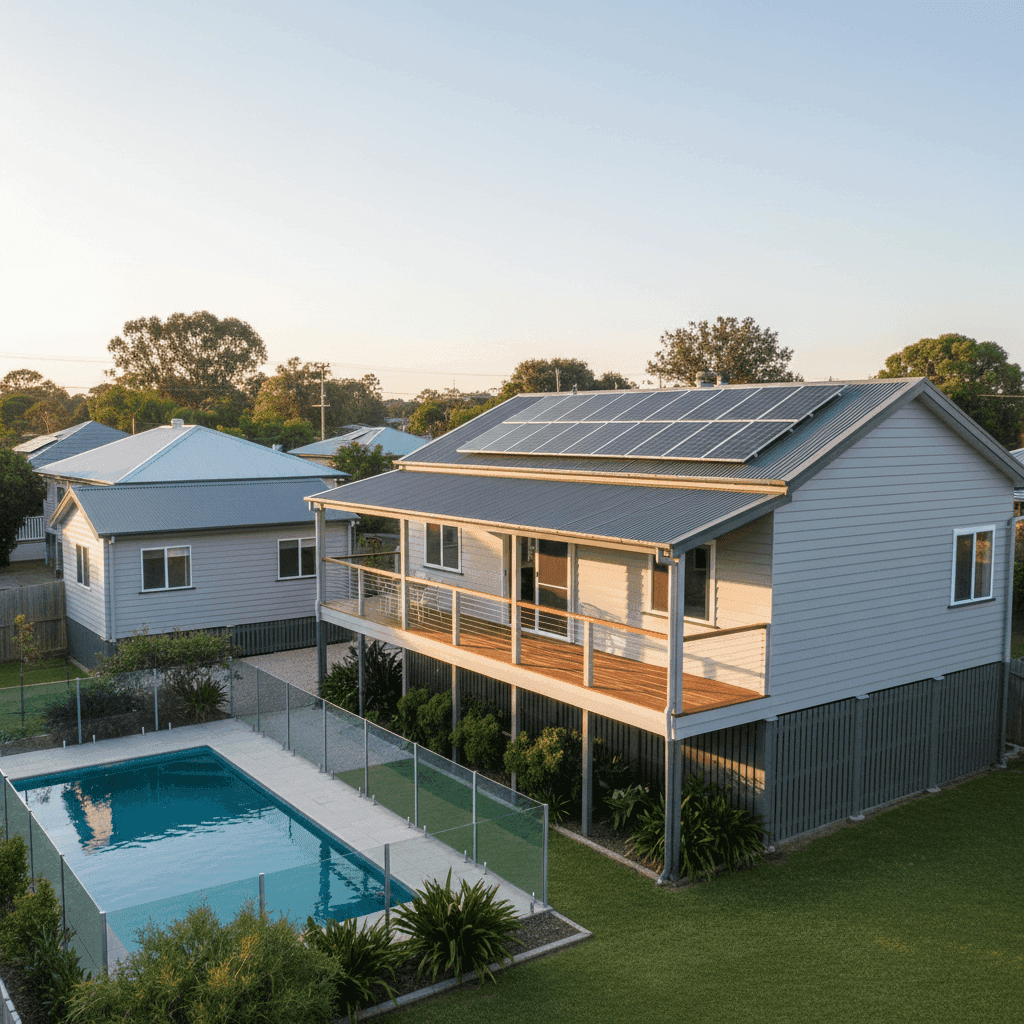
At 205 square metres with a building sum insured of $430,000, this is a larger-than-average home for the suburb. Rebuild costs are a primary driver of premiums, and a higher sum insured naturally increases the insurer's exposure.
Vinyl Cladding Exterior
Vinyl cladding is considered a moderate-risk external wall material compared to brick. It can be more susceptible to impact damage and certain weather events, which may influence how insurers assess the property's vulnerability.
Elevated Foundation
The home is elevated by at least one metre. While elevation can actually reduce flood risk in some scenarios, it introduces additional structural complexity — particularly around sub-floor spaces and the potential for storm or wind damage — which some insurers price accordingly.
Swimming Pool
A pool adds both asset value and liability exposure. Insurers factor in the cost of pool fencing, equipment, and the broader liability risk associated with having a pool on the property.
Solar Panels
Solar panels represent a meaningful replacement cost if damaged by hail, storm, or fire. With panels increasingly common on Australian rooftops, insurers are becoming more sophisticated in pricing this risk, but it does add to the overall sum insured calculation.
Granny Flat
The presence of a granny flat adds additional insurable structures to the property. Depending on how the policy is structured, this can increase the building sum insured and the overall complexity of a claim.
Steel / Colorbond Roof
On the positive side, a Colorbond steel roof is generally viewed favourably by insurers. It's durable, fire-resistant, and performs well in high-wind conditions — factors that can help moderate premiums compared to tiled or older roofing materials.
---
Tips for Homeowners in Riverstone
If you're looking to bring your premium closer to the local average, here are four practical steps worth considering.
1. Shop around — seriously. The gap between this quote and the Riverstone median suggests there's meaningful competition in the market. Different insurers assess risk differently, and a property with vinyl cladding, a pool, solar panels, and a granny flat may be priced very differently across providers. Get a comparison quote at CoverClub to see what's available for your specific address.
2. Review your sum insured carefully. Over-insuring is a common and costly mistake. Use a reputable building cost calculator (such as those provided by Cordell or Archicentre Australia) to confirm whether $430,000 accurately reflects your home's rebuild cost — not its market value. Adjusting this figure to an accurate level could reduce your premium without leaving you underinsured.
3. Consider a higher excess. A $1,000 excess is standard, but opting for a higher voluntary excess (say, $2,000 or $2,500) can meaningfully reduce your annual premium. This strategy works well if you have the savings to cover a larger out-of-pocket cost in the event of a claim.
4. Bundle and ask for discounts. Many insurers offer discounts when you hold multiple policies — such as home, contents, and car — with the same provider. It's also worth asking directly about loyalty discounts, security system discounts, or any promotions currently available.
---
Compare Your Options Today
Whether you're renewing an existing policy or shopping around for the first time, comparing quotes is one of the most effective ways to ensure you're not overpaying. CoverClub makes it easy to see how your premium stacks up against real data from your suburb and beyond.
Start comparing home insurance quotes at CoverClub — it takes just a few minutes and could save you hundreds of dollars a year.