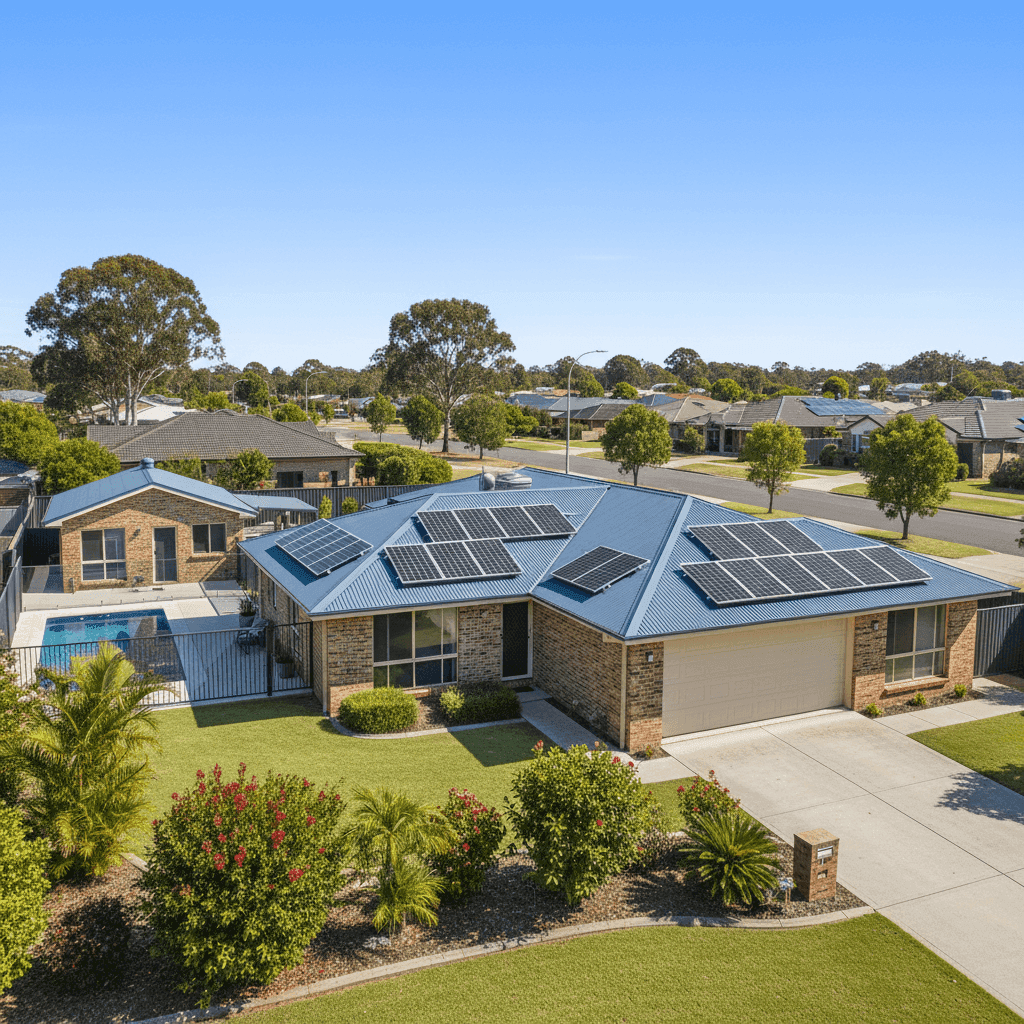
Rochedale South is a well-established residential suburb in Brisbane's south-east corridor, known for its spacious family homes and convenient access to major arterials. If you own a large free standing home in this pocket of Queensland, understanding what drives your home insurance premium — and whether you're paying a fair price — can make a significant difference to your household budget.
This article breaks down a real home and contents insurance quote for a substantial seven-bedroom, four-bathroom brick veneer property in Rochedale South (QLD 4123), comparing it against suburb, state, and national benchmarks to help you make an informed decision.
---
Is This Quote Fair?
The annual premium on this quote comes in at $3,997 per year (or $376 per month), covering a building sum insured of $1,394,000 and $80,000 in contents. Our price rating for this quote is Expensive — above average for the suburb.
To put that in context: the average home and contents premium across Rochedale South sits at around $2,108 per year, with a median of $2,056. This quote is nearly 90% above the suburb median, which is a notable gap worth examining.
That said, it's important not to read that figure in isolation. This is an exceptionally large property — 415 sqm of living space with seven bedrooms, four bathrooms, a pool, solar panels, and a granny flat. The building sum insured of $1,394,000 reflects genuine replacement cost exposure that is considerably higher than a typical three- or four-bedroom home in the same street. A higher insured value almost always translates to a higher premium, so some elevation above the suburb average is entirely expected.
The more relevant question is whether this specific premium is competitive for a property of this size and complexity. Based on our data, there is likely room to find a better rate by comparing across multiple insurers — particularly given the quote sits above even the suburb's 75th percentile of $2,562 per year.
---
How Rochedale South Compares
Understanding where Rochedale South sits in the broader insurance landscape helps frame whether this suburb is inherently expensive to insure.
| Benchmark | Average Premium | Median Premium |
|---|---|---|
| Rochedale South (4123) | $2,108/yr | $2,056/yr |
| Queensland | $9,129/yr | $3,903/yr |
| National | $5,347/yr | $2,764/yr |
| LGA (Brisbane) | $16,277/yr | — |
A few things stand out here. Queensland's average premium is extremely high at $9,129 — heavily skewed by cyclone-prone regions in far north Queensland where premiums can be eye-watering. The state median of $3,903 is a more grounded figure, and on that measure, this quote of $3,997 is actually sitting close to the Queensland median — not dramatically out of line for a large property.
Compared to the national median of $2,764, the quote is elevated, but again, the property size and sum insured justify a meaningful premium above the national midpoint.
The Brisbane LGA average of $16,277 appears very high and is likely influenced by a wide mix of property types, flood-affected areas, and high-value homes across the city. Rochedale South's own averages are considerably more modest, suggesting it remains a relatively affordable suburb to insure within the Brisbane context.
---
Property Features That Affect Your Premium
Several characteristics of this property have a direct bearing on the premium calculated:
Size and sum insured: At 415 sqm with seven bedrooms and four bathrooms, this is a large home by any measure. The $1,394,000 building sum insured reflects the true cost of rebuilding a property of this scale, and insurers price accordingly. Larger homes simply cost more to replace.
Brick veneer construction: Brick veneer walls are generally viewed favourably by insurers. They offer solid fire resistance and durability compared to timber or fibre cement cladding, which can contribute to more competitive premiums.
Steel/Colorbond roof: Colorbond roofing is widely used across Queensland and is well-regarded for its durability, resistance to corrosion, and performance in storms. It tends to attract neutral-to-positive treatment from underwriters.
Slab foundation: A concrete slab is considered a stable and low-risk foundation type, with no subfloor space that could be affected by moisture, pests, or flooding.
Swimming pool: Pools add to the insured value of the property and can introduce liability considerations. They typically contribute a modest uplift to premiums.
Solar panels: Rooftop solar is increasingly common across Queensland. Panels add replacement value to the building sum insured and can be a source of claims if damaged in storms or hail events. Ensuring your solar system is adequately covered within your building sum insured is important.
Granny flat: A secondary dwelling on the same property adds significant replacement cost exposure. If the granny flat is included within the building sum insured, this is a meaningful driver of the higher insured value — and the higher premium.
1986 construction: Homes built in the mid-1980s can carry slightly higher rebuild complexity due to older construction methods and materials. Insurers may factor this into their risk assessment, particularly when estimating accurate replacement costs.
No cyclone risk: Rochedale South falls outside Queensland's designated cyclone risk zones, which is a genuine saving grace. Properties in far north Queensland can pay multiples of what south-east Queensland homeowners pay, purely due to cyclone exposure.
---
Tips for Homeowners in Rochedale South
1. Verify your building sum insured regularly With a property of this size and complexity — including a granny flat and solar panels — it's worth reviewing your sum insured annually. Construction costs have risen significantly in recent years, and being underinsured on a $1.4 million rebuild could leave you seriously out of pocket after a major event.
2. Compare quotes across multiple insurers This quote is rated as expensive relative to the suburb. Even accounting for the property's size, shopping around via a comparison platform could surface more competitive options. Insurers price risk differently, and a large brick veneer home with a Colorbond roof may be viewed more favourably by some underwriters than others.
3. Ask about bundling discounts Some insurers offer discounts when you combine home and contents cover under a single policy, or when you hold multiple policies (such as car insurance) with the same provider. It's worth asking the question.
4. Review your contents sum insured At $80,000, the contents cover is relatively modest for a seven-bedroom home. It's worth doing a proper inventory — including furniture, appliances, electronics, clothing, and valuables — to make sure you're not underinsured on the contents side. An underestimate here can be just as costly as one on the building side.
---
Compare Your Options with CoverClub
Whether you're renewing your existing policy or shopping around for the first time, comparing quotes is the single most effective way to ensure you're not overpaying. At CoverClub, you can enter your property details and see how your premium stacks up against real quotes from across the market — no obligation, no hassle. For a home as significant as this one, even a modest saving per year adds up considerably over time.