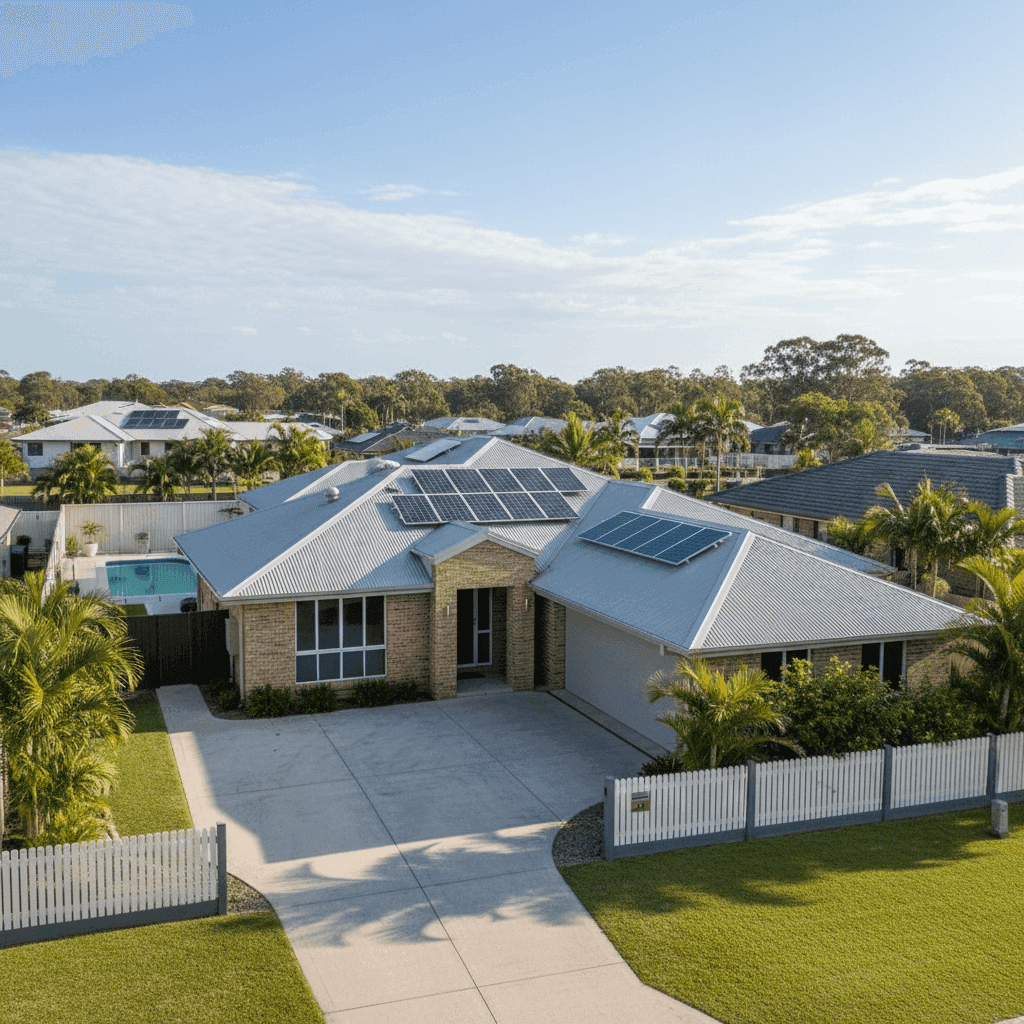
Runaway Bay is one of the Gold Coast's most sought-after waterside suburbs, and the homes here reflect that — spacious, well-appointed, and built to last. This article takes a close look at a real home insurance quote for a six-bedroom, four-bathroom free standing home in Runaway Bay (QLD 4216), breaking down whether the premium is reasonable, how it stacks up against local and national benchmarks, and what property features are likely driving the cost.
---
Is This Quote Fair?
The annual premium for this Home and Contents policy comes in at $12,279 per year (or $1,177/month), covering a building sum insured of $2,188,000 and contents valued at $173,000. Both the building and contents excess are set at $1,000.
Our price rating for this quote is Expensive (Above Average) — and the data backs that up.
The suburb average for Runaway Bay sits at just $4,776 per year, with a median of $4,474. This quote is more than 2.5 times the suburb average, which is a significant gap. Even at the 75th percentile for the suburb — meaning 75% of comparable quotes are cheaper — premiums only reach $5,432/yr. This quote sits well above even that upper band.
That said, context matters. The property in question is substantially larger and more valuable than a typical Runaway Bay home. A 367 sqm build with a $2.188 million sum insured, above-average fittings, a pool, solar panels, and ducted climate control is not a standard suburban dwelling — it's a high-value asset, and insurers price accordingly. The elevated sum insured alone is one of the single biggest drivers of premium cost, and at this level, some degree of premium loading is expected.
Still, even accounting for the property's size and value, there may be room to shop around. A premium this far above the local norm warrants a comparison.
---
How Runaway Bay Compares
Understanding where a premium sits relative to broader benchmarks helps put the number in perspective. Here's how Runaway Bay stacks up:
| Benchmark | Average Premium | Median Premium |
|---|---|---|
| Runaway Bay (QLD 4216) | $4,776/yr | $4,474/yr |
| Gold Coast LGA | $8,161/yr | — |
| Queensland | $9,129/yr | $3,903/yr |
| National | $5,347/yr | $2,764/yr |
A few things stand out here. Runaway Bay's average is notably lower than both the Queensland state average ($9,129/yr) and the Gold Coast LGA average ($8,161/yr). This suggests the suburb itself is not considered particularly high-risk by insurers — it's not a cyclone-designated zone, and it doesn't carry the same coastal exposure penalties seen in parts of Far North Queensland.
Interestingly, the Queensland state average is significantly higher than the national average of $5,347/yr, largely due to the outsized impact of high-risk regional Queensland properties pulling the state figure up. The national median of $2,764/yr is a reminder of just how wide the spread can be across Australia.
For this specific property, the $12,279 premium exceeds even the Queensland state average — pointing firmly to the property's size, rebuild value, and features as the primary cost drivers rather than location risk alone.
---
Property Features That Affect Your Premium
Several characteristics of this property will be influencing the premium, for better or worse:
Building size and sum insured: At 367 sqm and a sum insured of $2,188,000, this is a large, high-value home. Rebuild costs for properties of this scale — especially with above-average fittings — can be substantial, and insurers price that risk directly into the premium.
Brick veneer construction and Colorbond roof: These are generally viewed favourably by insurers. Brick veneer offers solid fire and impact resistance, while steel/Colorbond roofing is durable and performs well in storm conditions. Both materials can contribute to more competitive premiums compared to timber-framed or tiled alternatives.
Concrete slab foundation: A slab foundation is considered low-risk for subsidence and movement, which is a positive factor for underwriters assessing structural risk.
Tile flooring: Tiles are durable and resistant to water damage, which may marginally reduce contents and building risk in the eyes of an insurer.
Swimming pool: Pools add to the insured value of the property and can introduce liability considerations, both of which contribute to a higher premium.
Solar panels: Solar systems are increasingly common, but they add to the replacement value of a home and can complicate roof-related claims. Most insurers now include solar panels under building cover, but the added value is reflected in the premium.
Ducted climate control: A full ducted system is a significant installation — costly to repair or replace — and adds to the overall building sum insured.
No cyclone risk: This is a meaningful positive. Properties in cyclone-designated zones (particularly in North Queensland) can attract substantial premium loadings. Runaway Bay falls outside these zones, which keeps location-based risk relatively contained.
---
Tips for Homeowners in Runaway Bay
1. Review your sum insured carefully At $2,188,000, the building sum insured is a major premium driver. Make sure your figure reflects the actual cost to rebuild — not the market value of the property. Overcovering can mean unnecessarily high premiums, while undercovering leaves you exposed. A quantity surveyor can provide an accurate rebuild estimate.
2. Compare multiple quotes Given this premium is well above the suburb average, it's worth getting at least two or three competing quotes. Insurers assess risk differently, and for a high-value property like this, the variation between providers can be substantial — potentially thousands of dollars per year.
3. Ask about bundling discounts Many insurers offer discounts when you combine home and contents cover under a single policy, or when you hold multiple policies (such as car insurance) with the same provider. It's always worth asking.
4. Check your contents valuation $173,000 in contents cover is reasonable for a home of this size and quality, but it's worth doing a room-by-room review periodically. Over- or under-insuring contents is a common issue — especially in homes with high-value electronics, jewellery, or artwork that may need to be listed separately.
---
Ready to Compare?
Whether you're renewing an existing policy or exploring your options for the first time, comparing quotes is the smartest move you can make. At CoverClub, you can enter your property details and see how your current premium stacks up — in seconds, with no obligation. Don't pay more than you need to for great cover.