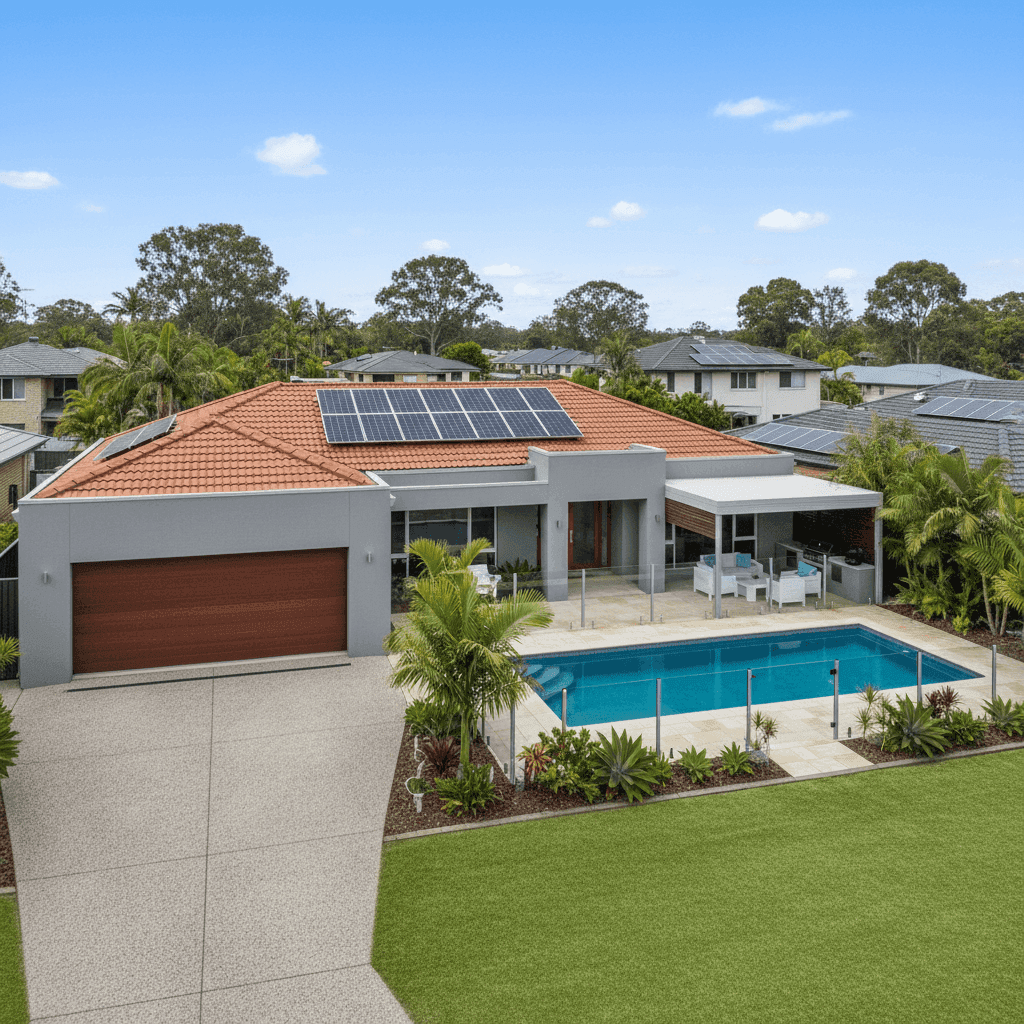
Runaway Bay is one of the Gold Coast's most sought-after residential pockets — a waterside suburb in Queensland's postcode 4216 that blends relaxed coastal living with strong property values. For owners of a free standing home here, understanding what you're paying for building insurance — and whether that price is reasonable — can make a real difference to your household budget.
This article analyses a recent building-only insurance quote for a 3-bedroom, 2-bathroom free standing home in Runaway Bay, breaking down how the premium stacks up against local, state, and national benchmarks.
---
Is This Quote Fair?
The quote in question comes in at $3,212 per year (or roughly $314 per month) for building-only cover, with a $2,000 building excess and a sum insured of $901,000.
Our price rating for this quote is FAIR — Around Average.
That assessment is well supported by the data. The suburb average for Runaway Bay sits at $4,090 per year, and the median is $3,687 per year — meaning this quote is tracking noticeably below both figures. In fact, it falls closer to the 25th percentile for the suburb ($2,624/yr) than to the median, which is a solid outcome for the homeowner.
It's worth noting the $2,000 building excess does play a role here. A higher excess typically reduces your annual premium, so part of the savings is offset by a larger out-of-pocket cost in the event of a claim. That said, for a well-maintained property with top-of-the-range fittings, many homeowners are comfortable accepting a higher excess in exchange for lower ongoing costs.
Overall, this is a competitive quote — not the cheapest on the market, but well within a sensible range for the suburb and property type.
---
How Runaway Bay Compares
To put this quote in proper context, it helps to look at the full picture — suburb, state, and national. You can explore live data on the Runaway Bay insurance stats page, the Queensland stats page, and the national stats page.
| Benchmark | Average Premium | Median Premium |
|---|---|---|
| Runaway Bay (suburb) | $4,090/yr | $3,687/yr |
| Gold Coast (LGA) | $5,494/yr | — |
| Queensland (state) | $4,547/yr | $3,931/yr |
| National | $2,965/yr | $2,716/yr |
A few things stand out here. First, the Gold Coast LGA average of $5,494 per year is substantially higher than the Runaway Bay suburb average — suggesting that certain parts of the Gold Coast (likely higher-risk coastal or flood-prone areas) are dragging that LGA figure up. Runaway Bay, by comparison, appears to be a relatively more insurable pocket within the region.
Second, Queensland as a whole is significantly more expensive to insure than the national average — a pattern driven by the state's exposure to tropical weather events, flooding, and storm damage. Queensland homeowners pay roughly 53% more on average than the national figure, which underscores just how location-sensitive home insurance pricing really is.
The quote of $3,212 sits below the Queensland median and well below the Gold Coast LGA average, making it a genuinely competitive result for this region.
---
Property Features That Affect Your Premium
Several characteristics of this property will have influenced the quoted premium — some favourably, others less so.
Concrete external walls are generally viewed positively by insurers. Concrete is highly resistant to fire, termites, and storm damage, and tends to hold up well compared to timber-framed construction. This likely contributes to a more competitive premium.
Tiled roof is another relatively insurer-friendly feature. Terracotta and concrete tiles are durable and perform well in most weather conditions, though they can be more costly to repair or replace than Colorbond if damaged.
Slab foundation is standard for Queensland homes of this era and presents no particular risk flags for insurers.
Top-of-the-range fittings are a meaningful factor. High-quality fixtures, appliances, and finishes push up the cost to rebuild or repair the home — which is reflected in the $901,000 sum insured. Ensuring this figure accurately represents full rebuild cost (not market value) is critical to avoiding underinsurance.
Swimming pool adds a modest premium loading in most policies, primarily due to liability considerations and the cost to repair or reinstate the pool structure following an insured event.
Solar panels are increasingly common on Queensland rooftops, but they do add to the insurable value of the property. Some insurers include solar systems under building cover automatically; others may require them to be specified. It's worth confirming this with your insurer.
Ducted climate control is another high-value fixture that contributes to the rebuild cost and, by extension, the sum insured.
The property was built in 1989, which means it's now over 35 years old. Older homes can attract slightly higher premiums due to ageing infrastructure (plumbing, wiring, roofing), though the concrete construction and tiled roof help mitigate this.
---
Tips for Homeowners in Runaway Bay
1. Review your sum insured regularly With top-of-the-range fittings, a pool, solar panels, and ducted air conditioning, the rebuild cost of this property is substantial. Building costs in Queensland have risen sharply in recent years — make sure your $901,000 sum insured still reflects current construction costs. Underinsurance is one of the most common and costly mistakes homeowners make.
2. Understand what your excess means in practice A $2,000 building excess is on the higher end. Before accepting this, consider how often you're likely to make a claim and whether the annual premium saving justifies the larger upfront cost if something goes wrong. For a well-built concrete home in a non-cyclone zone, it may well be worth it.
3. Confirm solar panels and pool are fully covered Ask your insurer specifically whether your solar panel system and pool are included under the building policy — and to what value. Some policies cap coverage on these items or require them to be listed separately.
4. Compare quotes at renewal time Even a "fair" quote can become uncompetitive over time. Insurers adjust their pricing models regularly, and loyalty doesn't always pay. Running a comparison at renewal is one of the simplest ways to make sure you're not overpaying.
---
Compare Home Insurance Quotes in Runaway Bay
Whether you're reviewing an existing policy or shopping for cover on a new property, it pays to see the full market. Get a home insurance quote at CoverClub to compare options for your Runaway Bay property and find out where your premium really sits.