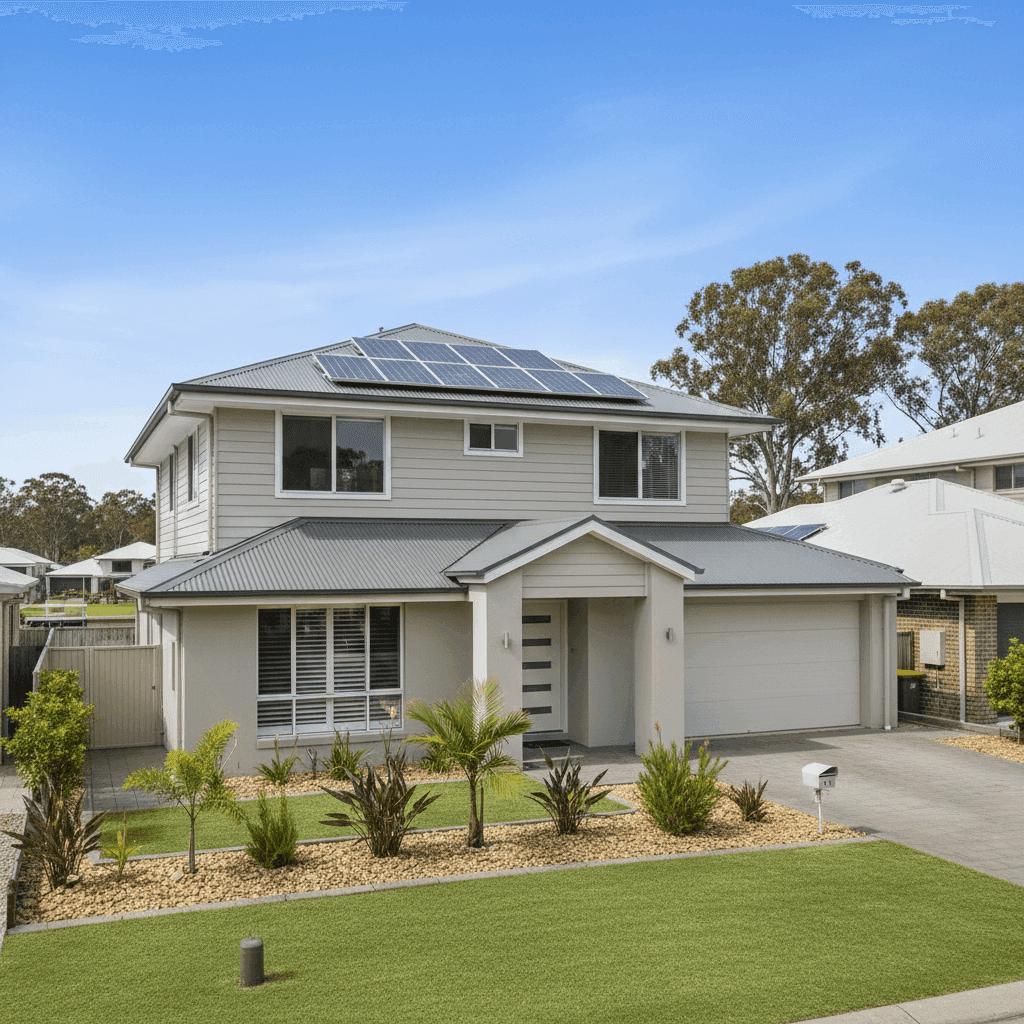
Runaway Bay is one of the Gold Coast's most sought-after residential pockets — a canal-side suburb in Queensland's 4216 postcode that blends relaxed coastal living with easy access to the broader Gold Coast. If you own a free standing home here, understanding what you should be paying for building insurance is an important part of protecting one of your biggest financial assets. This article breaks down a recent building-only insurance quote for a three-bedroom, three-bathroom free standing home in Runaway Bay, and puts the numbers into real context.
---
Is This Quote Fair?
The quote in question comes in at $4,349 per year (or approximately $417 per month) for building-only cover, with a $1,000 building excess and a sum insured of $449,000. Our price rating for this quote is FAIR — Around Average.
That "fair" rating isn't a consolation prize — it actually reflects a reasonably competitive position. The quote sits below the suburb average of $4,776 per year and also below the suburb median of $4,474 per year. In other words, this homeowner is paying less than the typical Runaway Bay property owner for comparable cover. While there is room to potentially do better (the suburb's 25th percentile sits at $3,582 per year), the quote is by no means overpriced for this location and property type.
For a modern home built in 2016 with quality fixtures, solar panels, ducted climate control, and a sum insured approaching half a million dollars, a premium in this range is consistent with what the broader market reflects for Runaway Bay.
---
How Runaway Bay Compares
To truly understand whether a quote represents good value, you need to look beyond the suburb and zoom out. Here's how this quote stacks up across different comparison points:
| Benchmark | Premium |
|---|---|
| This Quote | $4,349/yr |
| Runaway Bay Suburb Average | $4,776/yr |
| Runaway Bay Suburb Median | $4,474/yr |
| Runaway Bay 25th Percentile | $3,582/yr |
| Runaway Bay 75th Percentile | $5,432/yr |
| QLD State Average | $9,129/yr |
| QLD State Median | $3,903/yr |
| Gold Coast LGA Average | $8,161/yr |
| National Average | $5,347/yr |
| National Median | $2,764/yr |
A few things stand out here. The Queensland state average of $9,129 per year is strikingly high — but this figure is heavily skewed by premiums in cyclone-prone and flood-affected regions of Far North Queensland, where insurance costs can be extreme. The state median of $3,903 is far more representative of what most Queenslanders pay, and this quote sits only modestly above that figure.
The Gold Coast LGA average of $8,161 per year might also raise eyebrows, but again, this is influenced by a wide range of properties across the LGA — from flood-prone low-lying areas to beachfront homes with elevated risk profiles. Runaway Bay's own suburb data (based on 69 quotes) paints a more accurate picture for this specific area.
Compared to the national average of $5,347 per year, this quote is actually below average — a positive sign. The national median of $2,764, however, is a reminder that many Australian homeowners in lower-risk areas pay significantly less. Coastal Queensland simply carries more inherent risk than, say, inland Victoria or suburban South Australia.
You can explore more data on the Runaway Bay suburb insurance stats page, the Queensland state overview, or the national insurance statistics.
---
Property Features That Affect Your Premium
Every home is different, and insurers weigh up a range of property characteristics when calculating your premium. Here's how the features of this particular home come into play:
Construction Year (2016) A relatively modern build works in the homeowner's favour. Homes constructed after 2010 typically comply with updated building codes, meaning stronger structural integrity, better cyclone and storm resistance, and reduced likelihood of claims related to ageing infrastructure.
Hardiplank/Hardiflex Exterior Walls Fibre cement cladding like Hardiplank is a popular choice in Queensland for good reason — it's durable, resistant to moisture and termites, and holds up well in coastal climates. Insurers generally view this material favourably compared to older weatherboard or solid brick alternatives.
Steel/Colorbond Roof Colorbond steel roofing is widely regarded as one of the best choices for Australian conditions. It's lightweight, highly resistant to wind and hail, and requires minimal maintenance. This is a positive factor in premium calculations.
Slab Foundation A concrete slab foundation is standard for modern Queensland homes and is generally considered low-risk by insurers. It eliminates concerns about subfloor flooding or timber decay that can affect older homes on stumps.
Solar Panels Solar panels add value to a home but also add to the replacement cost. Insurers factor in the cost of reinstating solar systems after damage, which can contribute modestly to a higher sum insured and, in turn, the premium.
Ducted Climate Control Like solar, ducted air conditioning is a significant fixed asset that increases the overall reinstatement value of the home. It's a worthwhile inclusion in your sum insured to avoid being underinsured.
No Pool, No Cyclone Risk Zone The absence of a pool removes a common source of liability and maintenance-related claims. Being outside a designated cyclone risk area is also a meaningful premium advantage — properties in cyclone zones across North Queensland can pay dramatically more for equivalent cover.
---
Tips for Homeowners in Runaway Bay
1. Review your sum insured annually With construction costs rising across Australia, the cost to rebuild your home may have increased since you last set your sum insured. $449,000 for a 139 sqm home in Runaway Bay is a reasonable starting point, but it's worth checking against a building cost calculator each year to make sure you're not underinsured.
2. Shop around — even if your current quote seems fair A "fair" rating means you're in a reasonable range, but the gap between the 25th percentile ($3,582) and 75th percentile ($5,432) in Runaway Bay is significant. Different insurers weight risk factors differently, and a comparable policy from another provider could save you several hundred dollars annually. Get a new quote at CoverClub to see what's available.
3. Check your policy covers solar panels and ducted systems Not all building policies automatically include solar panels or fixed air conditioning systems as standard. Review your Product Disclosure Statement (PDS) carefully to confirm these assets are covered — and that the sum insured reflects their replacement value.
4. Consider your excess strategically This quote carries a $1,000 building excess. Opting for a higher excess (say, $2,000 or $2,500) can reduce your annual premium, which makes sense if you have sufficient savings to cover a larger out-of-pocket cost in the event of a claim. Conversely, if cash flow is a concern, keeping the excess lower provides more predictable costs when you need to claim.
---
Compare Your Home Insurance Today
Whether you're reviewing an existing policy or shopping for cover for the first time, comparing quotes is the single most effective way to ensure you're getting fair value. CoverClub makes it easy to see how your premium stacks up against real data from your suburb, your state, and across Australia. Start your comparison at CoverClub and take the guesswork out of home insurance.