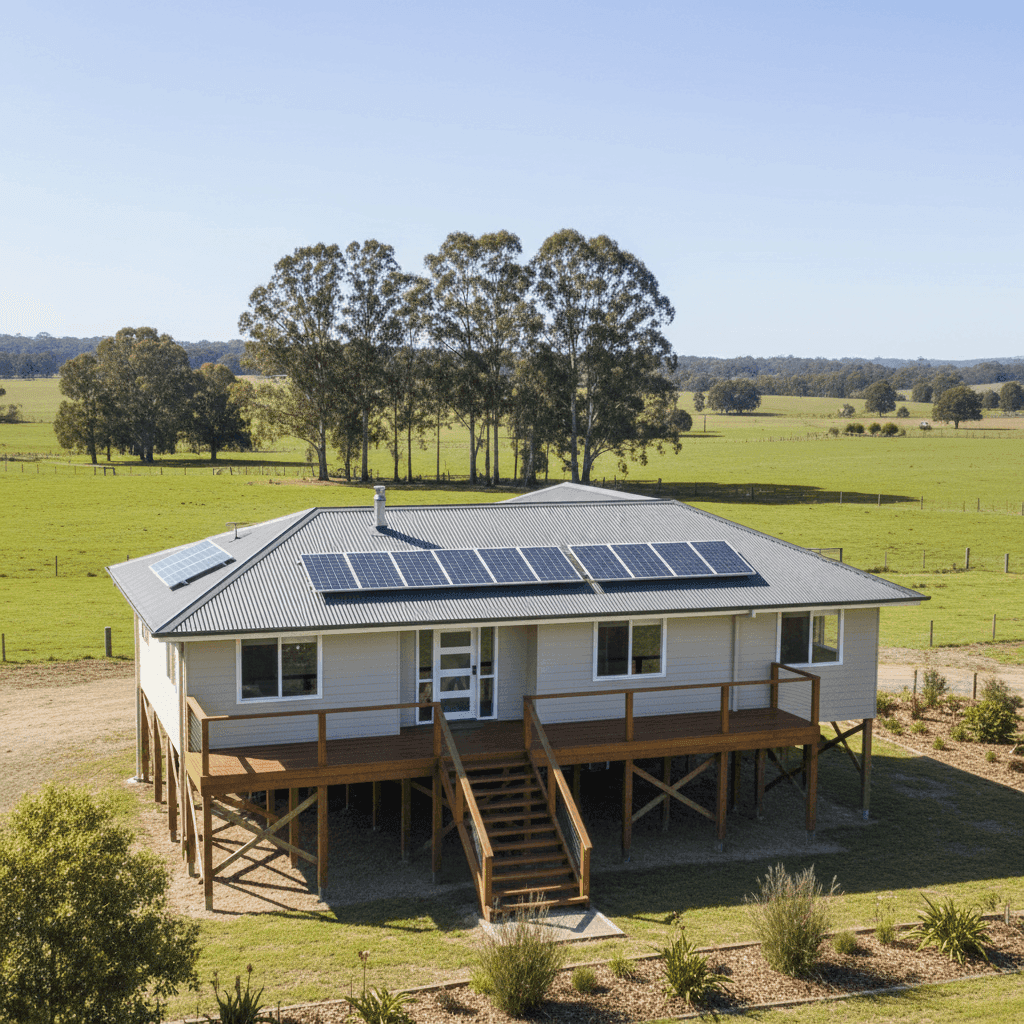
Sarsfield is a small rural locality in East Gippsland, Victoria — a region known for its stunning landscapes, tight-knit community, and, frankly, some of the more complex home insurance pricing in the state. If you own a free standing home here, understanding what drives your premium is essential to making sure you're getting a fair deal. In this article, we analyse a recent home and contents insurance quote for a 4-bedroom, 2-bathroom property in Sarsfield (postcode 3875) and unpack exactly what the numbers mean for local homeowners.
---
Is This Quote Fair?
The quote in question comes in at $4,317 per year (or $386/month) for combined home and contents cover, with a building sum insured of $1,091,000 and contents valued at $120,000. The building excess sits at $2,000, with a separate $600 excess for contents claims.
Our price rating for this quote is FAIR — Around Average, and the data backs that up. Based on 24 quotes collected for the Sarsfield area, the suburb average premium is $4,396/yr and the median sits at $4,263/yr. This quote lands neatly between those two figures — meaning it's neither a standout bargain nor an overpriced outlier.
To put it another way: roughly half of Sarsfield homeowners are paying more than $4,263/yr, and half are paying less. At $4,317, this quote is sitting right in the middle of the pack for the local market.
That said, "average for the suburb" doesn't automatically mean "the best you can do." There's meaningful spread in the data — the 25th percentile sits at $3,524/yr and the 75th percentile reaches $5,135/yr — a range of over $1,600 between the cheaper and more expensive quotes. That gap is significant, and it highlights why shopping around genuinely pays off in this postcode.
---
How Sarsfield Compares
The suburb-level context is useful, but zooming out tells an even more interesting story.
| Benchmark | Premium |
|---|---|
| This quote | $4,317/yr |
| Sarsfield average | $4,396/yr |
| Sarsfield median | $4,263/yr |
| VIC state average | $3,000/yr |
| VIC state median | $2,718/yr |
| National average | $5,347/yr |
| National median | $2,764/yr |
| East Gippsland LGA average | $3,003/yr |
A few things stand out here. First, Sarsfield premiums — including this quote — are running significantly above the Victorian state average of $3,000/yr and the East Gippsland LGA average of $3,003/yr. That's not a coincidence; it reflects the elevated risk profile of rural Gippsland, particularly around bushfire exposure.
Second, while the national average premium of $5,347/yr might make this quote look reasonable by comparison, the national median of just $2,764/yr tells a different story — the national average is being pulled upward by high-risk postcodes (cyclone zones in Queensland and the Northern Territory, bushfire-prone areas in Victoria and NSW). Sarsfield is clearly one of those higher-risk locations.
Compared to the broader Victorian insurance landscape, where the median sits at $2,718/yr, Sarsfield homeowners are paying a notable premium — roughly 57% more than the state median. That's the cost of insuring in a region with real environmental risk.
---
Property Features That Affect Your Premium
Several characteristics of this property have a direct bearing on the quote:
Hardiplank/Hardiflex External Walls Fibre cement cladding like Hardiplank is generally viewed favourably by insurers. It's non-combustible, resistant to rot and termites, and holds up well in harsh weather — all of which can work in your favour at premium time compared to, say, weatherboard or timber cladding.
Steel/Colorbond Roof Colorbond roofing is another positive signal for insurers. It's durable, fire-resistant, and performs well in high-wind and ember-attack scenarios — a meaningful consideration in East Gippsland's bushfire-prone environment.
Elevated on Stumps (At Least 1 Metre) Being elevated by at least a metre is a double-edged sword. On one hand, it can reduce flood risk to the structure itself. On the other, elevated homes can be more vulnerable to wind damage, and the subfloor space adds complexity to rebuilding costs — which may partly explain the relatively high building sum insured of $1,091,000 for a 244 sqm home.
Timber/Laminate Flooring Timber floors add character and value but can be costly to repair or replace after water damage or fire. This is worth keeping in mind when reviewing your contents and building cover limits.
Solar Panels The property has solar panels installed. These are typically covered under building insurance, but it's worth confirming with your insurer that they're explicitly included in the sum insured — and that the $1,091,000 building figure adequately accounts for their replacement cost.
Bushfire Risk Context Sarsfield sits within East Gippsland, a region that experienced catastrophic bushfires during the 2019–20 Black Summer. Insurers price this risk into premiums for the entire region, regardless of whether an individual property has previously been affected. This is arguably the single biggest factor pushing Sarsfield premiums above the state average.
---
Tips for Homeowners in Sarsfield
1. Review your building sum insured carefully At $1,091,000 for a 244 sqm home built in 2003, the sum insured is substantial. Make sure this figure reflects the true cost to rebuild the property — not its market value. Elevated homes on stumps, in particular, can carry higher rebuild costs due to subfloor access and structural complexity. Underinsurance is a real risk, especially in regional areas where building costs have risen sharply in recent years.
2. Shop around — the spread is wide With a $1,600+ gap between the 25th and 75th percentile premiums in Sarsfield, there's real money to be saved by comparing quotes. A "fair" rating means you're not being gouged, but it doesn't mean you've found the best available price. Get a quote through CoverClub to see what multiple insurers would charge for your specific property.
3. Confirm solar panel coverage If your insurer hasn't explicitly confirmed that your solar panels are covered under the building policy, ask. Some policies include them automatically; others require a specific endorsement. Given the cost of modern solar systems, this is worth a five-minute phone call.
4. Consider your excess settings This quote carries a $2,000 building excess and $600 contents excess. Opting for a higher excess is one of the most effective ways to reduce your annual premium — but make sure you'd genuinely be able to cover that amount out of pocket in the event of a claim. For many homeowners, a $2,500 or $3,000 excess can unlock meaningful savings.
---
Compare Your Options with CoverClub
Whether you're renewing your policy or shopping for the first time, CoverClub makes it easy to see how your quote stacks up against the market. Our suburb-level data for Sarsfield and the surrounding area is updated regularly, giving you a real-world benchmark — not just an insurer's word that you're getting a good deal. Start comparing quotes today and make sure your home is protected at a price that's genuinely competitive.