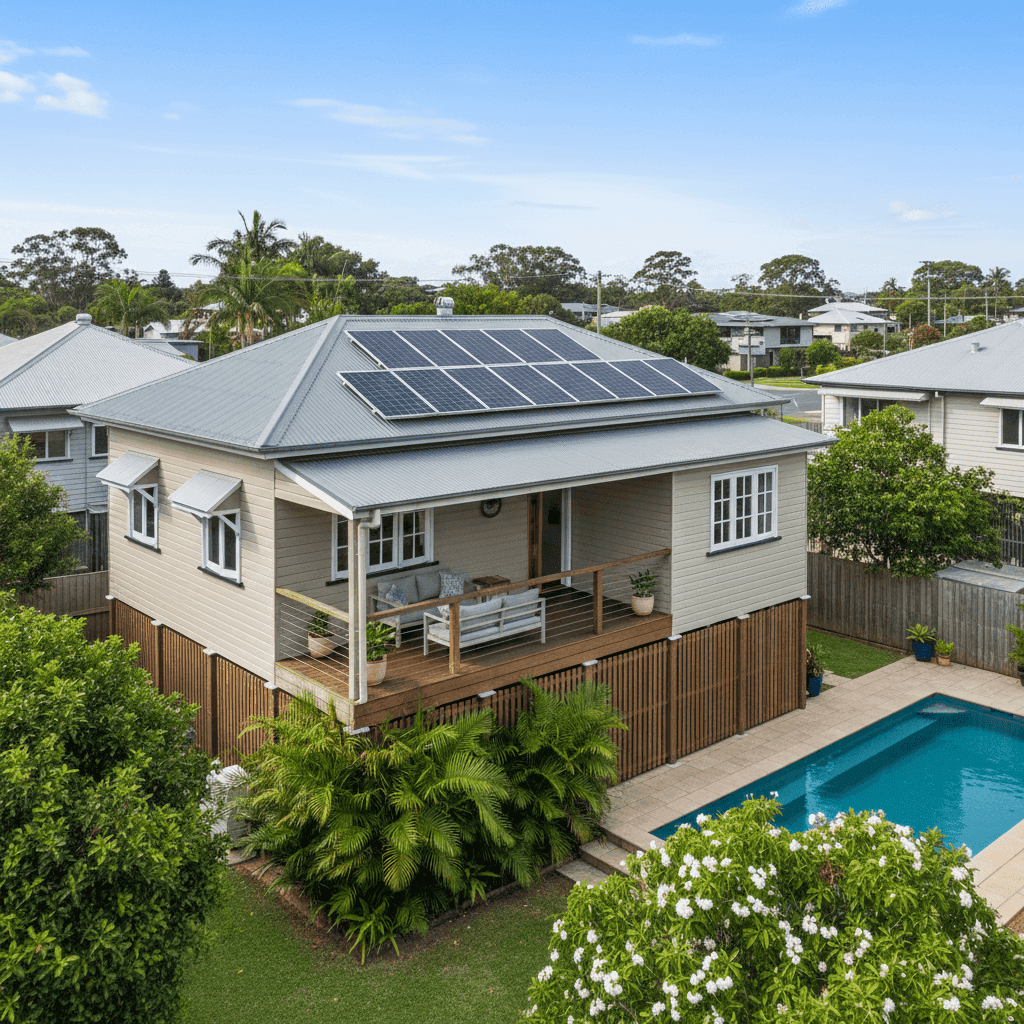
Shorncliffe is one of Brisbane's most charming bayside suburbs — a leafy, heritage-rich pocket of Moreton Bay where older elevated homes sit close to the water and the community has a distinctly relaxed, coastal feel. It's also a suburb where home insurance costs can vary significantly depending on your property's characteristics. This article breaks down a real home and contents insurance quote for a 3-bedroom, 2-bathroom free standing home in Shorncliffe (QLD 4017) and puts the numbers into context so you can judge whether you're paying a fair price.
---
Is This Quote Fair?
The quote in question comes in at $8,600 per year (or $761/month), covering a building sum insured of $1,300,000 and $70,000 in contents. Our price rating for this quote is Expensive — Above Average.
To understand why, it helps to look at the numbers in context. The suburb average for Shorncliffe sits at just $3,415/year, with a median of $3,466/year. At $8,600, this quote is more than 2.5 times the local suburb average — a substantial gap that warrants some explanation.
That said, the comparison isn't entirely apples-to-apples. A building sum insured of $1,300,000 is considerably higher than what many properties in the suburb would be insured for, which alone will push the premium upward. The property also carries several features — a pool, solar panels, ducted climate control, above-average fittings, and an elevated stump foundation — all of which contribute to a higher replacement cost and, by extension, a higher premium.
So while "expensive" is technically accurate relative to the suburb benchmark, the premium reflects a property that is genuinely more complex and costly to rebuild than the average Shorncliffe home.
---
How Shorncliffe Compares
It's worth zooming out to understand where Shorncliffe sits in the broader insurance landscape.
| Benchmark | Average Premium | Median Premium |
|---|---|---|
| Shorncliffe (QLD 4017) | $3,415/yr | $3,466/yr |
| Queensland | $9,129/yr | $3,903/yr |
| National | $5,347/yr | $2,764/yr |
| Brisbane LGA | $16,277/yr | — |
A few things stand out here. Queensland's average premium of $9,129/year is notably high — but the median of $3,903 tells a different story. That large gap between average and median is a classic sign of a skewed distribution: a relatively small number of very high-risk or high-value properties are pulling the average up dramatically. The same pattern appears nationally, where the average ($5,347) is nearly double the median ($2,764).
Interestingly, the Brisbane LGA average of $16,277/year is extraordinarily high, again reflecting the outsized influence of flood-prone, high-value, or otherwise high-risk properties across the broader council area.
Against the national picture, a quote of $8,600 for a well-appointed, elevated home with a $1.3M building sum insured is less surprising. It sits below Queensland's average premium and well below the Brisbane LGA average — which, on reflection, makes this quote look considerably more reasonable than the "expensive" tag might initially suggest.
---
Property Features That Affect Your Premium
Several characteristics of this property have a meaningful impact on what insurers charge. Here's how each one factors in:
Hardiplank/Hardiflex Cladding Fibre cement cladding like Hardiplank is generally viewed favourably by insurers — it's durable, fire-resistant, and low-maintenance. This is unlikely to be pushing the premium up.
Steel/Colorbond Roof Colorbond roofing is one of the more insurer-friendly roofing materials in Australia. It's resilient, long-lasting, and performs well in storms. Another tick in the right column.
Stump Foundation (Elevated by at Least 1m) This is a significant factor. Elevated homes on stumps — a classic Queensland design — can be more expensive to repair or rebuild due to the complexity of the subfloor structure. However, the elevation also provides meaningful flood protection, which can offset some risk in low-lying coastal areas like Shorncliffe.
1985 Construction A home built in 1985 is now 40 years old. Older homes can carry higher premiums because ageing electrical systems, plumbing, and structural components increase the likelihood of claims. Insurers factor in the cost of bringing older materials up to current building codes when calculating rebuilding costs.
Above-Average Fittings Higher-quality fixtures and finishes — think stone benchtops, quality cabinetry, premium appliances — cost more to replace. An "above average" fittings rating will meaningfully increase both the building sum insured and the premium.
Swimming Pool Pools add to the insurable value of the property and introduce additional liability considerations, both of which contribute to a higher premium.
Solar Panels Solar systems are now covered under most home insurance policies, but they add to the replacement cost of the building. A full solar installation can easily represent $10,000–$20,000 in additional insurable value.
Ducted Climate Control Like solar, ducted air conditioning is a fixed building asset that adds to the overall rebuild cost — and therefore the sum insured and premium.
---
Tips for Homeowners in Shorncliffe
1. Review your building sum insured carefully A sum insured of $1,300,000 is substantial. Make sure it reflects the actual cost to rebuild your home from scratch (not its market value), including demolition, site costs, and current construction rates. Overinsuring unnecessarily inflates your premium; underinsuring leaves you exposed. Consider getting a professional building valuation every few years.
2. Compare multiple quotes — every year Insurers reprice their books regularly, and loyalty doesn't always pay. The difference between the cheapest and most expensive quote for the same property can be thousands of dollars. Use a comparison service like CoverClub to benchmark your renewal premium before you accept it.
3. Ask about discounts for your home's features Your Colorbond roof, Hardiplank cladding, and elevated foundation are all risk-reducing features. Some insurers offer discounts for properties with these characteristics — but you may need to ask explicitly, or shop around to find an insurer that prices them favourably.
4. Consider your excess settings This policy carries a $2,000 building excess and $1,000 contents excess. Opting for a higher voluntary excess is one of the most straightforward ways to reduce your annual premium. If you have a good claims history and sufficient savings to cover a larger out-of-pocket cost, it may be worth modelling the trade-off.
---
Ready to Compare?
Whether you're renewing your policy or buying cover for the first time, it pays to see what's available in the market before you commit. CoverClub makes it easy to compare home and contents insurance quotes for properties in Shorncliffe and across Australia. Get a quote today and find out if you could be paying less — or at least know that what you're paying is genuinely competitive for your property.
You can also explore detailed insurance cost data for Shorncliffe (QLD 4017), Queensland, and the rest of Australia on the CoverClub stats hub.