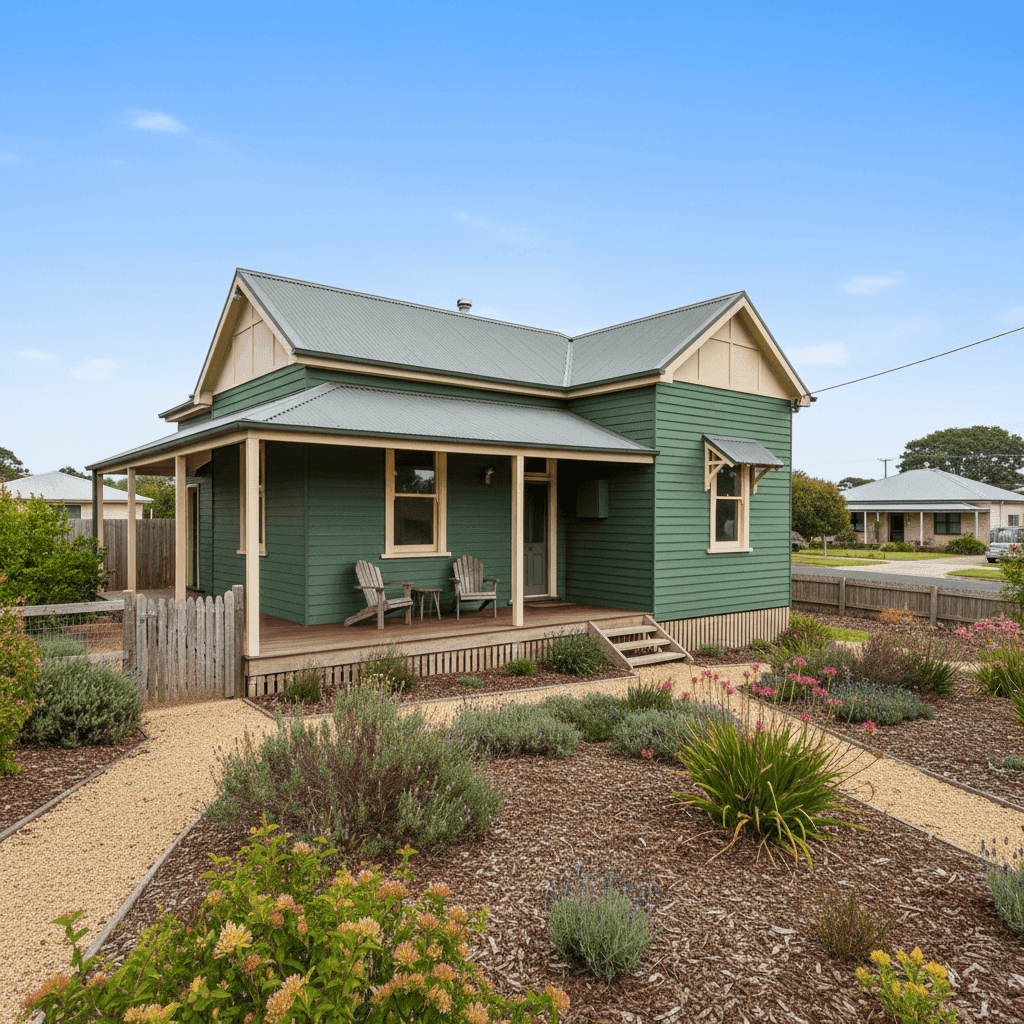
Home insurance costs can vary enormously depending on where you live, what your home is made of, and how much cover you need. To help homeowners in regional Victoria make sense of their premiums, we've analysed a real home and contents insurance quote for a four-bedroom free standing home in Snake Valley, VIC 3351 — a quiet rural locality in the Central Highlands, roughly midway between Ballarat and Skipton.
Here's what the numbers look like, and what they mean for you.
---
Is This Quote Fair?
The quote in question comes in at $3,677 per year (or $361/month) for combined home and contents cover, with a building sum insured of $719,000 and contents valued at $150,000. The building excess is $3,000 and the contents excess is $600.
Our pricing analysis rates this quote as Expensive — above average for the area.
To put that in context: the suburb average for Snake Valley sits at just $2,290/year, with a median of $2,214/year. That means this quote is running approximately $1,387 above the local average — a gap of around 61%. Even compared to the 75th percentile for the suburb ($2,849/year), this quote is still noticeably higher.
That said, it's worth noting that the sum insured here is substantial. A building replacement value of $719,000 for a 214 sqm home in a regional Victorian town is on the higher end, and this alone will push the premium well above what neighbours with more modest sums insured might be paying. Contents cover of $150,000 also adds meaningfully to the total cost.
The high building excess of $3,000 is worth flagging too — while a higher excess typically reduces your premium, it also means you're carrying more financial risk in the event of a claim. It's worth asking whether that trade-off is working in your favour.
---
How Snake Valley Compares
Understanding your premium in isolation is only half the picture. Here's how this quote stacks up against broader benchmarks:
| Benchmark | Annual Premium |
|---|---|
| This quote | $3,677 |
| Snake Valley suburb average | $2,290 |
| Snake Valley suburb median | $2,214 |
| Snake Valley 25th percentile | $1,638 |
| Snake Valley 75th percentile | $2,849 |
| VIC state average | $2,921 |
| VIC state median | $2,694 |
| National average | $2,965 |
| National median | $2,716 |
| Moyne LGA average | $2,572 |
(Based on 31 quotes sampled for the Snake Valley area.)
Interestingly, this quote sits above not only the Victorian state average of $2,921/year, but also the national average of $2,965/year. That's a meaningful signal that there may be room to find a more competitive price — particularly for a property in a low-cyclone-risk, inland Victorian location.
The Moyne LGA average of $2,572/year provides another useful reference point, sitting comfortably below this quote by over $1,100 annually.
---
Property Features That Affect Your Premium
Several characteristics of this particular home are likely influencing the premium, for better or worse.
Weatherboard timber construction is one of the most significant factors. Older weatherboard homes — this one was built in 1975 — are generally considered higher risk by insurers due to their susceptibility to fire, rot, and pest damage compared to brick veneer or double brick. Replacement costs can also be unpredictable, which may lead insurers to price more conservatively.
A steel/Colorbond roof is actually a positive from an insurance perspective. Colorbond is durable, low-maintenance, and performs well in both fire and storm conditions — so this likely helps keep the premium from being even higher.
Stump foundations are common in older Victorian homes and can introduce some complexity around subsidence or movement claims, which some insurers factor into their risk assessments. Combined with vinyl flooring, the home has a profile consistent with a well-maintained but older regional property.
The 214 sqm floor area and four bedrooms mean this is a reasonably large home, which naturally supports a higher replacement cost — and by extension, a higher building sum insured and premium.
On the plus side, the absence of a pool, solar panels, and ducted climate control keeps things relatively straightforward. These features can sometimes add complexity (and cost) to a policy.
---
Tips for Homeowners in Snake Valley
If you're a homeowner in Snake Valley — or anywhere in the Central Highlands — here are some practical steps to make sure you're getting the best value from your home insurance.
1. Review your sum insured carefully. A building sum insured of $719,000 may be appropriate, but it's worth verifying this against a current building cost estimate. Over-insuring is a common issue that quietly inflates premiums year after year. Use a quantity surveyor or your insurer's online calculator to check your rebuild cost.
2. Shop around — seriously. With this quote sitting above both the state and national averages, comparing alternatives is a no-brainer. Even a modest saving of $500–$800/year adds up to thousands over the life of your ownership. CoverClub makes it easy to compare quotes in minutes.
3. Consider your excess strategy. The $3,000 building excess on this policy is quite high. While a higher excess does reduce your premium, it means you'd need to cover the first $3,000 of any building claim yourself. If cash flow is a concern, it may be worth modelling whether a lower excess — with a slightly higher premium — offers better overall protection.
4. Maintain your weatherboard cladding. From a practical standpoint, keeping your timber cladding in good repair (painting, sealing, treating for termites) not only protects your home but demonstrates to insurers that the property is well-maintained. Some insurers take condition into account when pricing renewals.
---
Compare Your Home Insurance Today
Whether you're reviewing an existing policy or shopping for the first time, it pays to know where your premium sits relative to the market. CoverClub provides transparent, data-driven comparisons for homeowners across Australia — including detailed suburb-level stats for Snake Valley and the surrounding area.
Get a home insurance quote today and find out if you could be paying less for the same level of cover.