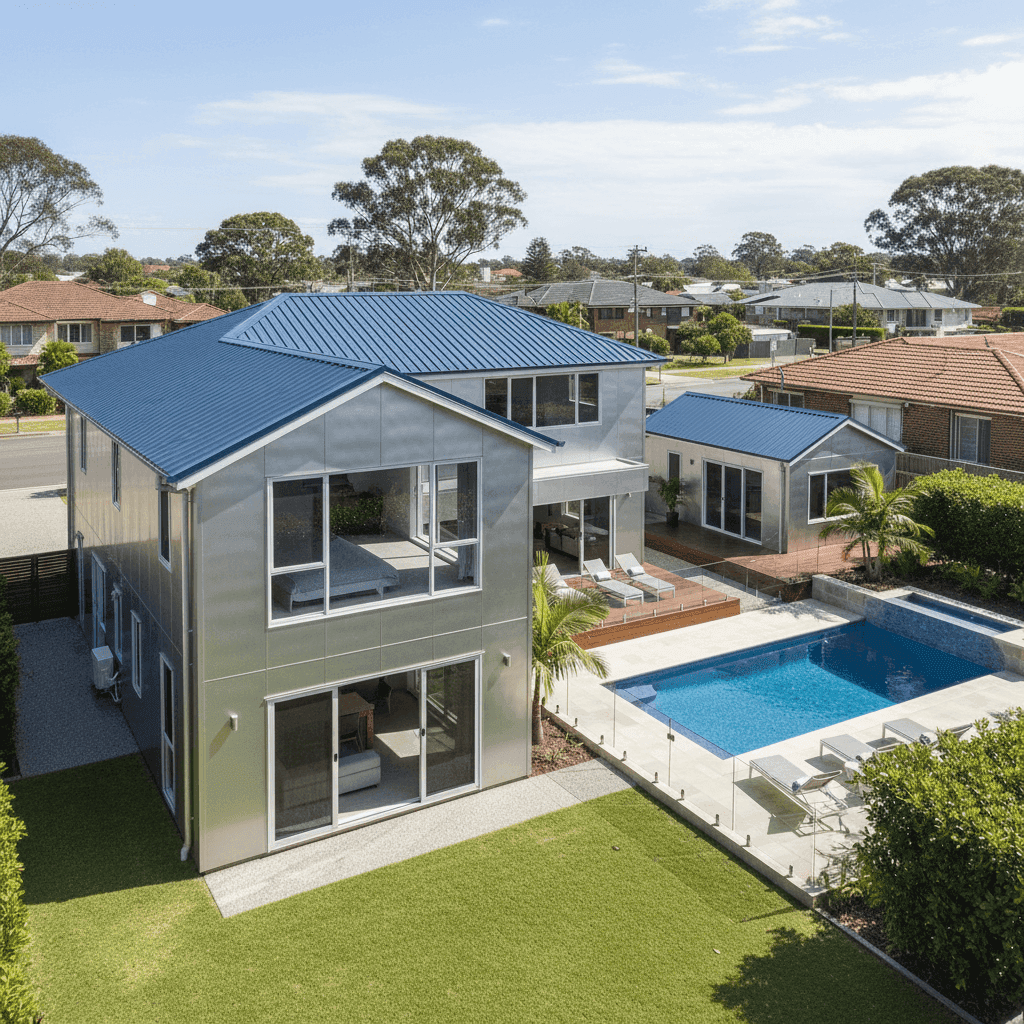
Southport, sitting at the heart of the Gold Coast, is one of Queensland's most dynamic suburban centres — a mix of established family homes, waterways, and a bustling CBD fringe. For owners of a free standing home in this postcode, understanding what you're paying for home insurance (and whether it's a fair price) is an important part of protecting one of your biggest assets.
This article breaks down a real home and contents insurance quote for a four-bedroom, two-bathroom free standing home in Southport QLD 4215, and puts it into context against local, state, and national benchmarks.
---
Is This Quote Fair?
The annual premium on this quote comes in at $4,166 per year (or $414 per month), covering both building and contents. The building is insured for $1,008,000, with contents valued at $50,000. Both the building and contents excess are set at $2,000.
Our pricing engine has rated this quote as FAIR — Around Average, and the data backs that up. Based on 54 quotes collected for Southport (4215), the suburb average sits at $4,415 per year, meaning this quote is actually tracking slightly below the local average — a modestly positive outcome for the homeowner.
That said, "average" doesn't always mean "the best available." The suburb's 25th percentile sits at $1,863/yr, which tells us that a meaningful portion of Southport homeowners are paying considerably less. Much of that variation comes down to differences in sum insured, property features, and the insurer chosen. For a home with a $1,008,000 building sum insured, a granny flat, and a pool, a premium in the $4,000–$4,500 range is broadly reasonable.
---
How Southport Compares
Context is everything when evaluating an insurance premium. Here's how this quote stacks up across different comparison points:
| Benchmark | Premium |
|---|---|
| This Quote | $4,166/yr |
| Southport (4215) Average | $4,415/yr |
| Southport (4215) Median | $2,903/yr |
| Gold Coast LGA Average | $8,161/yr |
| QLD State Average | $9,129/yr |
| QLD State Median | $3,903/yr |
| National Average | $5,347/yr |
| National Median | $2,764/yr |
A few things stand out here. The Queensland state average of $9,129/yr is extraordinarily high — largely driven by properties in cyclone-prone and flood-affected regions of the state, where premiums can be eye-watering. Southport, while coastal, is not classified as a cyclone risk area, which provides meaningful relief on the premium.
The Gold Coast LGA average of $8,161/yr is also notably elevated compared to this quote, again reflecting the diversity of risk profiles across the broader Gold Coast region — from canal-front properties to elevated hinterland homes.
Compared to the national average of $5,347/yr, this quote is sitting about $1,180 below the mark, which is a reasonable outcome. The national median of $2,764/yr is lower, but that figure is heavily influenced by lower-value properties and simpler risk profiles across the country.
For a deeper look at how premiums are trending in your area, visit the Southport suburb stats page.
---
Property Features That Affect Your Premium
Every property tells a story through its features, and insurers price risk accordingly. Here's how the characteristics of this particular home are likely influencing the premium:
Construction era (1984): Homes built in the early-to-mid 1980s are well past their initial depreciation curve, but they can carry elevated risk around ageing wiring, plumbing, and structural materials. Insurers factor this into their pricing.
Aluminium weatherboard exterior: Aluminium cladding is relatively low-maintenance and resistant to rot, but it can be more susceptible to impact damage and may carry different fire resistance ratings compared to brick. It's a common material in Queensland homes of this era.
Steel / Colorbond roof: Colorbond roofing is widely regarded as a solid, durable choice — it handles Queensland's heat and storm seasons well and is generally viewed favourably by insurers compared to older roofing materials like terracotta tiles or asbestos sheeting.
Stump foundations: Homes on stumps (also known as timber or concrete pier foundations) are a hallmark of older Queensland architecture. While they offer excellent ventilation and some natural flood resilience, they can be more vulnerable to subsidence, termite activity, and storm movement. This is a factor insurers assess carefully.
Timber and laminate flooring: These materials add to the overall contents and building replacement cost, and can be more susceptible to water damage than concrete slab floors — particularly relevant in a region that sees significant rainfall.
Swimming pool: Pools add to the insured value of the property and introduce liability considerations. Most standard home insurance policies include pool structures in the building cover, but it's worth confirming what's included.
Granny flat: The presence of a secondary dwelling on the property is a meaningful factor. Granny flats increase the total replacement cost of the building and may affect liability cover depending on whether the flat is rented out. It's essential to ensure your sum insured accounts for the full cost of rebuilding both structures.
$1,008,000 building sum insured: This is a substantial sum insured, and it's the primary driver of the premium. Homeowners should regularly review their sum insured to ensure it reflects current construction costs — particularly given how significantly building costs have risen in recent years.
---
Tips for Homeowners in Southport
1. Review your building sum insured annually. Construction costs across Queensland have risen sharply since 2020. If your sum insured hasn't been updated recently, you may be underinsured — meaning a total loss claim might not cover the full cost of rebuilding. Use a quantity surveyor or your insurer's calculator to validate the figure, especially with a granny flat to account for.
2. Clarify granny flat coverage with your insurer. Not all policies automatically extend full cover to secondary dwellings. If your granny flat is rented out, this can change your coverage obligations significantly — some insurers will require a separate landlord policy for the secondary structure. Get this confirmed in writing.
3. Maintain your stump foundations. Homes on stumps benefit from regular inspections for termite activity, timber rot, and settlement. Proactive maintenance not only protects the home but can also support your insurer's assessment of the property's condition.
4. Compare quotes before renewing. Insurance loyalty rarely pays off in Australia. Premiums can vary significantly between insurers for identical properties — sometimes by hundreds or even thousands of dollars. Use a comparison platform like CoverClub to benchmark your renewal quote before automatically accepting it.
---
Find a Better Deal with CoverClub
Whether you're renewing your current policy or shopping around for the first time, comparing quotes is one of the simplest ways to make sure you're not overpaying. CoverClub aggregates real premium data from across Australia to help homeowners make informed decisions. Get a home insurance quote today and see how your premium stacks up against your neighbours.