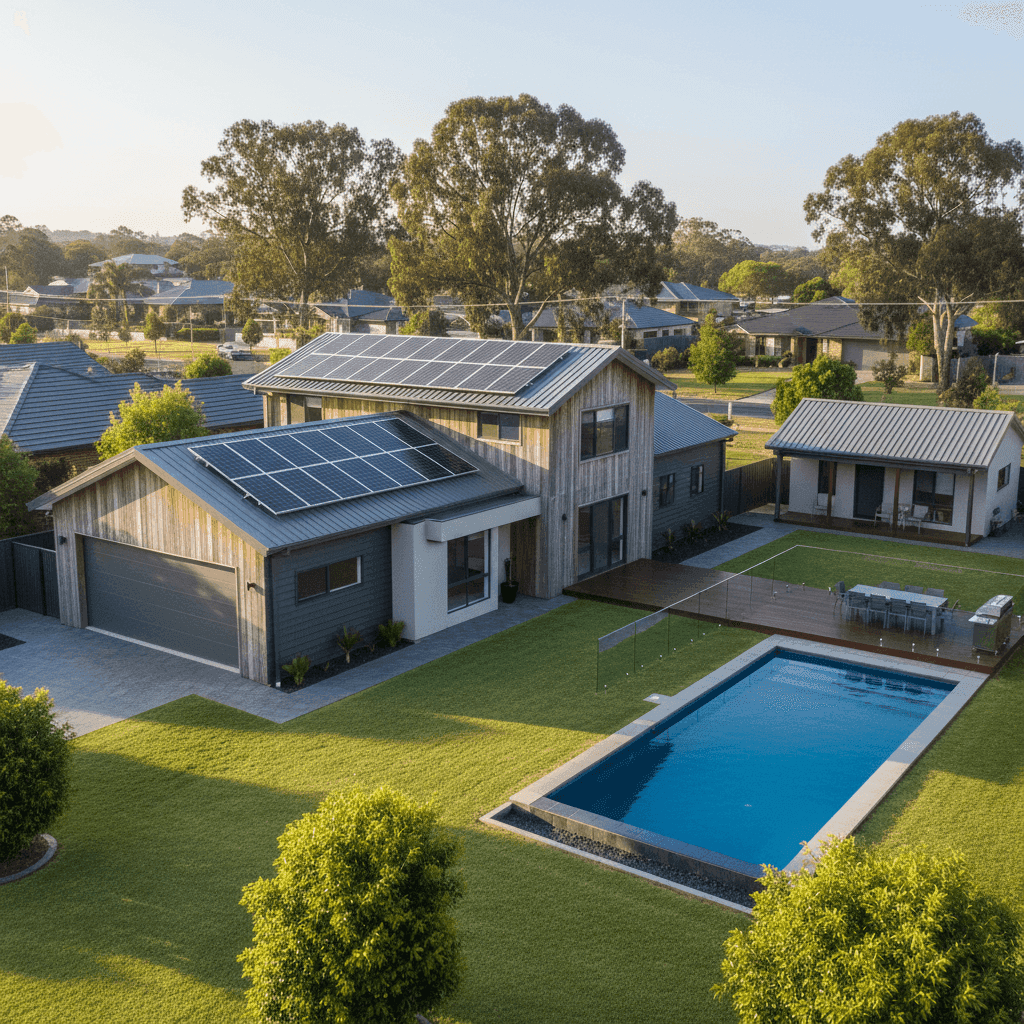
If you own a free standing home in Spring Flat, NSW 2850, you've probably wondered whether you're paying a fair price for home and contents insurance — or whether there's a better deal out there. In this article, we analyse a real quote for a four-bedroom, two-bathroom property in the area, compare it against local, state, and national benchmarks, and share practical tips to help you get better value on your cover.
---
Is This Quote Fair?
The quote in question comes to $5,637 per year (or $540/month) for combined home and contents insurance, with a building sum insured of $983,000 and contents valued at $150,000. Both the building and contents excess are set at $1,000.
Our price rating for this quote is Expensive — above average for the Spring Flat area.
To put that in perspective: the suburb average premium sits at just $3,277 per year, and the median is $3,347. That means this quote is running roughly 72% above the local average — a significant gap that's worth investigating before renewing or accepting as-is.
That said, context matters. A high building sum insured ($983,000) naturally pushes premiums upward, and several features of this particular property — more on those below — add genuine complexity that insurers price accordingly. Still, a gap this wide suggests there may be room to shop around.
---
How Spring Flat Compares
Understanding where Spring Flat sits in the broader insurance landscape helps frame whether a premium is genuinely elevated or simply reflective of local conditions.
| Benchmark | Annual Premium |
|---|---|
| Spring Flat suburb average | $3,277 |
| Spring Flat suburb median | $3,347 |
| Spring Flat 25th percentile | $2,575 |
| Spring Flat 75th percentile | $4,135 |
| NSW state average | $9,528 |
| NSW state median | $3,770 |
| Lithgow LGA average | $11,842 |
| National average | $5,347 |
| National median | $2,764 |
A few things stand out here. First, the NSW state average of $9,528 is dramatically skewed by high-risk postcodes — coastal flood zones, bushfire-prone regions, and cyclone corridors — which pull the mean well above the median of $3,770. Spring Flat's local averages are comfortably below the state median, suggesting it's a relatively affordable area to insure overall.
Compared to the national average of $5,347, this quote of $5,637 is only marginally higher — about 5.4% above the national mean. So while it's expensive for Spring Flat specifically, it's not wildly out of step with what Australians pay on average across the country.
The Lithgow LGA average of $11,842 is notably high, likely driven by a mix of bushfire exposure and older housing stock across the broader region — factors that don't necessarily apply uniformly to every property within the LGA.
You can explore localised data further on the Spring Flat suburb stats page.
---
Property Features That Affect Your Premium
This isn't a straightforward suburban brick-veneer. Several characteristics of this property are likely contributing to a higher-than-average premium:
Age of construction (1971): Homes built over 50 years ago often attract loading from insurers due to the increased likelihood of outdated wiring, plumbing, and structural wear. A 1971 build will typically cost more to insure than a comparable modern home.
Stump foundation: Homes on stumps (also called pier foundations) are more susceptible to movement, subsidence, and pest damage than slab-on-ground construction. Insurers factor this into their risk models, particularly for older homes.
Timber and laminate flooring: While aesthetically appealing, timber floors — especially in older homes — can be more expensive to repair or replace following water damage or impact events, which may influence the contents and building premium.
Steel/Colorbond roof: Generally considered a lower-risk roofing material than tiles (less likely to crack or leak), Colorbond can actually work in your favour with some insurers. However, in hail-prone inland NSW regions, metal roofing can be more susceptible to hail damage, which some insurers price in.
Swimming pool: Pools add liability exposure and increase the complexity of the insured property. Most insurers include pool coverage within the building policy, but it does contribute to a higher sum insured and overall premium.
Solar panels: Rooftop solar adds replacement value to the building and introduces additional risk around fire and storm damage. Depending on the insurer, panels may or may not be automatically included in the building sum insured — worth confirming with your provider.
Granny flat: A secondary dwelling on the property increases the total insurable value and may require specific coverage provisions. Some policies cover a granny flat automatically; others treat it as a separate structure requiring a policy endorsement.
Ducted climate control: Ducted HVAC systems are expensive to repair or replace and are typically covered under the building policy. Their presence can push up the building sum insured and, consequently, the premium.
Taken together, these features paint a picture of a well-appointed but complex property — one that genuinely warrants a higher premium than a simpler, newer home. The question is whether the current quote is the most competitive price for this level of risk.
---
Tips for Homeowners in Spring Flat
1. Shop around with your property details ready With a sample size of only 11 quotes in the Spring Flat area, there's meaningful variation between insurers. The gap between the 25th percentile ($2,575) and 75th percentile ($4,135) is over $1,500 per year — clear evidence that not all insurers price this suburb the same way. Use a comparison service like CoverClub to benchmark multiple quotes side by side.
2. Review your building sum insured carefully A sum insured of $983,000 is substantial. Make sure this figure reflects the actual rebuild cost of your home — not its market value. Overcooking the sum insured is a common mistake that leads to unnecessarily high premiums. Consider using a professional quantity surveyor or your insurer's rebuild cost calculator to validate the figure.
3. Ask about your granny flat and solar panels specifically Before signing any policy, confirm in writing how the insurer treats the granny flat and solar panels. Are they included in the building sum insured? Are there sub-limits or exclusions? Gaps in coverage here can be costly at claim time.
4. Consider your excess strategy Both excesses are currently set at $1,000. Increasing your excess — say, to $2,000 or $2,500 — can meaningfully reduce your annual premium. If you have a good claims history and a financial buffer to cover a higher excess, this is one of the simplest levers available to bring your premium down.
---
Ready to Compare?
Whether you're renewing your existing policy or shopping for the first time, it pays to compare. CoverClub makes it easy to see how your premium stacks up and find better value cover for your home in Spring Flat. Get a quote today and see what you could be saving.