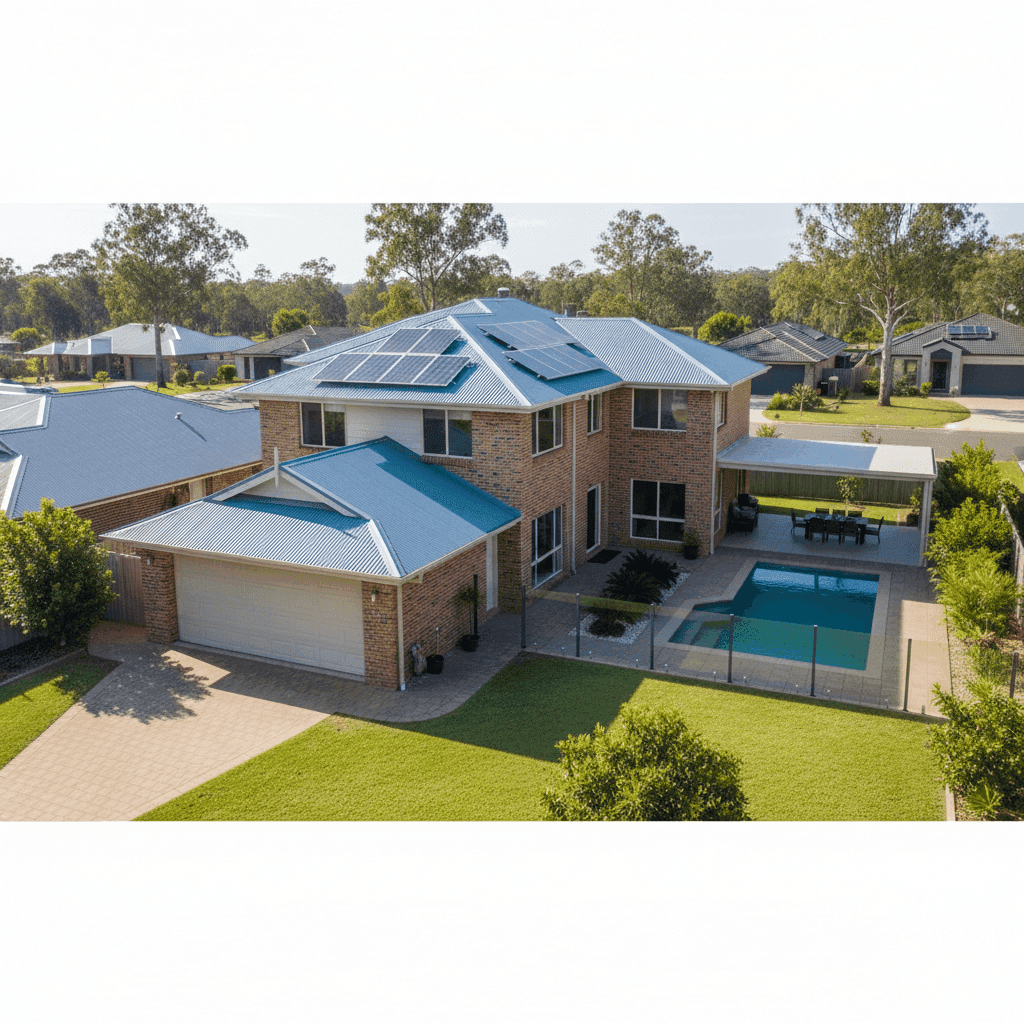
If you own a free standing home in Springfield, QLD 4300, you're likely no stranger to the question: am I paying too much for home insurance? With property values rising across South East Queensland and insurers adjusting their risk models, it pays to understand exactly where your premium sits — and why. This article breaks down a recent home and contents insurance quote for a four-bedroom, two-bathroom brick veneer home in Springfield, comparing it against suburb, state, and national benchmarks so you can make a truly informed decision.
---
Is This Quote Fair?
The quote in question comes in at $2,571 per year (or $240/month) for combined home and contents cover, with a building sum insured of $680,000 and contents valued at $230,000. Both the building and contents excess are set at $2,000.
Our price rating for this quote is FAIR — Around Average, and the data backs that up. The suburb average for Springfield sits at $2,614/year, meaning this quote comes in just below what most comparable properties in the area are paying. It also falls comfortably within the interquartile range — between the 25th percentile of $2,267/year and the 75th percentile of $3,003/year — which tells us this isn't an outlier in either direction.
In short: this is a competitive, market-rate premium. It's not the cheapest deal available, but it's well within the range of what Springfield homeowners are typically quoted, and it's meaningfully below the upper end of the market. For a property of this size and specification, there's no obvious red flag here.
---
How Springfield Compares
To truly appreciate this quote, it helps to zoom out and look at the broader insurance landscape. The numbers tell a striking story:
| Benchmark | Premium |
|---|---|
| This quote | $2,571/yr |
| Springfield suburb average | $2,614/yr |
| Springfield suburb median | $2,657/yr |
| QLD state average | $9,129/yr |
| QLD state median | $3,903/yr |
| Ipswich LGA average | $8,901/yr |
| National average | $5,347/yr |
| National median | $2,764/yr |
The gap between the QLD average ($9,129/yr) and the QLD median ($3,903/yr) is enormous — a clear sign that Queensland's insurance market is heavily skewed by high-risk properties, particularly those in cyclone-prone coastal and far-north regions. Springfield, sitting inland in the Ipswich LGA, benefits from a significantly lower risk profile than, say, Cairns or Townsville.
That said, the Ipswich LGA average of $8,901/year looks alarming at first glance. This figure is likely pulled upward by a subset of higher-risk or higher-value properties within the broader LGA. Springfield's own suburb-level data — based on 30 quotes — paints a much more reassuring picture.
Compared to the national median of $2,764/year, this quote is actually below the midpoint for Australian homeowners. You can explore the full Springfield suburb insurance stats, Queensland state data, and national benchmarks on CoverClub.
---
Property Features That Affect Your Premium
Every home is unique, and insurers price risk based on the specific characteristics of your property. Here's how the features of this Springfield home influence what you pay:
Brick Veneer Walls & Colorbond Roof Brick veneer is a popular and well-regarded construction type in Queensland. It offers solid fire resistance and structural durability, which insurers generally view favourably. A Colorbond steel roof is similarly well-regarded — it's lightweight, resistant to corrosion, and performs well in storm conditions. Together, these materials place this home in a relatively low-risk construction category.
Concrete Slab Foundation A slab-on-ground foundation is the standard for post-2000 Queensland homes and is considered stable and low-maintenance. It reduces the risk of subsidence or pest-related structural damage compared to older raised timber foundations, which is a positive factor for insurers.
Built in 2008 At around 17 years old, this home is young enough to have been built under modern building codes but old enough that some components (roofing, hot water systems, electrical) may be approaching the end of their service life. Keeping up with maintenance is key to avoiding claim complications.
Swimming Pool A pool adds value to your property but also introduces liability risk. Most home insurance policies include legal liability cover, which is particularly relevant for pool owners — especially if you have visitors or children around. It's worth confirming your policy's liability limits.
Solar Panels Solar panels are a common feature on newer Queensland homes, but they're not always automatically covered under a standard building policy. Check whether your insurer explicitly covers panels for damage from storms, hail, or fire — and whether that coverage extends to the inverter and associated electrical components.
Ducted Climate Control Ducted air conditioning is a significant fixed asset and is generally covered under building insurance as a permanent fixture. However, it's worth confirming this with your insurer, particularly for mechanical breakdown scenarios.
214 sqm, 4 Bedrooms, Standard Fittings At 214 square metres with standard-quality fittings, the $680,000 building sum insured works out to roughly $3,178/sqm. This is on the higher end for a standard-finish home in this area, but rebuild costs have risen sharply post-COVID due to labour and materials inflation. It's worth getting a professional building replacement cost estimate to ensure you're neither underinsured nor over-insured.
---
Tips for Homeowners in Springfield
1. Review your building sum insured annually Construction costs in South East Queensland have increased significantly over the past few years. An insured value that was accurate in 2021 may now leave you underinsured. Use a quantity surveyor or your insurer's online calculator to verify your rebuild cost each year.
2. Confirm solar panel and pool coverage explicitly Don't assume these features are covered — ask your insurer in writing. Solar panels in particular can be a grey area, and some policies require a specific endorsement to cover them for storm or impact damage.
3. Consider your excess carefully A $2,000 excess on both building and contents is on the higher side. While a higher excess typically lowers your premium, it means you'll be out of pocket significantly before your insurer steps in. If your emergency fund is limited, it may be worth exploring lower-excess options, even if the annual premium is slightly higher.
4. Shop around at renewal time Loyalty doesn't always pay in insurance. Insurers regularly offer better rates to new customers than to existing ones. Use a comparison tool like CoverClub to benchmark your renewal quote against the market — even a 10–15% saving on a $2,500 premium puts real money back in your pocket.
---
Ready to Compare?
Whether you're reviewing your current policy or shopping for cover on a new property, CoverClub makes it easy to see how your quote stacks up. Get a home insurance quote today and compare your options side by side — it only takes a few minutes, and you might be surprised at what you find.