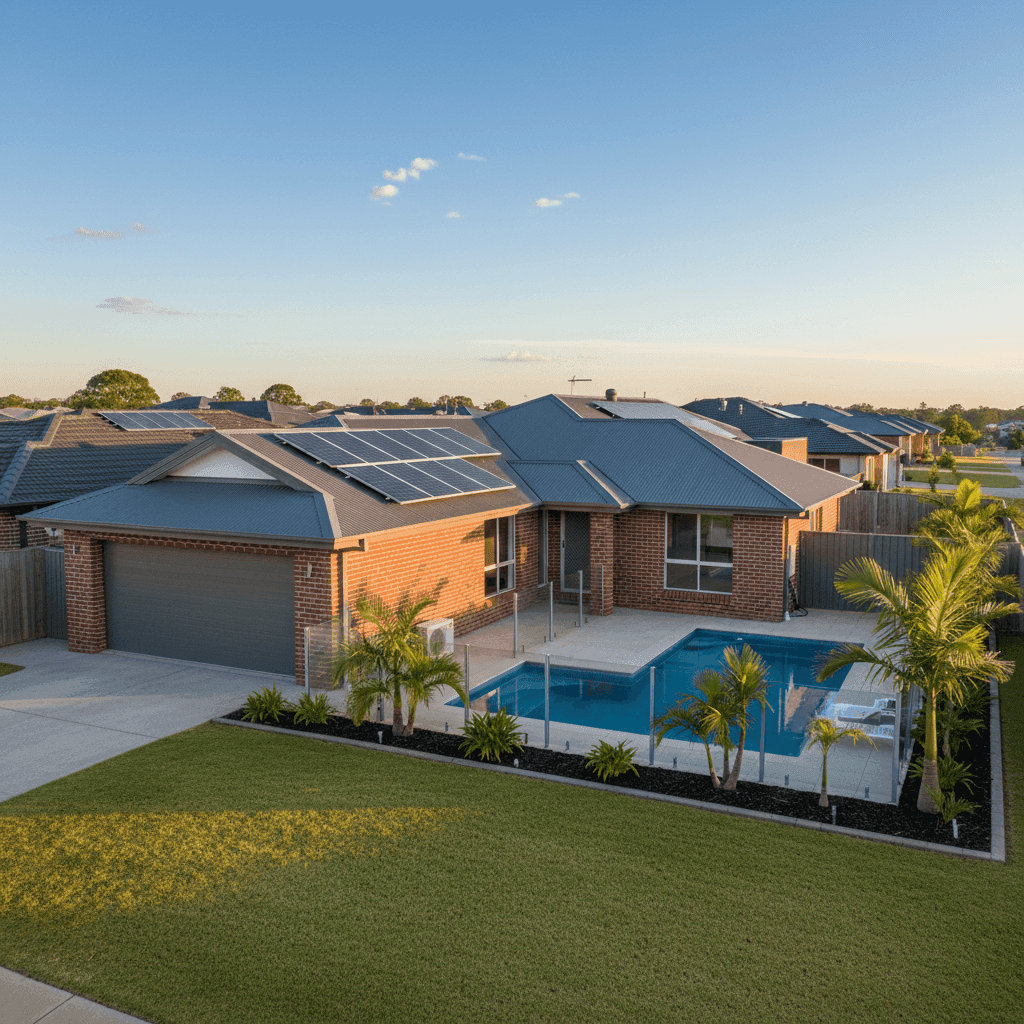
Springfield, QLD is one of South East Queensland's fastest-growing master-planned communities, and with that growth comes an increasing number of homeowners navigating the home insurance market. If you own a four-bedroom free standing home in the 4300 postcode, understanding where your premium sits relative to the broader market can make a real difference to your hip pocket. This article breaks down a recent home and contents insurance quote for a brick veneer home in Springfield — and what it means for you.
---
Is This Quote Fair?
The short answer: yes, broadly fair — but there's room to do better.
The quote in question sits at $2,361 per year (or $219/month) for combined home and contents cover, with a building sum insured of $721,000 and contents valued at $50,000. Both the building and contents excess are set at $2,000.
Our pricing analysis rates this quote as Fair (Around Average) for the Springfield area. Based on a sample of 30 quotes from the 4300 postcode, the suburb average premium is $2,614/yr and the median sits at $2,657/yr. That means this quote comes in roughly 10–12% below the local average — a meaningful saving, though not quite in the cheapest quartile for the area.
The 25th percentile for Springfield premiums is $2,267/yr, meaning the most competitively priced quarter of quotes in this suburb are below that mark. At $2,361, this quote is just above that threshold — suggesting there may be slightly cheaper options available, but you'd need to shop carefully to find them.
---
How Springfield Compares
To put this quote in proper context, it helps to zoom out and look at the bigger picture. Springfield's suburb insurance data tells an interesting story when compared against broader benchmarks.
| Benchmark | Average Premium | Median Premium |
|---|---|---|
| Springfield (4300) | $2,614/yr | $2,657/yr |
| Ipswich LGA | $8,901/yr avg | — |
| Queensland | $9,129/yr avg | $3,903/yr |
| National | $5,347/yr avg | $2,764/yr |
A few things stand out here. First, the QLD state average of $9,129/yr looks alarming — but this is heavily skewed by high-risk coastal and cyclone-prone areas in North Queensland, where premiums can be extraordinary. The QLD median of $3,903/yr is a more representative figure for most South East Queensland homeowners.
Similarly, the Ipswich LGA average of $8,901/yr reflects the diversity of risk profiles across the council area, which spans everything from flood-prone river suburbs to newer elevated estates like Springfield.
Compared to the national median of $2,764/yr, this Springfield quote of $2,361/yr is actually below the national midpoint — a positive sign for homeowners in this part of the 4300 postcode.
The key takeaway: Springfield sits in a relatively favourable risk position compared to many other parts of Queensland, and this quote reflects that reasonably well.
---
Property Features That Affect Your Premium
Not all homes are rated the same way by insurers, and the specific characteristics of this property play a meaningful role in how the premium is calculated.
Brick veneer construction with a Colorbond roof is generally well-regarded by insurers. Brick veneer offers solid fire resistance and structural durability, while steel/Colorbond roofing is lightweight, long-lasting, and performs well in high-wind events. Together, these materials typically attract more competitive premiums than, say, weatherboard cladding with a tile roof.
Slab foundation is standard for homes built in this era and region, and it's a neutral-to-positive factor for insurers — no subfloor cavity means less risk of certain types of pest damage and moisture ingress.
Built in 2008, this home is relatively modern. Newer builds benefit from compliance with updated building codes, which generally means better structural integrity and improved safety features. This can translate into lower premiums compared to homes built in the 1970s or 1980s.
The swimming pool is worth noting. Pools add value to a property but also introduce liability considerations. Most insurers factor pool ownership into their liability cover assessment, and it can nudge premiums slightly upward.
Solar panels are increasingly common on Queensland rooftops, and insurers are becoming more familiar with rating them. They add to the replacement cost of the home (hence the higher building sum insured), but they're generally not a major premium driver on their own.
Ducted climate control is another feature that contributes to the building's replacement value. A 214 sqm home with ducted air conditioning, a pool, and solar panels justifiably warrants a $721,000 building sum insured — underpaying on this figure (known as underinsurance) is a risk many homeowners don't fully appreciate until it's too late.
No cyclone risk is a significant premium advantage for Springfield. Unlike coastal and northern Queensland properties, this home is not in a designated cyclone risk zone, which removes one of the largest premium loading factors in the state.
---
Tips for Homeowners in Springfield
1. Review your building sum insured annually Construction costs in South East Queensland have risen sharply in recent years. A sum insured of $721,000 may be appropriate today, but it's worth reassessing each year to ensure it reflects current rebuild costs — not the figure you set when you first took out the policy.
2. Consider raising your excess to reduce your premium Both the building and contents excess on this quote are set at $2,000. If you have the financial buffer to absorb a higher out-of-pocket cost in the event of a claim, increasing your excess to $3,000 or $5,000 can meaningfully reduce your annual premium.
3. Don't overlook contents cover At $50,000, the contents value here is on the modest side for a four-bedroom home with standard fittings. Take the time to do a proper contents inventory — furniture, appliances, clothing, tools, and outdoor items add up quickly. Underinsuring your contents is just as risky as underinsuring the building.
4. Shop around at renewal time Insurers don't always reward loyalty. Premiums can shift significantly from year to year, and what was a competitive quote 12 months ago may no longer be the best deal on the market. Comparing quotes annually is one of the simplest ways to avoid paying more than you need to.
---
Compare Your Options with CoverClub
Whether you're reviewing an existing policy or shopping for cover for the first time, CoverClub makes it easy to see how your premium stacks up. Get a home insurance quote today and find out if you're getting a fair deal — or if there's a better option waiting for you.