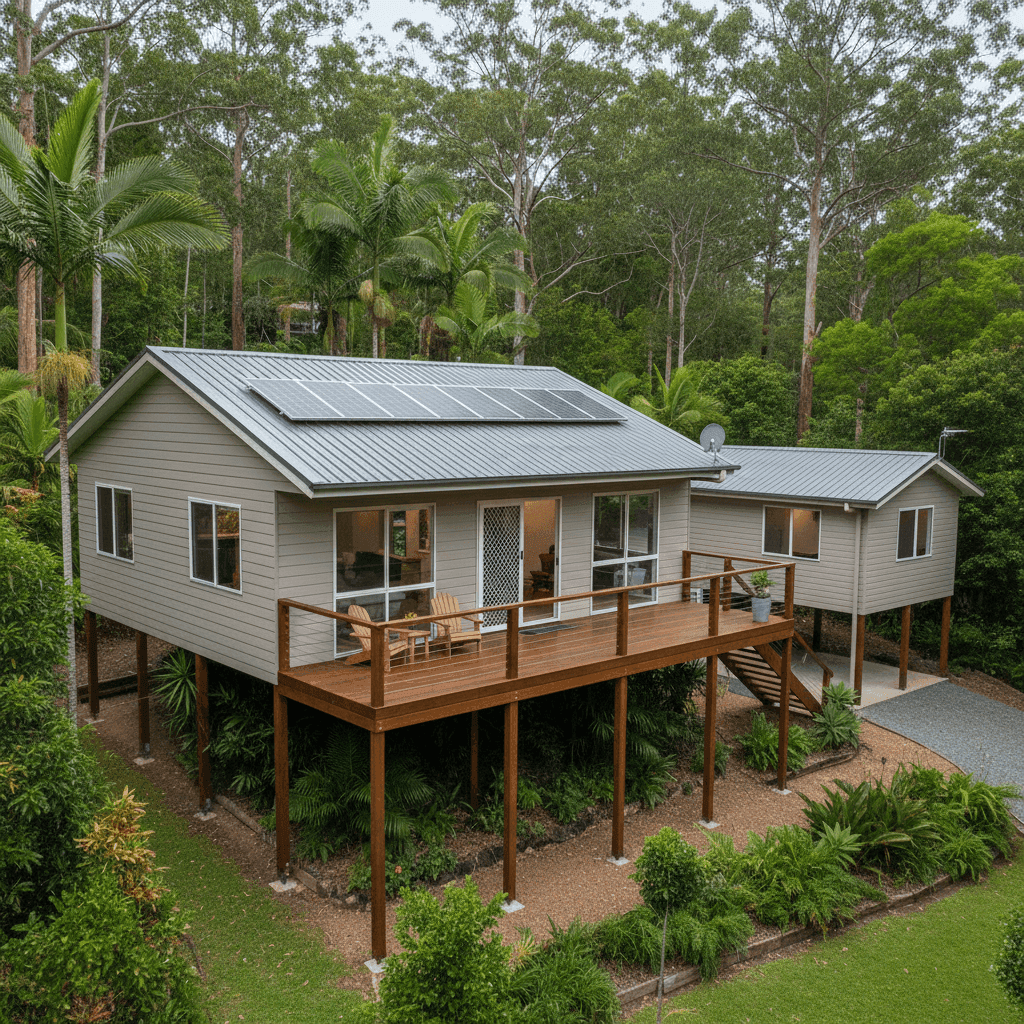
Tamborine Mountain is one of South East Queensland's most picturesque addresses — a lush, elevated escape in the Scenic Rim that attracts tree-changers, retirees, and families alike. But living above the clouds comes with its own set of insurance considerations. This article breaks down a real home and contents insurance quote for a three-bedroom free standing home in the area, rated Fair (Around Average), and explores what's driving the premium and how it stacks up against local, state, and national benchmarks.
---
Is This Quote Fair?
The quoted annual premium of $3,898 (or $384/month) covers both building (insured for $700,000) and contents ($100,000), with a $1,000 excess applying to each. Our pricing engine has rated this quote as Fair — Around Average, and the data backs that up.
Looking at the Tamborine Mountain suburb statistics, the suburb average sits at $3,632/yr and the median at $3,478/yr. This quote lands comfortably within the middle of the local market — above the median, but well below the 75th percentile of $4,279/yr. In other words, roughly a quarter of comparable properties in the area are paying more than this quote.
For a property with several risk-influencing features (more on those below), a premium in this range is reasonable rather than alarming. That said, "fair" doesn't mean you can't do better — it simply means this quote is neither a standout bargain nor an outlier on the expensive end.
---
How Tamborine Mountain Compares
To put this quote into proper context, it helps to zoom out and look at the broader pricing landscape.
| Benchmark | Premium |
|---|---|
| This quote | $3,898/yr |
| Tamborine Mountain average | $3,632/yr |
| Tamborine Mountain median | $3,478/yr |
| Scenic Rim LGA average | $8,744/yr |
| QLD average | $9,129/yr |
| QLD median | $3,903/yr |
| National average | $5,347/yr |
| National median | $2,764/yr |
A few things stand out here. First, the Scenic Rim LGA average of $8,744/yr and the Queensland state average of $9,129/yr are dramatically higher than what's quoted here — largely because those figures are skewed by high-risk flood and cyclone-prone postcodes elsewhere in the region and state. The Queensland state insurance data reflects a market under significant pressure from extreme weather events.
Second, while the national average of $5,347/yr might suggest this quote is a relative bargain, the national median of $2,764/yr tells a different story — many Australian homeowners, particularly in lower-risk areas, are paying considerably less. Tamborine Mountain's elevated terrain and unique construction styles naturally push premiums higher than the typical suburban home.
With 85 quotes in the suburb sample, there's a solid data set to draw from, and this quote sits in a credible middle ground.
---
Property Features That Affect Your Premium
Several characteristics of this property directly influence how insurers price the risk. Here's what matters most:
Elevated Foundation (Poles)
This home is elevated by at least one metre on a pole foundation — a classic Queenslander-style construction. While this style can offer advantages in flood resilience (water passes beneath rather than through the living space), insurers still factor in the increased complexity and cost of repairs to elevated structures. Pole homes can also be more exposed to wind damage.
Hardiplank/Hardiflex External Walls
Fibre cement cladding like Hardiplank and Hardiflex is generally viewed favourably by insurers. It's fire-resistant, durable, and low-maintenance — qualities that can help moderate premiums compared to older timber weatherboard homes.
Steel/Colorbond Roof
Colorbond roofing is another positive from an insurance standpoint. It's resilient, lightweight, and performs well in high-wind conditions — a relevant consideration for a hilltop property exposed to strong south-easterly winds.
Construction Year: 1970
At over 50 years old, the home is considered an older dwelling. Ageing electrical wiring, plumbing, and structural elements can increase the likelihood of claims, which insurers price accordingly. A building sum insured of $700,000 for a 153 sqm home reflects the higher rebuild costs associated with older, character-style construction.
Solar Panels
The presence of solar panels adds a layer of complexity to the building sum insured. Panels need to be covered for storm, hail, and fire damage, and their replacement cost should be factored into your building coverage. Ensure your policy explicitly covers solar equipment.
Granny Flat
A secondary dwelling on the property increases the total insurable area and potential replacement cost. It's important to confirm with your insurer that the granny flat is included within the building sum insured — some policies require it to be listed separately or may have specific conditions around rental use.
No Pool, No Ducted Climate Control
The absence of a pool and ducted air conditioning removes two common sources of claims and complexity, which works in the homeowner's favour.
---
Tips for Homeowners in Tamborine Mountain
1. Review your building sum insured regularly Construction costs have risen sharply in recent years. A 153 sqm elevated home with a granny flat and older construction style can be expensive to rebuild. Make sure your $700,000 sum insured reflects current labour and material costs in the Scenic Rim — underinsurance is a real risk in this market.
2. Confirm your granny flat is fully covered Not all policies automatically extend building cover to secondary dwellings. Ask your insurer directly whether the granny flat is included, and whether any rental income from it affects your coverage terms.
3. Document your solar panel system Keep records of your solar panel brand, model, installation date, and replacement value. In the event of a hail or storm claim — both realistic scenarios on Tamborine Mountain — having this documentation will speed up the claims process considerably.
4. Shop around at renewal time A "Fair" rating means there's room to improve. Insurers price risk differently, and some may view the property's Colorbond roof, fibre cement walls, and elevated foundation more favourably than others. Comparing quotes annually is the single most effective way to ensure you're not overpaying.
---
Compare Your Options at CoverClub
Whether you're reviewing an existing policy or shopping for the first time, CoverClub makes it easy to see how your premium stacks up. Our suburb-level data gives you real market context — not just a generic estimate. Get a home insurance quote today and find out if you could be paying less for the same level of cover.