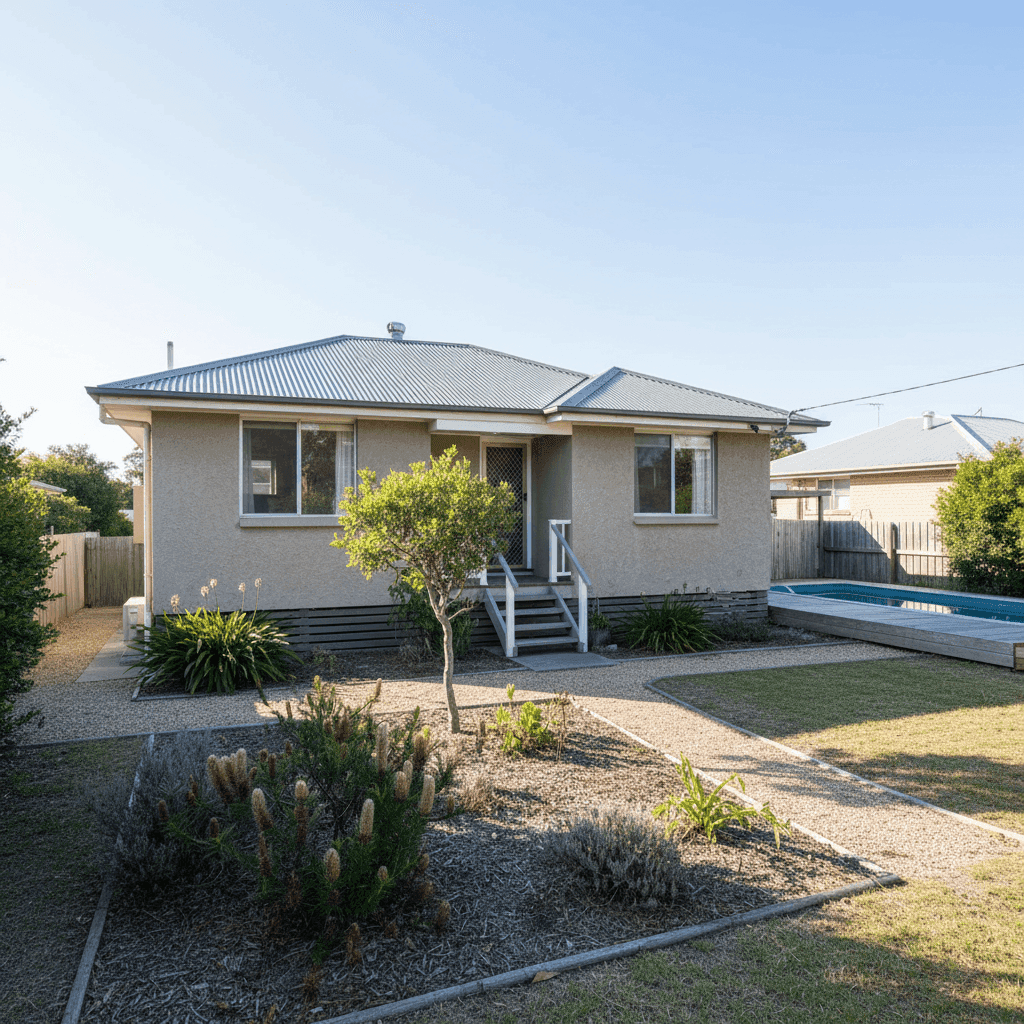
If you own a free standing home in The Entrance North, NSW 2261, you already know the appeal — a relaxed coastal lifestyle on the Central Coast, with Tuggerah Lake on one side and the Pacific Ocean not far away. But that desirable location also comes with its own insurance considerations, from ageing housing stock to proximity to water. This article breaks down a real building insurance quote for a three-bedroom home in the suburb, and puts the numbers in context so you can judge whether you're getting a fair deal.
---
Is This Quote Fair?
The quote in question is $3,847 per year (or $369 per month) for building-only cover on a 3-bedroom, 1-bathroom free standing home, with a $1,000 building excess and a sum insured of $662,000.
Our price rating for this quote is FAIR — Around Average, and the data backs that up. Here's why:
- The suburb median premium for The Entrance North is $3,682/yr, meaning this quote sits just $165 above the midpoint of local pricing — a difference of less than 5%.
- The suburb average is considerably higher at $5,731/yr, which is skewed upward by some very expensive outliers (the 75th percentile hits $8,873/yr).
- At $3,847/yr, this quote falls comfortably between the 25th percentile ($3,012/yr) and the 75th percentile ($8,873/yr), placing it in the mainstream of what homeowners in this postcode are actually paying.
In short, this isn't a bargain-basement price, but it's far from the top of the range. For a property of this age and construction type, it represents reasonable market pricing.
---
How The Entrance North Compares
To understand whether this quote is competitive, it helps to zoom out and look at the broader picture. You can explore the full data on the The Entrance North insurance stats page, the NSW state overview, and national insurance benchmarks.
| Benchmark | Annual Premium |
|---|---|
| This Quote | $3,847 |
| Suburb Median (2261) | $3,682 |
| Suburb Average (2261) | $5,731 |
| LGA Average (Central Coast) | $8,387 |
| NSW State Median | $3,770 |
| NSW State Average | $9,528 |
| National Median | $2,764 |
| National Average | $5,347 |
A few things stand out here. The NSW state average of $9,528/yr is extraordinarily high — a reflection of how dramatically expensive premiums can be in some parts of the state, particularly in flood-prone or bushfire-affected regions. The state median of $3,770/yr is a far more representative figure, and this quote lands almost exactly on that mark.
Against national benchmarks, the picture is mixed. The quote is above the national median of $2,764/yr, but well below the national average of $5,347/yr. The Entrance North is a coastal suburb, and coastal properties typically attract higher premiums than inland equivalents — so sitting above the national median is expected.
The Central Coast LGA average of $8,387/yr is notably elevated, suggesting that some properties in the broader region carry significant risk loadings. By comparison, this quote looks quite competitive within its own LGA context.
With only 24 quotes in the suburb sample, the data has some natural variance — but the trend is clear: this quote is solidly mid-market.
---
Property Features That Affect Your Premium
Insurance pricing isn't arbitrary — it's driven by the specific characteristics of your home. Here's how the features of this property are likely influencing the premium:
Construction year (1978): Homes built in the late 1970s are well past the 50-year mark. Older properties can attract higher premiums due to the cost of sourcing period-appropriate materials and the likelihood of ageing electrical, plumbing, and roofing systems. That said, a well-maintained home of this era can still be insured competitively.
Concrete external walls: Concrete construction is generally viewed favourably by insurers. It's fire-resistant, durable, and less susceptible to impact damage than timber weatherboard. This is likely a positive factor in keeping the premium reasonable.
Steel/Colorbond roof: Colorbond roofing is a popular choice across coastal NSW for good reason — it handles wind, rain, and salt air well. Insurers tend to rate metal roofing positively compared to older tile or asbestos alternatives.
Stump foundations: Homes on stumps (also called piers or posts) are common in coastal and flood-adjacent areas of NSW. This foundation type can be a risk flag for some insurers, as it may indicate flood or inundation exposure, though it also allows for better airflow and drainage.
Timber/laminate flooring: Timber floors can be costly to repair or replace after water damage events, which may contribute a modest loading to the premium.
Swimming pool: The presence of a pool adds to the sum insured and introduces liability considerations, both of which can nudge premiums upward.
Ducted climate control: Ducted systems are expensive to replace and add to the overall rebuild cost, which is reflected in the $662,000 sum insured.
Sum insured ($662,000): For a 130 sqm home, this equates to roughly $5,092 per square metre — a figure that aligns with current construction costs in coastal NSW when factoring in finishes, site conditions, and the cost of demolition and removal.
---
Tips for Homeowners in The Entrance North
1. Review your sum insured annually. Construction costs have risen sharply in recent years. A sum insured that was adequate two years ago may now fall short of what it would actually cost to rebuild. Use a building cost calculator or speak with a quantity surveyor to validate your figure — underinsurance is one of the most common and costly mistakes homeowners make.
2. Ask about discounts for security and safety features. Many insurers offer premium reductions for homes with monitored alarms, deadbolts, and smoke detectors. If your home has these features and they're not already factored in, it's worth raising with your insurer.
3. Consider your excess carefully. The $1,000 excess on this policy is fairly standard. Opting for a higher voluntary excess (say, $2,000 or $2,500) can meaningfully reduce your annual premium — just make sure the amount is something you can comfortably cover if you need to make a claim.
4. Compare quotes at renewal, not just at purchase. Insurance premiums can shift significantly from year to year, and loyalty doesn't always pay. Running a comparison at renewal time — even if you end up staying with your current insurer — ensures you're not quietly drifting into an overpriced policy.
---
Ready to Compare?
Whether you're assessing your current policy or shopping for the first time, the best way to know if you're getting value is to compare. Get a home insurance quote at CoverClub and see how your options stack up — it takes just a few minutes and could save you hundreds each year.