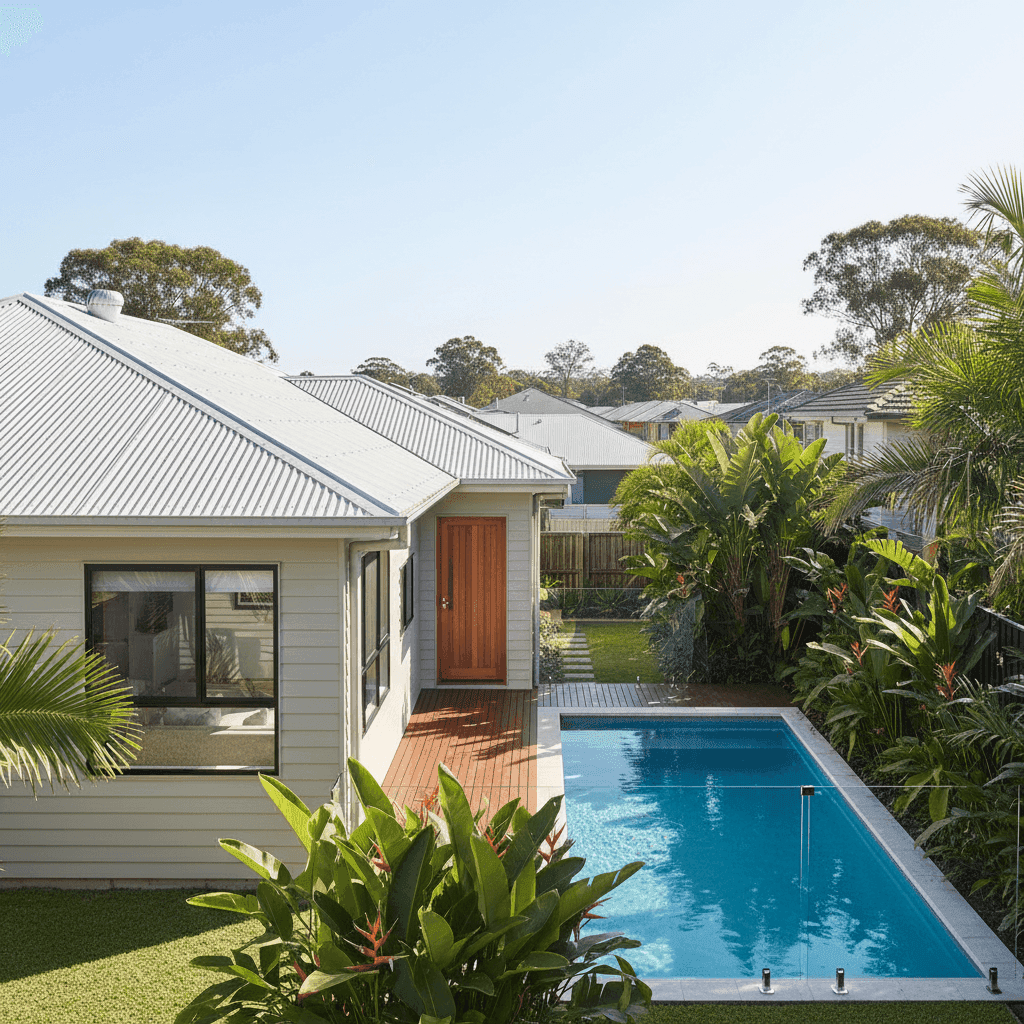
Nestled in the foothills of the D'Aguilar Range, The Gap is one of Brisbane's most sought-after leafy suburbs — known for its bushland setting, family-friendly streets, and proximity to Walkabout Creek and the Mt Coot-tha Reserve. It's also a suburb where home insurance costs can vary quite a bit depending on your property's features and the level of cover you choose. In this article, we break down a real home and contents insurance quote for a 4-bedroom, 2-bathroom townhouse in The Gap (postcode 4061), and put the numbers into context against local, state, and national benchmarks.
---
Is This Quote Fair?
The quote in question comes in at $2,996 per year (or $287/month) for combined home and contents cover, with a building sum insured of $550,000 and contents valued at $50,000. Both the building and contents excesses are set at $1,000.
Our pricing engine rates this quote as Fair — Around Average, and the data backs that up. The suburb average premium for The Gap sits at $3,092/year, while the median is $3,073/year (based on a sample of 35 quotes in the area). At $2,996, this quote comes in just below both the local average and median — meaning the policyholder is getting a price that's competitive for the neighbourhood without being an outlier in either direction.
It's worth noting that The Gap's 25th percentile premium is $2,276/year and the 75th percentile reaches $3,943/year. This quote sits comfortably in the middle band, suggesting it reflects a fairly typical risk profile for the area rather than a particularly high- or low-risk property.
For more detail on what homeowners in this postcode are paying, check out the The Gap suburb insurance stats on CoverClub.
---
How The Gap Compares
One of the most striking things about this quote is how favourable it looks when you zoom out to the broader picture.
| Benchmark | Premium |
|---|---|
| This quote | $2,996/yr |
| The Gap suburb average | $3,092/yr |
| The Gap suburb median | $3,073/yr |
| QLD state average | $9,129/yr |
| QLD state median | $3,903/yr |
| National average | $5,347/yr |
| National median | $2,764/yr |
| Brisbane LGA average | $16,277/yr |
The Queensland state average of $9,129/year is heavily skewed by high-risk coastal and cyclone-prone areas — think Cairns, Townsville, and the Whitsundays — where premiums can be eye-watering. The Gap, sitting well inland and outside designated cyclone risk zones, benefits enormously from its lower natural hazard exposure. This is why the suburb's premiums are dramatically lower than the QLD state average.
The Brisbane LGA average of $16,277/year may seem alarming at first glance, but this figure is similarly distorted by properties in flood-prone suburbs or those with high replacement values. The Gap's elevated terrain generally protects it from the riverine flooding that pushes premiums sky-high in lower-lying Brisbane suburbs.
Compared to the national median of $2,764/year, this quote is only modestly higher — a reasonable premium for a 4-bedroom property with a $550,000 building sum insured. Explore how Queensland compares to other states on the QLD insurance stats page, or see the full picture on the national home insurance stats page.
---
Property Features That Affect Your Premium
Every property has its own risk fingerprint, and the features of this townhouse play a meaningful role in shaping the premium.
Hardiplank / Hardiflex external walls are a strong asset from an insurer's perspective. This fibre cement cladding is non-combustible, resistant to rot and termites, and holds up well in bushfire-prone environments — which is relevant given The Gap's proximity to bushland. It's generally viewed more favourably than timber weatherboard cladding.
Steel / Colorbond roofing is another tick in the right column. Colorbond is durable, low-maintenance, and performs well in high-wind events. It's one of the most common roofing materials in Queensland and is well understood by insurers when calculating replacement costs.
Concrete slab foundation is a stable, low-risk base that minimises concerns around subsidence and pest ingress — both of which can be costly claims.
Timber and laminate flooring can be a moderate cost consideration in a contents or building claim (depending on how your policy classifies fixed floor coverings), but it's not unusual for properties in this bracket.
The in-ground pool adds a small amount of complexity to the risk profile — primarily around liability and the cost of repair or replacement following an insured event. Pools are typically covered under building insurance, and it's worth confirming this is explicitly included in your policy schedule.
Ducted climate control is another fixed asset that adds to the building's replacement value. These systems can be expensive to replace, so it's important your sum insured accounts for this — and at $550,000 for a 2018-built townhouse in The Gap, it appears to be reasonably well-covered.
The absence of solar panels simplifies the risk picture slightly, as solar systems can complicate claims around roof damage and electrical faults.
---
Tips for Homeowners in The Gap
1. Review your sum insured annually Construction costs in South East Queensland have risen significantly in recent years. A building sum insured of $550,000 for a 2018-built townhouse is reasonable, but it's worth using an independent building cost calculator each year at renewal to ensure you're not underinsured — especially given the cost of materials and trades since 2020.
2. Confirm pool and outdoor structures are covered Pools, decking, pergolas, and fences are not always automatically included in standard building policies. Check your Product Disclosure Statement (PDS) to confirm these are covered and that the limits are adequate.
3. Reassess your contents value $50,000 in contents cover is a common starting point, but many households underestimate what they own. Walk through each room and consider electronics, appliances, clothing, furniture, and valuables. The Insurance Council of Australia recommends doing a proper home inventory every couple of years.
4. Consider bushfire preparedness The Gap borders bushland and carries some bushfire exposure. While this property isn't in a cyclone risk zone, it's worth checking your insurer's bushfire-related exclusions and ensuring you've taken reasonable steps to maintain defensible space around the property — this can also support your case if you ever need to make a claim.
---
Compare Your Options with CoverClub
Whether you're renewing your policy or shopping around for the first time, it pays to compare. CoverClub makes it easy to see what other homeowners in The Gap are paying and to get a quote tailored to your property. Start your comparison at CoverClub and find out if your current premium is really as competitive as it looks.