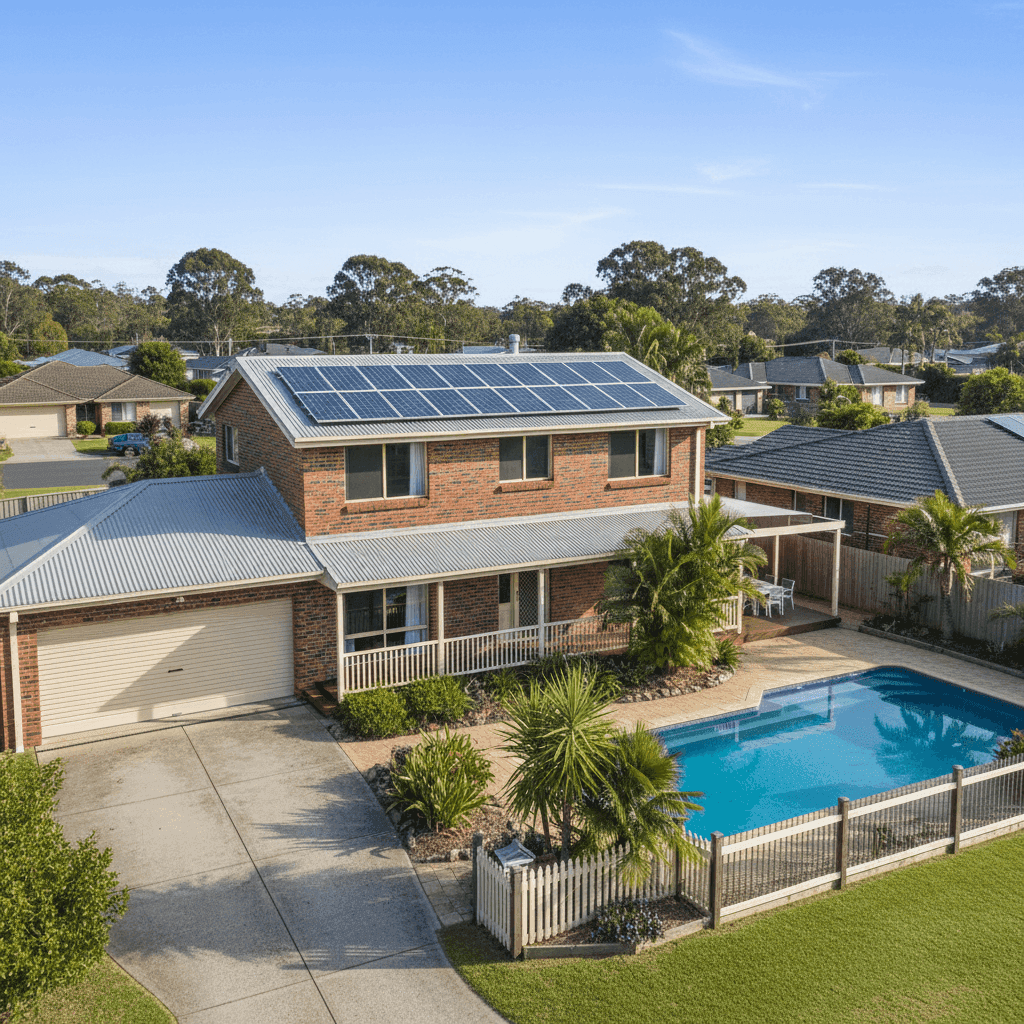
If you own a four-bedroom free standing home in Townsend, NSW 2463, you're likely no stranger to the task of shopping around for the right home insurance cover. Townsend is a relaxed riverside locality in the Clarence Valley, and while it sits outside cyclone-risk zones, there are still plenty of property-specific factors that shape what you'll pay each year. This article breaks down a real home and contents insurance quote for a property in this suburb — and helps you understand whether the price stacks up.
---
Is This Quote Fair?
The quote in question comes in at $3,433 per year (or $329 per month) for combined home and contents cover, with a building sum insured of $1,030,000 and contents valued at $150,000. Both the building and contents excess are set at $5,000.
Based on available market data, this quote is rated Expensive — above average for the Townsend area. The suburb average sits at around $2,354 per year, and the median is $2,315 per year. That means this quote is roughly 46% above the local average — a meaningful gap worth investigating before you commit.
That said, context matters. The building sum insured of $1,030,000 is on the higher end, and the property includes features like a swimming pool, solar panels, and ducted climate control — all of which add to the insurer's risk assessment and, in turn, the premium. A higher excess of $5,000 has been applied to both building and contents, which typically works to reduce a premium rather than inflate it, so the overall cost is likely being driven by the coverage level and property features rather than a poorly structured policy.
It's also worth noting that the sample size for Townsend is relatively small (8 quotes), so the suburb averages should be treated as a guide rather than a definitive benchmark.
---
How Townsend Compares
To put this quote in broader perspective, here's how Townsend premiums compare across different geographic levels:
| Benchmark | Average Premium | Median Premium |
|---|---|---|
| Townsend (2463) | $2,354/yr | $2,315/yr |
| NSW | $9,528/yr | $3,770/yr |
| National | $5,347/yr | $2,764/yr |
| Clarence Valley LGA | $31,244/yr | — |
A few things stand out here. The NSW state average of $9,528 per year is dramatically higher than the Townsend suburb average — largely because NSW includes high-risk coastal and flood-prone areas that push averages up significantly. The national average of $5,347 tells a similar story.
Most striking is the Clarence Valley LGA average of $31,244 per year. This figure is heavily skewed by flood-affected properties within the LGA — Clarence Valley has experienced significant flooding in recent years, and insurers price that risk accordingly for many addresses in the region. Townsend itself may not carry the same flood exposure as other parts of the LGA, which helps explain why local suburb premiums are considerably lower than the LGA-wide figure.
At $3,433 per year, this quote sits above the Townsend suburb median but well below both the NSW and national averages — which suggests it's not wildly out of line once the property's features and coverage level are factored in.
---
Property Features That Affect Your Premium
Several characteristics of this property have a direct bearing on the insurance cost:
Brick veneer construction with a Colorbond roof Brick veneer walls are generally viewed favourably by insurers — they're durable, fire-resistant, and less susceptible to weather damage than timber-framed alternatives. A steel/Colorbond roof is similarly regarded as a resilient choice, particularly in areas that experience heavy rain or hail. Together, these materials can help moderate your premium compared to less robust construction types.
Slab foundation A concrete slab foundation is standard for homes built in this era and region, and it carries relatively low risk from an insurer's perspective — there's no subfloor space to contend with, and it's generally resistant to subsidence and pest-related damage.
Swimming pool A pool increases the replacement and liability risk associated with a property. Insurers factor in the cost of pool structures, fencing compliance, and associated equipment when calculating the building sum insured and overall premium.
Solar panels Rooftop solar systems add value to a property but also add complexity to an insurance claim. Panels can be damaged by hail, storms, or falling debris, and their replacement cost needs to be reflected in the building sum insured. Some insurers include solar panels automatically; others require them to be specifically noted in the policy.
Ducted climate control Ducted air conditioning systems are expensive to repair or replace, and they're factored into the overall building replacement cost. This is another feature that contributes to a higher sum insured — and by extension, a higher premium.
1990 construction Homes built around 1990 are now over three decades old. While they're generally well-constructed, ageing electrical systems, plumbing, and roofing materials can present a higher risk of claims compared to newer builds. Insurers may price this in, particularly if the property hasn't had documented upgrades.
---
Tips for Homeowners in Townsend
1. Review your building sum insured carefully A sum insured of $1,030,000 for a 214 sqm home works out to roughly $4,813 per square metre — which is on the higher end for a standard-quality fit-out. It's worth getting an independent building replacement cost estimate to make sure you're not over-insured, as this directly affects your premium. Equally, being underinsured can leave you seriously out of pocket after a major claim.
2. Shop around — especially given the above-average rating With only 8 quotes in the local sample, there's genuine variation in what different insurers will charge for a property like this. Use a comparison tool like CoverClub to see multiple quotes side by side and identify whether a better-priced option exists for the same level of cover.
3. Check your flood and water damage inclusions Given that Townsend sits within the broader Clarence Valley — a region with known flood history — it's essential to confirm exactly what your policy covers in terms of flood, storm surge, and rainwater damage. Not all policies treat these the same way, and the distinction can be critical at claim time.
4. Consider whether your excess is working for you A $5,000 excess on both building and contents is quite high. While a higher excess does reduce your annual premium, it also means you'll be covering the first $5,000 of any claim yourself. If you have a strong emergency fund and are primarily insuring against catastrophic loss, this can make sense — but it's worth modelling the trade-off against a lower excess option.
---
Compare Your Home Insurance Options
Whether you're renewing your current policy or exploring cover for the first time, it pays to compare. CoverClub makes it easy to see how your quote stacks up against the market — and to find a policy that gives you the right protection at a fair price. Get a home insurance quote today and see what's available for your Townsend property.