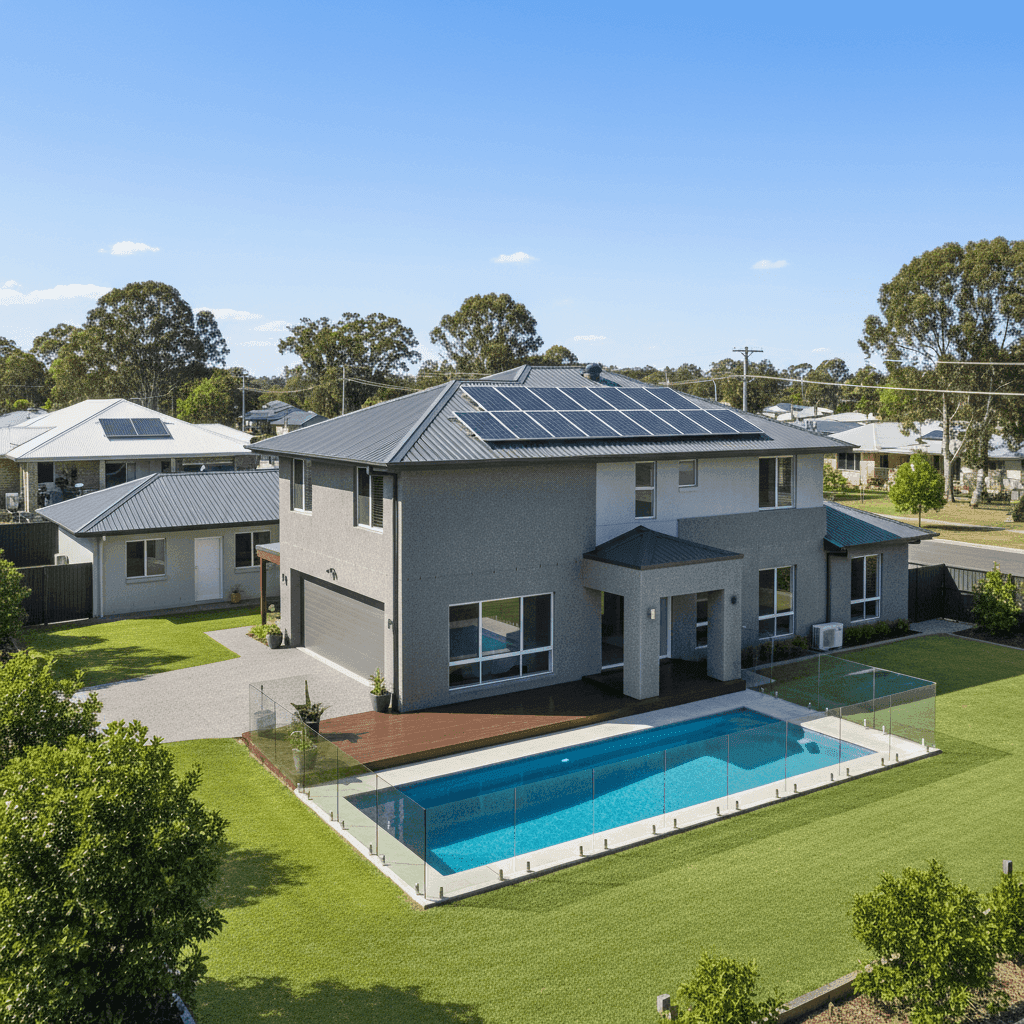
If you own a free standing home in Townview, QLD 4825, you've likely noticed that home insurance can vary dramatically depending on who you ask — and where you live. Townview sits in the Mount Isa region of far north-west Queensland, a part of the state where property characteristics, remoteness, and local risk factors all play a role in what insurers charge. In this article, we analyse a real building insurance quote for a four-bedroom, concrete-walled home in Townview, break down how it stacks up against local, state, and national benchmarks, and share practical tips to help you get the best possible cover for your money.
---
Is This Quote Fair?
The quote in question comes in at $2,470 per year (or $242/month) for building-only cover on a 277 sqm free standing home, with a sum insured of $827,000 and a $1,000 building excess. Our price rating for this quote is FAIR — Around Average.
That rating reflects a genuine middle-ground position. The premium sits comfortably close to the suburb average and below the suburb median, which means you're not being overcharged relative to what other Townview homeowners are paying. At the same time, there's room to do better — the cheapest quartile of quotes in the suburb comes in at around $1,756/year, so with the right insurer and policy configuration, meaningful savings could be on the table.
For a property of this size, age, and specification — built in 1976, concrete external walls, Colorbond roof, slab foundation, tiled flooring, and standard fittings — a sub-$2,500 annual premium is a reasonable outcome. It's not a bargain, but it's not a rip-off either.
---
How Townview Compares
Understanding where your premium sits in the broader market is one of the most useful things you can do as a homeowner. Here's how this quote measures up:
| Benchmark | Premium |
|---|---|
| This Quote | $2,470/yr |
| Townview Suburb Average | $2,505/yr |
| Townview Suburb Median | $2,736/yr |
| Townview 25th Percentile | $1,756/yr |
| Townview 75th Percentile | $3,210/yr |
| QLD State Average | $9,129/yr |
| QLD State Median | $3,903/yr |
| National Average | $5,347/yr |
| National Median | $2,764/yr |
| Carpentaria LGA Average | $5,066/yr |
Note: Townview suburb data is based on a sample of 6 quotes — a relatively small pool, so treat averages with some caution.
A few things stand out here. First, this quote is below both the QLD state median ($3,903) and the national median ($2,764), which is a solid result. Queensland as a whole carries some of the highest home insurance premiums in the country — largely driven by cyclone-prone coastal areas and flood-affected regions — so coming in under the state median is meaningful.
Second, the Carpentaria LGA average of $5,066/year is notably higher than what this property is attracting, suggesting that individual property characteristics (more on those below) are working in the homeowner's favour.
For a deeper look at what other properties in the postcode are paying, visit the Townview suburb insurance stats page. You can also explore the QLD state overview or browse national home insurance data to put things in a broader context.
---
Property Features That Affect Your Premium
Insurers don't just look at your postcode — they assess a detailed picture of your property. Several features of this home are worth examining through that lens.
Construction Materials
Concrete external walls are generally viewed favourably by insurers. Concrete is durable, fire-resistant, and holds up well against the kind of extreme heat experienced in far north-west Queensland. Combined with a steel/Colorbond roof — another material insurers tend to like for its resilience and longevity — this home presents a relatively low structural risk profile.
Age of Construction
Built in 1976, this property is approaching the 50-year mark. Older homes can attract higher premiums due to ageing plumbing, wiring, and structural components. However, the use of durable materials like concrete and steel likely offsets some of that concern.
Slab Foundation & Tiled Flooring
A slab-on-ground foundation is common in Queensland and is generally considered stable. Tiled flooring is also a positive signal — it's resilient, easy to maintain, and doesn't carry the water damage risk associated with timber or carpet in a building-only context.
Pool & Granny Flat
The presence of a swimming pool adds to the replacement cost of the property and can influence the sum insured calculation. Similarly, a granny flat on the property increases the total insurable area and is a factor in setting the building sum insured. At $827,000, the sum insured appears to account for these additions — it's important to ensure this figure is regularly reviewed to avoid underinsurance.
Solar Panels
Solar panels are a fixed building improvement and are typically covered under building insurance. They can add to the replacement cost, so confirming they're included in your sum insured is worthwhile.
No Cyclone Risk
Townview is not classified as a cyclone risk area, which is a significant premium advantage compared to coastal Queensland towns. This is likely one of the key reasons this property's premium sits well below the QLD state average.
---
Tips for Homeowners in Townview
1. Review your sum insured annually With a granny flat, pool, and solar panels, your property has more insurable components than a standard home. Building costs change over time, and underinsurance is a real risk — especially for larger or more complex properties. Use a building cost calculator or speak to a quantity surveyor to make sure $827,000 still reflects today's rebuild cost.
2. Shop around — the gap between the 25th and 75th percentile is significant In Townview, the difference between the cheapest and most expensive quartile of quotes spans roughly $1,450/year. That's not a small amount. Even if your current quote is fair, running a comparison every 12 months could surface a better deal. Get a new quote at CoverClub to see what's available for your property.
3. Check your excess settings This policy carries a $1,000 building excess. Opting for a higher voluntary excess (say, $2,000 or $2,500) can meaningfully reduce your annual premium. If you have the financial buffer to cover a larger out-of-pocket amount in the event of a claim, this is often a smart trade-off.
4. Confirm your granny flat is fully covered Not all standard building policies automatically extend full cover to secondary dwellings. Read your Product Disclosure Statement (PDS) carefully to confirm your granny flat — including its fixtures and fittings — is explicitly covered under the policy terms.
---
Compare Your Options with CoverClub
Whether you're renewing your existing policy or shopping around for the first time, CoverClub makes it easy to see how your quote stacks up against the market. With real data from properties across Australia, you can make an informed decision rather than just accepting whatever lands in your inbox at renewal time. Start a free quote comparison today and find out if you're getting a fair deal — or if there's a better one waiting.