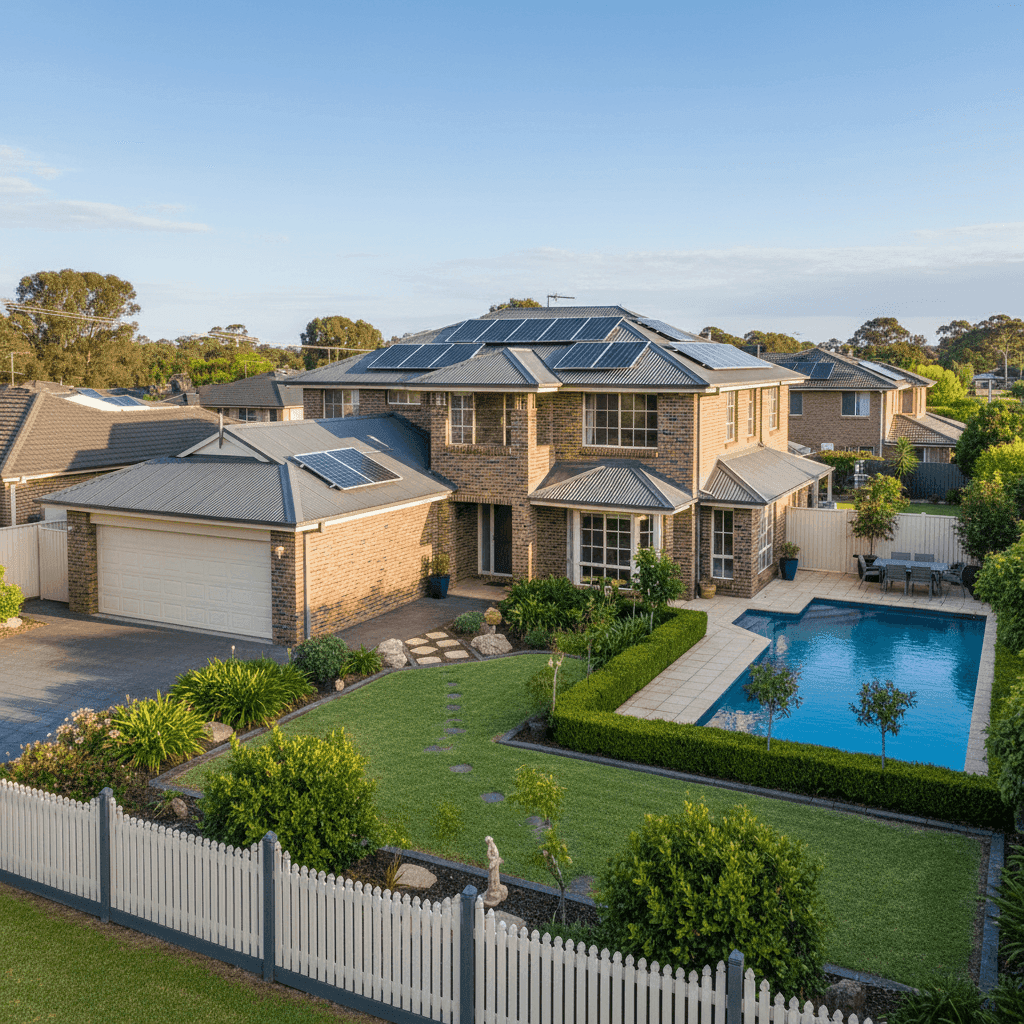
Traralgon is the largest town in the Latrobe Valley, sitting about 160 km east of Melbourne in regional Victoria. It's a well-established community with a mix of older and newer residential properties — and like most of regional Victoria, home insurance costs here are shaped by a unique blend of local risk factors, property characteristics, and market dynamics. This article breaks down a real home and contents insurance quote for a five-bedroom free-standing home in Traralgon (postcode 3844) and puts it in context against suburb, state, and national benchmarks.
---
Is This Quote Fair?
The quote in question comes in at $2,637 per year (or $246/month) for combined home and contents cover, with a building sum insured of $200,000 and contents valued at $400,000. Both the building and contents excesses are set at $1,000.
Our pricing engine rates this quote as Fair — Around Average, and the data backs that up. At $2,637 per year, this premium sits comfortably within the typical range for the Traralgon area, landing between the suburb's 25th percentile ($1,435/yr) and 75th percentile ($2,806/yr). It's modestly above the suburb average of $2,426/yr, but that's largely explained by the size and features of this particular property — more on that below.
Importantly, this quote is noticeably below both the Victorian state average ($2,921/yr) and the national average ($2,965/yr), which suggests the homeowner is getting reasonable value relative to the broader market. For a large, well-appointed property with a pool, solar panels, and ducted climate control, a premium in this range is genuinely competitive.
---
How Traralgon Compares
Understanding where Traralgon sits in the broader insurance landscape helps put any individual quote into perspective.
| Benchmark | Average Premium | Median Premium |
|---|---|---|
| Traralgon (3844) | $2,426/yr | $1,927/yr |
| Wellington LGA | $2,836/yr | — |
| Victoria (VIC) | $2,921/yr | $2,694/yr |
| National | $2,965/yr | $2,716/yr |
(Based on 155 quotes sampled for the Traralgon suburb.)
A few things stand out here. First, Traralgon's median premium of $1,927/yr is significantly lower than the Victorian median ($2,694/yr) — a gap of nearly $770 per year. This suggests that a large proportion of Traralgon properties attract relatively modest premiums, likely reflecting the area's lower-risk profile compared to coastal or bushfire-prone parts of the state.
Second, the Wellington LGA average of $2,836/yr is higher than the Traralgon suburb average, which makes sense — the broader LGA encompasses more rural and semi-rural properties that may carry higher risk profiles than the township itself.
You can explore the full breakdown of local pricing data on the Traralgon suburb stats page, compare it against all of Victoria, or see how it stacks up on the national stats page.
---
Property Features That Affect Your Premium
This isn't a basic starter home — it's a substantial five-bedroom, two-bathroom property built in 1989, with a floor area of 214 sqm and above-average fittings quality. Each of these characteristics feeds into how insurers calculate risk and replacement cost.
Brick Veneer Construction Brick veneer is one of the most common external wall types in Australian suburban homes, and insurers generally view it favourably. It offers solid fire resistance and structural durability, which can help moderate premiums compared to timber-clad homes.
Steel / Colorbond Roof A Colorbond steel roof is a strong asset from an insurance perspective. It's highly durable, resistant to fire and hail, and has a long lifespan — all factors that reduce the likelihood of a claim. This roof type tends to attract more competitive premiums than terracotta or concrete tiles in some risk categories.
Stump Foundation The property sits on stumps, which is common for homes of this era in regional Victoria. Stump foundations can be more vulnerable to movement and subsidence over time, and some insurers factor this into their assessment — particularly for older homes. It's worth ensuring your policy covers any gradual deterioration risks appropriately.
Swimming Pool A pool adds both value and liability exposure. Insurers consider the risk of accidents, damage to pool equipment, and the cost of repairs or replacement. This will contribute to a higher premium compared to an equivalent property without a pool.
Solar Panels Solar panels are increasingly common in Australian homes, but they do add to the replacement cost of the building. Most standard home insurance policies cover solar panels as part of the building sum insured, so it's important to ensure your building cover adequately reflects their value.
Ducted Climate Control Ducted heating and cooling systems are a significant fixed asset. Like solar panels, they form part of the building's insured value and can increase the cost to rebuild or repair — which is reflected in the premium.
Above-Average Fittings Quality With above-average fittings, the cost to repair or replace internal fixtures — from kitchen joinery to bathroom fittings — is higher than a standard home. Insurers account for this when estimating rebuild costs, which influences the overall premium.
---
Tips for Homeowners in Traralgon
1. Review your building sum insured regularly With 214 sqm of living space, above-average fittings, solar panels, and ducted climate control, the cost to fully rebuild this home could be substantial. Building costs have risen sharply in recent years — make sure your $200,000 sum insured still reflects current construction rates in regional Victoria. Underinsurance is one of the most common and costly mistakes homeowners make.
2. Consider raising your excess to reduce your premium Both excesses on this policy are set at $1,000. If you have a financial buffer and rarely make small claims, increasing your excess (say, to $2,000 or $2,500) can meaningfully reduce your annual premium. Just make sure the saving is worth the additional out-of-pocket cost if you do need to claim.
3. Bundle your home and contents cover This quote already combines building and contents insurance, which typically attracts a discount compared to holding two separate policies. If you haven't already consolidated your cover, it's worth exploring — most major insurers offer multi-policy discounts.
4. Check what your policy says about the pool and solar These are two areas where policy wording varies significantly between insurers. Confirm that your pool equipment (pump, filter, heating) is covered, and that your solar panels are included in the building sum insured at full replacement value. If either is excluded or capped, it may be worth shopping around.
---
Compare Quotes and Find Better Value
Whether you're renewing your current policy or shopping for the first time, comparing quotes is the single most effective way to ensure you're not overpaying. Premiums for the same property can vary by hundreds — sometimes thousands — of dollars between insurers.
Get a home insurance quote at CoverClub and see how your property compares in seconds. With real pricing data from across Australia, CoverClub helps you make a confident, informed decision — not just a guess.