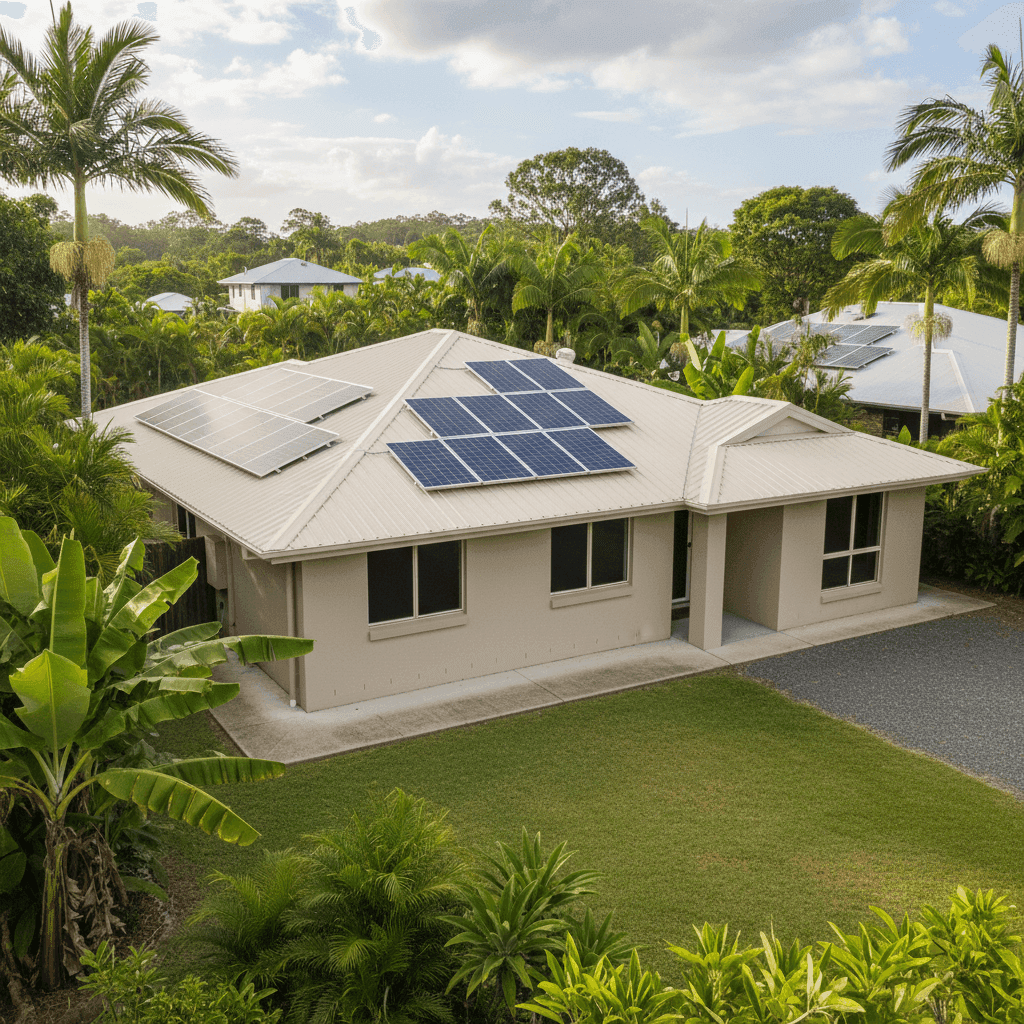
Getting a handle on home insurance costs in Far North Queensland can feel like navigating a maze — premiums vary wildly depending on your suburb, your property's construction, and the risks insurers associate with your area. This article breaks down a real building insurance quote for a three-bedroom free standing home in Tully Heads, QLD 4854, and puts the numbers in context so you can judge whether your own policy is working hard enough for you.
---
Is This Quote Fair?
The short answer: yes — and then some. This quote came in at $3,612 per year (or $346/month) for building-only cover with a $1,000 excess and a sum insured of $550,000. CoverClub rates this as CHEAP, meaning it sits below average for the area.
To put that in perspective, the suburb average for Tully Heads is $5,931/year, and the median sits at $4,971/year. This quote lands below even the 25th percentile for the suburb ($3,639/year), meaning it's cheaper than at least 75% of comparable quotes we've seen for this postcode. That's a meaningful saving — potentially over $2,300 per year compared to what many local homeowners are paying.
Of course, premiums depend heavily on the specific insurer, the policy's inclusions and exclusions, and how the property's individual risk profile is assessed. A "cheap" quote doesn't automatically mean the best policy — but it's certainly a strong starting point.
---
How Tully Heads Compares
Understanding where Tully Heads sits in the broader insurance landscape helps explain why premiums here can be elevated — and why finding a competitive quote matters so much.
| Benchmark | Premium |
|---|---|
| This quote | $3,612/yr |
| Suburb average (Tully Heads) | $5,931/yr |
| Suburb median | $4,971/yr |
| LGA average (Cassowary Coast) | $5,573/yr |
| QLD state average | $9,129/yr |
| QLD state median | $3,903/yr |
| National average | $5,347/yr |
| National median | $2,764/yr |
(Based on [Tully Heads suburb data](https://coverclub.com.au/stats/QLD/4854/tully-heads) from CoverClub's quote database. Sample size: 9 quotes.)
A few things stand out here. The QLD state average of $9,129/year is extraordinarily high — driven largely by the extreme premiums seen in cyclone-prone coastal and far-north communities. The state median of $3,903/year is far more representative for properties outside the highest-risk zones, and this quote sits just slightly above that figure.
Nationally, the average home insurance premium is $5,347/year, though the median of $2,764/year tells a different story — most Australian homeowners are paying less than the average, with a smaller number of very high-risk properties pulling the mean upward. You can explore QLD-wide insurance trends to see how different regions within the state compare.
The takeaway? Tully Heads sits in a part of Queensland where insurance costs can be significant, making it all the more important to shop around and benchmark your quote.
---
Property Features That Affect Your Premium
Insurers don't just look at your postcode — they assess the physical characteristics of your home in considerable detail. Here's how the features of this particular property likely influenced the premium:
Concrete external walls are generally viewed favourably by insurers. Concrete is highly resistant to fire, impact damage, and rot, and tends to hold up well in severe weather events. Compared to timber-framed or weatherboard homes, a concrete-walled property can attract a lower risk assessment.
Steel/Colorbond roofing is another tick in the right column. Colorbond is a popular choice in Queensland for good reason — it's lightweight, corrosion-resistant, and performs well in high-wind conditions. It's also non-combustible, which matters in areas where bushfire or ember attack is a consideration.
Slab foundation removes the risk associated with elevated or stumped homes, where subfloor flooding and structural movement can be concerns. Combined with tile flooring, this property has a hard-surface finish that's easy to repair and resistant to water damage — both relevant in a tropical coastal environment.
Solar panels are an increasingly common feature on Australian homes, but they do add a degree of complexity to a building insurance policy. Panels represent a capital asset that needs to be included in the sum insured, and some insurers charge a small loading to account for the cost of replacement. It's worth confirming your policy explicitly covers solar panels as part of the building.
Ducted climate control is another fixed asset that should be reflected in your sum insured. These systems can be expensive to replace, and their inclusion in the building cover calculation is important for avoiding underinsurance.
The property has no pool, which removes one liability and maintenance risk that insurers sometimes factor into premiums. And while Tully Heads is in Far North Queensland, this property is noted as being in a non-cyclone risk area — a significant factor that likely contributes to the more competitive premium compared to nearby coastal properties that do attract cyclone loading.
---
Tips for Homeowners in Tully Heads
Whether you're renewing your policy or shopping around for the first time, here are four practical steps worth taking:
- Review your sum insured annually. Building costs have risen sharply across Australia in recent years. A sum insured of $550,000 may have been appropriate when the policy was first written, but it's worth checking against current construction costs for your area. Underinsurance is one of the most common — and costly — mistakes homeowners make.
- Confirm your solar panels are covered. Ask your insurer directly whether the solar system is included in your building cover and whether there are any sub-limits or exclusions. Some policies treat panels as a separate item or exclude damage from certain causes.
- Don't just renew automatically. The fact that this quote is rated CHEAP relative to the suburb average shows that significant price variation exists in this market. Use a comparison service like CoverClub to benchmark your renewal quote before accepting it.
- Understand your excess obligations. This policy carries a $1,000 building excess. Make sure that figure is comfortable for your financial situation — a higher excess can reduce your premium, but it needs to be an amount you could genuinely cover in the event of a claim.
---
Compare Your Home Insurance Today
Whether you own a home in Tully Heads or anywhere else in Australia, it pays — literally — to compare your options. CoverClub makes it easy to see how your quote stacks up against real data from your suburb, your region, and the country. Get a quote and compare now to make sure you're not overpaying for your cover.