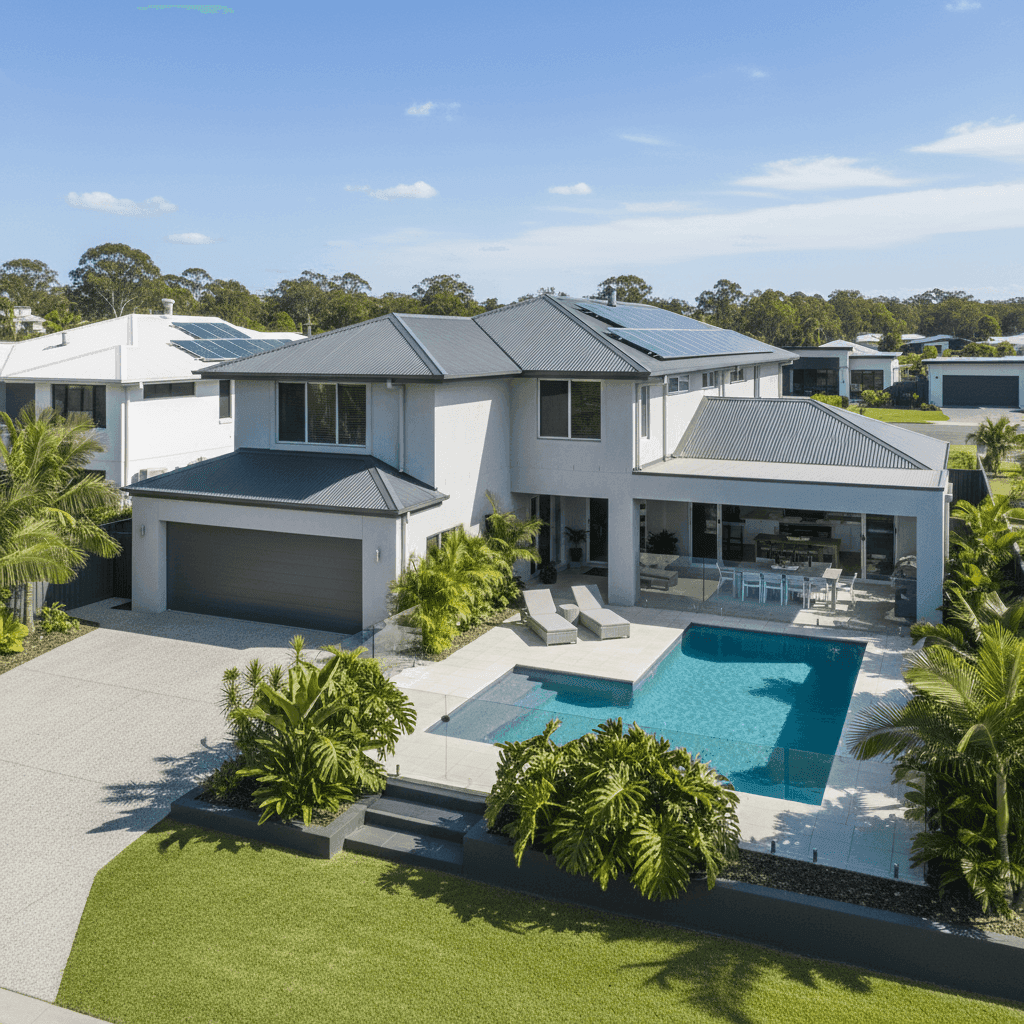
Twin Waters is a picturesque canal-side suburb on Queensland's Sunshine Coast, known for its leafy streets, waterfront lifestyle, and well-established residential properties. For owners of a free standing home in this sought-after pocket of the Sunshine Coast, understanding what you're paying for home insurance — and whether that price is fair — is an important part of protecting what's likely your most valuable asset.
This article breaks down a real home and contents insurance quote for a four-bedroom, three-bathroom free standing home in Twin Waters (postcode 4564), and puts the numbers into context against local, state, and national benchmarks.
---
Is This Quote Fair?
The quote in question comes in at $6,528 per year (or $619 per month), covering both building and contents. The building is insured for $1,501,000, with contents covered at $120,000. Both the building and contents excess are set at $2,000.
Our price rating for this quote is FAIR — Around Average, and the data backs that up.
When compared against other quotes in Twin Waters, this premium sits noticeably above the suburb median of $4,258/yr, but comfortably below the suburb average of $7,094/yr. That gap between median and average is telling — it suggests a handful of high-value properties are pulling the average upward, which is consistent with the premium waterfront and canal-front homes that Twin Waters is known for.
At $6,528, this quote falls within the middle band of the local market (between the 25th percentile of $2,708 and the 75th percentile of $8,432), which is exactly where a well-constructed, above-average-quality home of this size and value should land. There's no red flag here — but there's also room to shop around.
---
How Twin Waters Compares
To appreciate what's driving this premium, it helps to zoom out and look at the broader picture.
| Benchmark | Premium |
|---|---|
| This quote | $6,528/yr |
| Twin Waters suburb average | $7,094/yr |
| Twin Waters suburb median | $4,258/yr |
| Sunshine Coast LGA average | $7,249/yr |
| QLD state average | $4,547/yr |
| QLD state median | $3,931/yr |
| National average | $2,965/yr |
| National median | $2,716/yr |
A few things stand out here. First, premiums in Twin Waters — and across the Sunshine Coast LGA — run significantly higher than the national average. The national median sits at just $2,716/yr, which is less than half of this quote. That's not unusual for coastal Queensland; proximity to the coast, flood-adjacent geography, and higher property values all contribute to elevated premiums in this region.
Second, Queensland as a whole carries higher premiums than the national norm, with a state average of $4,547/yr versus the national average of $2,965/yr. This reflects the state's exposure to severe weather events, including storms, flooding, and hail.
For a property of this calibre — 244 sqm, high-quality fittings, a pool, and solar panels, insured for $1.5 million — paying $6,528/yr is a reasonable outcome. It's below the Sunshine Coast LGA average and only marginally above the suburb average when you account for the higher-than-typical sum insured.
---
Property Features That Affect Your Premium
Several characteristics of this home play a meaningful role in how insurers price the risk.
Concrete external walls and Colorbond roof are generally viewed favourably by insurers. Concrete construction is resilient against fire, wind, and impact damage, while Colorbond steel roofing is durable, lightweight, and performs well in coastal and storm-prone environments. These features can help moderate premiums compared to older or less robust construction types.
Slab foundation is the most common foundation type in Queensland and is typically straightforward for insurers to assess. It doesn't carry the same risk profile as suspended timber floors in flood-prone areas.
Timber and laminate flooring is worth noting from a contents and building perspective. While aesthetically desirable, timber floors can be more susceptible to water damage than tiles, which may factor into how some insurers assess risk — particularly in a coastal suburb like Twin Waters.
Above-average fittings quality directly influences the cost to rebuild or repair. Higher-spec kitchens, bathrooms, and finishes cost more to replace, and the $1,501,000 building sum insured reflects this reality for a 244 sqm home with three bathrooms and premium appointments.
A swimming pool and solar panels both add insurable value and complexity. Pools require specific liability and structural coverage, while solar panel systems — particularly inverters and panels themselves — need to be accounted for within the building sum insured. It's worth confirming with your insurer that both are explicitly covered under your policy.
No cyclone risk designation is a notable positive for this property. Parts of Queensland carry mandatory cyclone excess provisions that can significantly increase out-of-pocket costs after a claim. Twin Waters falling outside a designated cyclone risk area is a meaningful factor keeping this premium more manageable than it might otherwise be.
---
Tips for Homeowners in Twin Waters
1. Verify your building sum insured regularly With construction costs having risen sharply in recent years, a sum insured set even two or three years ago may no longer reflect the true cost to rebuild. For a home of this size and quality, underinsurance is a real risk. Use a quantity surveyor or your insurer's building cost calculator to sense-check your figure annually.
2. Confirm pool and solar panel coverage Not all standard home policies automatically cover solar panel systems or in-ground pools to the extent you might expect. Ask your insurer specifically what's included — and what's excluded — for both. Some policies treat solar panels as a building fixture, others don't.
3. Consider the value of a higher excess This policy carries a $2,000 excess on both building and contents. If you have the financial buffer to absorb a larger out-of-pocket cost in the event of a claim, opting for a higher excess (say, $3,000–$5,000) can meaningfully reduce your annual premium. Run the numbers with your insurer before deciding.
4. Compare quotes at renewal — every year Insurance markets shift, and loyalty doesn't always pay. Given that the suburb's 25th percentile sits at $2,708/yr and the 75th at $8,432/yr, there's clearly a wide range of what different insurers will charge for similar properties in Twin Waters. Shopping around at renewal is one of the simplest ways to ensure you're not overpaying.
---
Ready to Compare?
Whether you're reviewing your current policy or insuring a home for the first time, CoverClub makes it easy to see how your quote stacks up. Get a home insurance quote today and compare real premiums from across the market — so you can make a confident, informed decision about protecting your Twin Waters home.