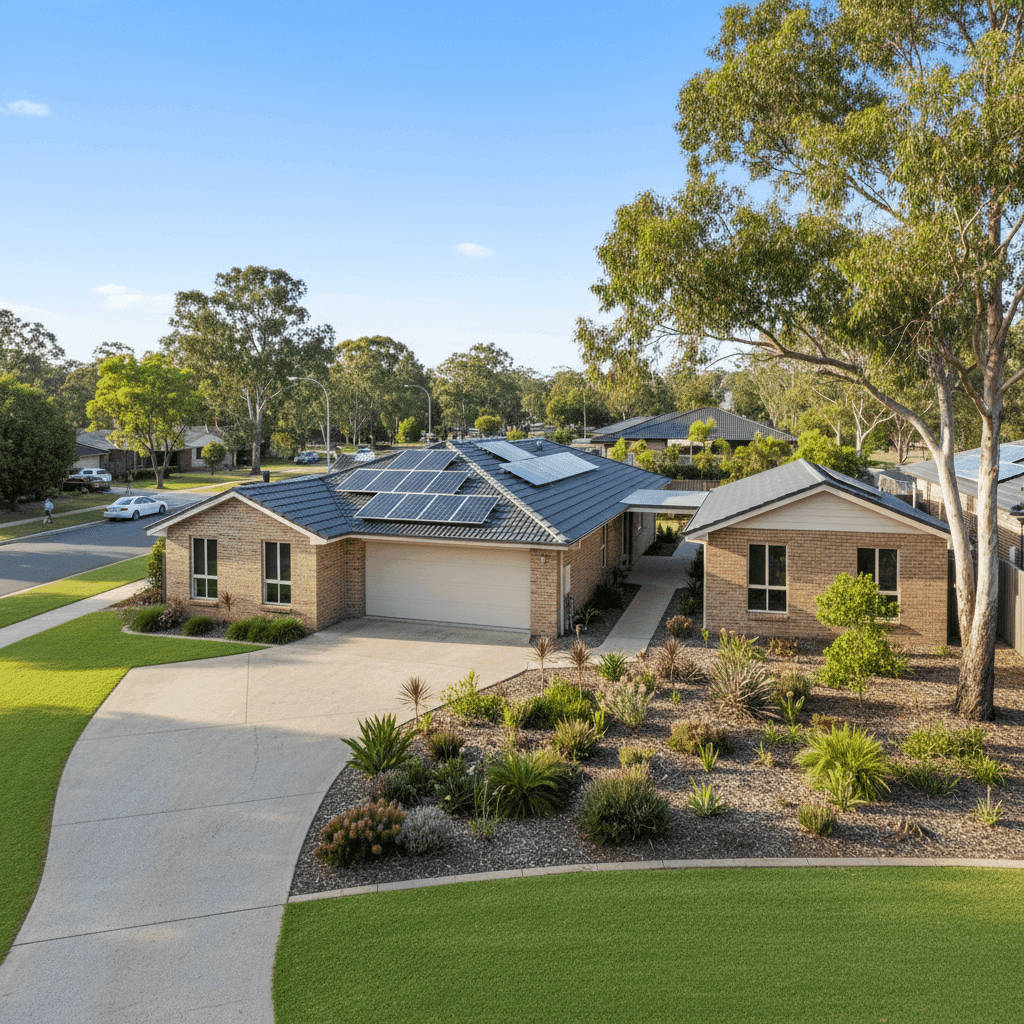
Upper Caboolture, sitting in the northern reaches of the Moreton Bay region, is a growing suburb attracting families drawn to its affordable land, newer estates, and easy access to the Bruce Highway. If you own a free standing home here, understanding what you should be paying for home and contents insurance — and why — can save you hundreds of dollars a year. This article breaks down a real quote for a four-bedroom, two-bathroom brick veneer home in Upper Caboolture (postcode 4510), and puts the numbers in context against local, state, and national benchmarks.
---
Is This Quote Fair?
The short answer: yes — this is an exceptionally competitive quote.
The property in question received a combined home and contents premium of $1,639 per year (or roughly $161 per month), covering a building sum insured of $895,000 and contents valued at $99,000. Our pricing model rates this as CHEAP — below average for the area.
To put that in perspective, the suburb average for Upper Caboolture sits at $3,051 per year, and the median is $2,813 per year. Even at the 25th percentile — meaning 75% of quotes are more expensive — local homeowners are still paying around $2,048 per year. This quote comes in well beneath that floor, making it a standout result in the local market.
The building excess is set at $3,000 and the contents excess at $1,000. Higher excesses are one lever insurers use to reduce premiums, so it's worth factoring in whether those out-of-pocket costs in a claim scenario are comfortable for your household budget. That said, even accounting for the elevated building excess, the annual saving compared to the suburb average is substantial.
---
How Upper Caboolture Compares
Home insurance pricing in Queensland is notoriously high by national standards, largely driven by the state's exposure to extreme weather events — cyclones in the north, flooding in river corridors, and storm damage across the south-east. Upper Caboolture itself is not classified as a cyclone risk area, which is a meaningful pricing advantage.
Here's how the numbers stack up across different benchmarks, based on data from quotes collected across Upper Caboolture (4510):
| Benchmark | Annual Premium |
|---|---|
| This quote | $1,639 |
| Upper Caboolture suburb average | $3,051 |
| Upper Caboolture suburb median | $2,813 |
| Upper Caboolture 25th percentile | $2,048 |
| Moreton Bay LGA average | $3,145 |
| QLD state average | $4,547 |
| QLD state median | $3,931 |
| National average | $2,965 |
| National median | $2,716 |
The QLD state average of $4,547 is the starkest comparison point. Homeowners across Queensland are paying, on average, nearly three times what this particular quote came in at. Even against the national average of $2,965, this quote represents a saving of over $1,300 per year.
The Moreton Bay LGA average of $3,145 also reinforces that Upper Caboolture sits in a region where premiums trend higher than the national norm — making a below-average result here all the more noteworthy. The suburb sample of 47 quotes provides a reasonably solid local dataset to draw meaningful comparisons from.
---
Property Features That Affect Your Premium
Several characteristics of this property work in its favour from an insurance pricing standpoint:
Brick veneer construction is generally well-regarded by insurers. It offers solid weather resistance and performs reasonably well in fire scenarios compared to lightweight cladding or weatherboard. Combined with a tiled roof, the home presents a durable external envelope that tends to attract more competitive premiums.
Slab foundation is standard for Queensland homes built in this era and doesn't introduce the underfloor moisture or pest-access concerns associated with older raised timber foundations.
The home was built in 1994, placing it in a sweet spot — old enough to have appreciated significantly in replacement value, but modern enough to have been constructed under building codes that incorporated improved cyclone and storm-resistance standards introduced in Queensland during the late 1980s and early 1990s.
At 397 square metres, this is a sizeable property. Larger homes generally carry higher rebuild costs, which is reflected in the $895,000 building sum insured. It's worth ensuring this figure is regularly reviewed — construction costs in South-East Queensland have risen sharply in recent years, and underinsurance remains one of the most common and costly mistakes homeowners make.
The presence of solar panels is worth noting. While solar adds value to a home, it also adds complexity to an insurance claim — panels can be damaged by hail, storms, or falling debris, and not all policies cover them under the standard building definition. Homeowners should confirm explicitly whether their policy covers solar panels and, if so, to what value.
The granny flat is another feature requiring careful attention. Secondary dwellings are not automatically covered under a standard home insurance policy. Some insurers include them within the building sum insured; others treat them as a separate structure requiring additional cover. Always check the Product Disclosure Statement (PDS) to understand exactly what's included.
Standard fittings quality and tiled flooring throughout suggest a well-maintained but not luxury-specification home, which typically results in more straightforward claims assessments and fewer valuation disputes.
---
Tips for Homeowners in Upper Caboolture
1. Review your building sum insured annually Construction costs have climbed significantly across Queensland. The $895,000 sum insured may be appropriate today, but it should be benchmarked against current rebuild cost estimates — not the property's market value — at each renewal. Many insurers offer a building calculator, or you can engage a quantity surveyor for a formal assessment.
2. Clarify solar panel and granny flat cover before you sign As noted above, both features can fall into grey areas in standard policies. Ask your insurer directly: Are the solar panels covered? Are they included in the building sum insured or listed separately? Is the granny flat covered as part of the main dwelling? Get the answers in writing or check the PDS carefully.
3. Understand your excess before a claim The $3,000 building excess on this policy is on the higher end. While it helps keep premiums down, it means you'll be out of pocket for the first $3,000 of any building claim. If that's not comfortable, it's worth getting comparison quotes with a lower excess to see how much the premium difference actually is — sometimes the trade-off is surprisingly small.
4. Shop around at every renewal Insurance loyalty rarely pays. Insurers frequently offer their best pricing to new customers, meaning long-term policyholders can end up significantly overpaying. Given the spread between the cheapest and most expensive quotes in Upper Caboolture (from $2,048 at the 25th percentile to $3,876 at the 75th percentile), active comparison at renewal can make a meaningful difference to your household budget.
---
Compare Your Own Quote
Whether you're a first-time buyer in Upper Caboolture or a long-term homeowner wondering if you're getting a fair deal, comparing quotes is the single most effective step you can take. CoverClub aggregates pricing data from across Australia to help you understand where your premium sits relative to your neighbours and the broader market. Get a home insurance quote today and see how your property stacks up.