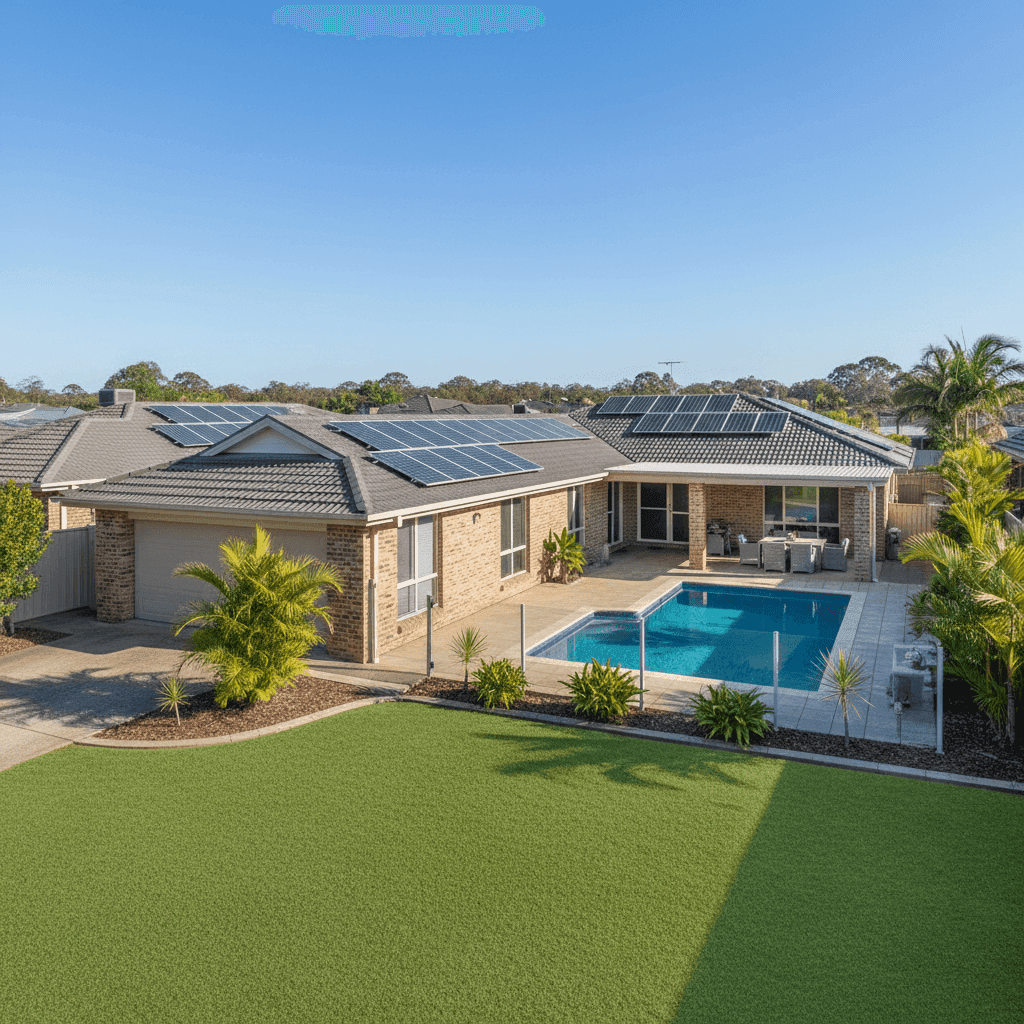
Upper Coomera is one of the Gold Coast's fastest-growing suburbs, attracting families with its modern estates, excellent schools, and easy motorway access. If you own a free standing home here — particularly a brick veneer build from the early 2000s — you're likely curious about whether you're paying a fair price for home and contents insurance. In this article, we break down a real quote of $2,769 per year for a four-bedroom, two-bathroom home in Upper Coomera (postcode 4209), and put it in context against suburb, state, and national benchmarks.
---
Is This Quote Fair?
The short answer: yes, broadly speaking. This quote has been rated Fair (Around Average), and the data backs that up.
At $2,769 per year (or roughly $275 per month), this premium sits comfortably between the suburb's 25th percentile ($1,822/yr) and 75th percentile ($3,693/yr). It's slightly above the Upper Coomera suburb median of $2,606/yr, but meaningfully below the suburb average of $3,117/yr — which tends to be pulled upward by higher-risk or higher-value properties in the mix.
For a home insured at $618,000 for the building and $170,000 for contents, a combined annual premium of $2,769 represents reasonable value. The $500 excess on both building and contents is a standard, middle-of-the-road figure — not so low that it inflates the premium, and not so high that a claim becomes a financial burden.
In short, this isn't a bargain-basement deal, but it's not overpriced either. There's room to shop around if you want to push toward the lower end of the suburb's range, but you'd want to ensure you're not sacrificing meaningful cover to get there.
---
How Upper Coomera Compares
One of the most striking things about this quote is just how well Upper Coomera compares to the broader Queensland and national picture.
| Benchmark | Annual Premium |
|---|---|
| This quote | $2,769 |
| Upper Coomera suburb median | $2,606 |
| Upper Coomera suburb average | $3,117 |
| QLD state median | $3,903 |
| QLD state average | $9,129 |
| Gold Coast LGA average | $8,161 |
| National median | $2,764 |
| National average | $5,347 |
The Queensland state average of $9,129/yr is eye-watering by comparison — though it's heavily skewed by cyclone-prone coastal and far-north Queensland regions, where premiums can run into the tens of thousands. Upper Coomera, sitting in the south-east corner of the state, benefits from not being classified as a cyclone risk area, which is a significant advantage.
Even the Gold Coast LGA average of $8,161/yr highlights how much variation exists within the same local government area. Beachside and flood-prone pockets of the Gold Coast face dramatically higher premiums, making Upper Coomera's inland, elevated position a genuine financial benefit for homeowners.
Compared to the national median of $2,764/yr, this quote is almost exactly in line — a reassuring sign that the pricing reflects the actual risk profile of the area rather than any geographic loading.
---
Property Features That Affect Your Premium
Several characteristics of this particular property work in the homeowner's favour — and a couple introduce modest additional considerations.
Brick Veneer Walls & Tiled Roof Brick veneer construction with a tile roof is one of the most common and well-regarded combinations in Australian residential building. Insurers generally view this favourably: brick veneer offers solid fire resistance and structural integrity, while tiles are durable and perform well in storms compared to corrugated iron or Colorbond on older homes. This combination typically attracts standard or below-standard risk ratings.
Concrete Slab Foundation A slab-on-ground foundation, common in Queensland homes built post-2000, is straightforward for insurers to assess. It avoids the subfloor moisture and pest risks associated with older timber-framed stumped homes, which can contribute to lower premiums.
Swimming Pool A pool adds liability considerations to any home insurance policy. Most home and contents policies cover the pool structure under building insurance, but homeowners should check the fine print around public liability — particularly if the pool is accessible to visitors or neighbouring properties.
Solar Panels The property's solar panels are worth a specific conversation with your insurer. Panels are generally covered under building insurance as a fixed fixture, but their value should be factored into your sum insured. With a $618,000 building sum insured on a 214 sqm home built in 2004, it's worth confirming that solar panels and any associated inverter equipment are adequately reflected in that figure.
Tile Flooring Tiles throughout the home are a practical choice in Queensland's climate and are straightforward from an insurance perspective — no concerns around water damage swelling or warping that can affect timber or laminate floors.
Building Size & Age At 214 sqm and built in 2004, this home sits in a sweet spot: large enough to be a comfortable family home, but not so large that rebuild costs become astronomical. The 2004 construction date means the home was built under modern building codes, which generally translates to better structural resilience and fewer insurer concerns.
---
Tips for Homeowners in Upper Coomera
1. Review Your Sum Insured Annually Construction costs have risen sharply across Australia in recent years. A building sum insured of $618,000 may have been accurate at policy inception, but it's worth recalculating your estimated rebuild cost each year — particularly given the size of this home and the inclusion of features like a pool and solar panels. Underinsurance is one of the most common and costly mistakes homeowners make.
2. Check Your Pool & Solar Panel Cover Ask your insurer explicitly how your pool and solar panels are covered. Some policies include them automatically under building cover; others require them to be separately listed. Confirm the liability provisions around the pool as well, especially if you have young children or frequently entertain guests.
3. Consider a Higher Excess to Reduce Premiums The current $500 excess is reasonable, but if you have a solid emergency fund and rarely make small claims, increasing your excess to $1,000 or more can meaningfully reduce your annual premium. This is a simple lever that many homeowners overlook.
4. Compare Quotes Before Renewal Even if your current premium is rated as fair, the insurance market shifts constantly. New insurers enter the market, existing providers re-price their books, and your risk profile may have changed. Running a comparison through CoverClub at renewal time takes minutes and could save you hundreds of dollars — without any obligation to switch.
---
Compare Your Own Quote
Whether you're reviewing your current policy or shopping for cover on a new purchase, it pays to see what the market looks like before you commit. CoverClub makes it easy to benchmark your premium against real quotes from Upper Coomera and across Queensland. Get a quote today at CoverClub and see how your home insurance stacks up — you might be surprised at what you find.