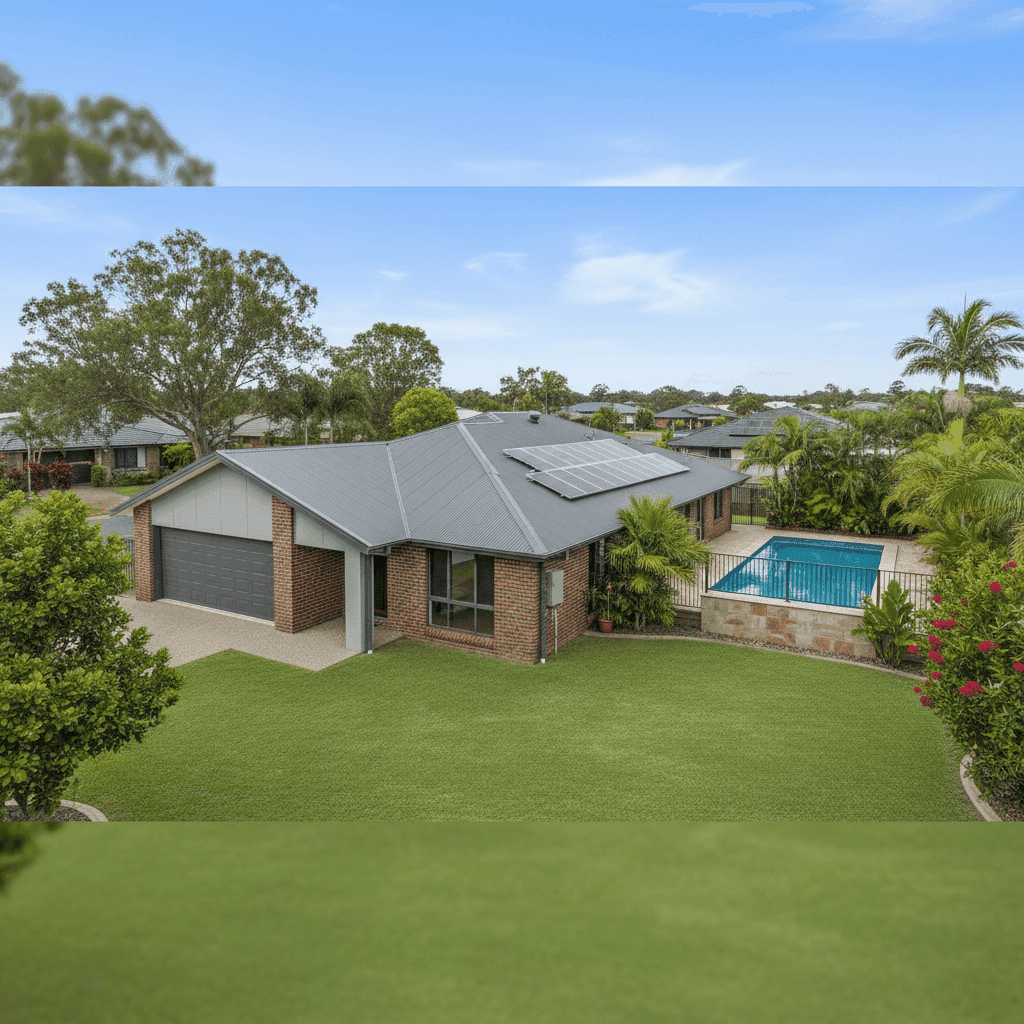
Victoria Point is a leafy bayside suburb on the Redland Coast, sitting on a peninsula that juts into Moreton Bay — and it's one of the more sought-after addresses in South East Queensland. But what does it actually cost to insure a home here? This article breaks down a real building insurance quote for a five-bedroom free-standing home in Victoria Point (QLD 4165), and puts that number in context against suburb, state, and national benchmarks.
---
Is This Quote Fair?
The annual premium on this quote comes in at $1,224 per year (or $120/month), covering the building only with a sum insured of $829,000 and a $2,000 excess. Our pricing engine has rated this quote as CHEAP — below average for the area.
To put that in perspective: the suburb average for Victoria Point sits at $3,494/year, with a median of $3,043/year. Even the 25th percentile — meaning 75% of quotes in this suburb are more expensive — comes in at $1,659/year. This quote at $1,224 sits comfortably below that bottom quartile, making it a genuinely strong result.
For a homeowner insuring a large, modern property with a pool and solar panels, landing a premium this far below the local average is noteworthy. It suggests the insurer has assessed this particular property's risk profile favourably — likely due to its relatively recent construction (2014), solid brick veneer walls, Colorbond roof, and concrete slab foundation.
---
How Victoria Point Compares
Understanding your premium means looking beyond just your suburb. Here's how Victoria Point stacks up across different benchmarks:
| Benchmark | Average Premium | Median Premium |
|---|---|---|
| Victoria Point (4165) | $3,494/yr | $3,043/yr |
| Redland LGA | $3,312/yr | — |
| Queensland | $4,547/yr | $3,931/yr |
| National | $2,965/yr | $2,716/yr |
A few things stand out here. First, Queensland's state average of $4,547/year is significantly higher than the national average of $2,965/year — a gap of over $1,500. This reflects the elevated weather risk across much of Queensland, including cyclones, severe storms, and flooding events that push premiums up across the state.
Victoria Point itself sits below the Queensland average but above the national average, which is fairly typical for a coastal suburb in South East Queensland. The suburb's proximity to Moreton Bay means storm surge and inundation risk are real considerations for insurers, even though this particular property is not in a designated cyclone risk zone.
The wide spread of premiums locally — from $1,659/year at the 25th percentile to $5,860/year at the 75th percentile — tells you that individual property characteristics make an enormous difference. Two homes on the same street can attract very different premiums depending on their construction, elevation, flood overlay, and the insurer's own risk models.
You can explore more local data on the Victoria Point suburb stats page.
---
Property Features That Affect Your Premium
Several characteristics of this property likely contribute to its favourable premium:
Construction year (2014). Newer homes generally attract lower premiums. A 2014 build means the property was constructed under modern Queensland building codes, which include improved cyclone tie-downs, better waterproofing standards, and more resilient structural requirements compared to homes built in the 1970s–90s.
Brick veneer external walls. Brick veneer is regarded as a durable, low-maintenance wall construction. It offers good fire resistance and structural integrity, which insurers typically reward with more competitive pricing compared to weatherboard or fibre cement cladding.
Steel/Colorbond roof. A Colorbond roof is one of the most insurer-friendly roofing materials in Australia. It's resistant to cracking, won't absorb moisture, and holds up well in high-wind events. Compared to terracotta or concrete tiles, Colorbond roofs are less likely to cause significant damage if dislodged in a storm.
Concrete slab foundation. Slab-on-ground construction eliminates the underfloor space that can trap moisture or be vulnerable to flooding in certain scenarios. It's a stable, well-regarded foundation type that generally doesn't attract loading from insurers.
Swimming pool. A pool adds to the sum insured and can introduce some liability considerations, but for a building-only policy, its impact on premium is generally modest. The pool would need to be factored into the replacement cost estimate.
Solar panels. Solar panels are increasingly common and most modern policies cover them as part of the building. They do add to the replacement value, which is already reflected in the $829,000 sum insured.
No ducted climate control. The absence of ducted air conditioning removes one potential source of claims (duct failures, water damage from condensation or leaks), which may subtly benefit the risk profile.
---
Tips for Homeowners in Victoria Point
1. Review your sum insured regularly. At $829,000 for a 277 sqm home, the sum insured here equates to roughly $2,993 per square metre — a reasonable figure for a well-finished modern home in Queensland. However, building costs have risen sharply in recent years. It's worth checking your estimate annually against a building cost calculator to ensure you're not underinsured.
2. Shop around — the spread is enormous. With premiums in Victoria Point ranging from under $1,700 to nearly $6,000 per year for similar properties, there is clearly no single "market rate." Different insurers weight risk factors very differently. Comparing multiple quotes at CoverClub takes minutes and could save you thousands.
3. Understand your flood and storm surge exposure. Victoria Point's coastal and low-lying areas can be subject to storm tide inundation. Check whether your property sits within a flood overlay zone via the Redland City Council flood maps, and confirm with your insurer exactly what flood cover is included or excluded in your policy. Not all policies treat riverine flood and storm surge the same way.
4. Consider contents cover. This quote covers the building only. If you have valuable contents — furniture, appliances, electronics, clothing — a separate contents policy or a combined building and contents policy is worth exploring. Contents theft, accidental damage, and storm damage to belongings are not covered under a building-only policy.
---
Compare Your Own Quote
Whether you're a Victoria Point local or buying into the area, getting a second opinion on your home insurance premium is always a smart move. At CoverClub, we make it easy to compare building and contents quotes from multiple Australian insurers side by side — so you can see exactly where your current premium sits and whether there's a better deal available.