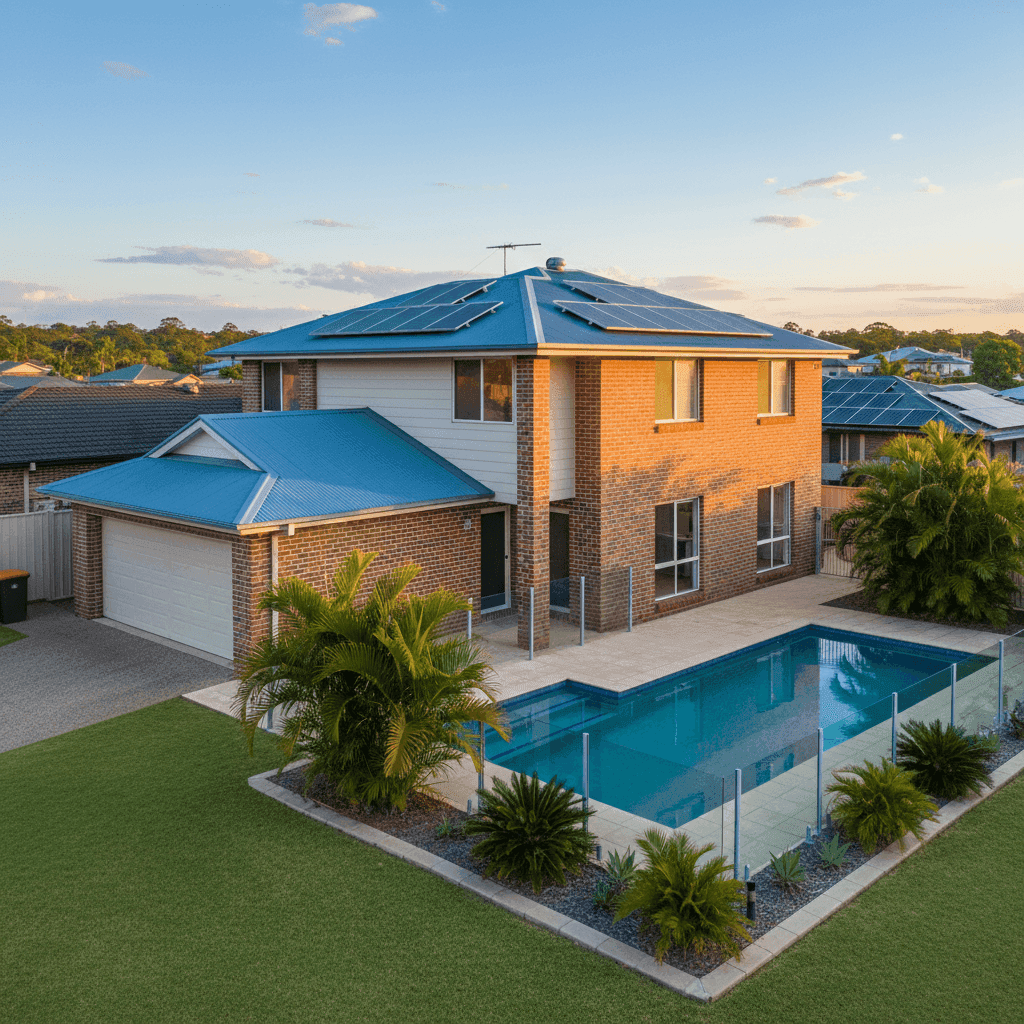
Victoria Point is a leafy bayside suburb on the Redland Peninsula, southeast of Brisbane, known for its relaxed coastal lifestyle and family-friendly streets. If you own a free standing home here, understanding what you should be paying for building insurance — and why — can make a real difference to your household budget. This article breaks down a recent building-only insurance quote for a four-bedroom, two-bathroom brick veneer home in Victoria Point (QLD 4165) and puts it in context against local, state, and national benchmarks.
---
Is This Quote Fair?
The quote in question comes in at $3,420 per year (or $328/month), with a $1,000 building excess. Based on data from 130 quotes collected for Victoria Point, this premium sits above the suburb average of $2,534/yr and above the 75th percentile of $3,231/yr — placing it firmly in the "Expensive" category relative to comparable local properties.
To put that plainly: roughly three-quarters of homes in Victoria Point are being quoted less than $3,231 per year for building insurance. At $3,420, this quote is higher than what most local homeowners are paying.
That said, "expensive" is relative. The sum insured here is $1,011,000 — a substantial rebuild figure that reflects the size (214 sqm) and features of the property. Insurers price building cover primarily based on rebuild cost, not market value, so a higher sum insured will naturally push the premium up. It's worth checking whether the sum insured is calibrated correctly for your property; over-insuring is a common and costly mistake.
---
How Victoria Point Compares
To understand whether this quote is genuinely high or simply reflects the property's profile, it helps to zoom out and look at the broader picture.
| Benchmark | Premium |
|---|---|
| This quote | $3,420/yr |
| Victoria Point suburb average | $2,534/yr |
| Victoria Point suburb median | $2,426/yr |
| Victoria Point 25th percentile | $1,447/yr |
| Victoria Point 75th percentile | $3,231/yr |
| Redland LGA average | $3,178/yr |
| QLD state average | $9,129/yr |
| QLD state median | $3,903/yr |
| National average | $5,347/yr |
| National median | $2,764/yr |
A few things stand out here. First, the Queensland state average of $9,129/yr is dramatically higher than what Victoria Point homeowners typically pay — a reflection of the extreme weather risk (cyclones, flooding) that drives up premiums in Far North Queensland and other high-risk areas. Victoria Point, by contrast, benefits from a relatively benign risk profile: it's not a designated cyclone risk area, and the bayside location doesn't carry the same flood exposure as parts of western Brisbane or regional QLD.
Second, when compared to the national average of $5,347/yr, this quote looks much more reasonable — it's well below the country-wide benchmark. And at $3,420, it's also below the QLD median of $3,903/yr, suggesting that even within Queensland, Victoria Point remains a comparatively affordable place to insure a home.
The Redland LGA average of $3,178/yr is the most directly comparable figure, and this quote sits about $242 above that mark — not a dramatic difference, but worth investigating.
---
Property Features That Affect Your Premium
Several characteristics of this property influence where the premium lands.
Brick veneer construction is generally viewed favourably by insurers. It's durable, fire-resistant, and performs well in storms — all factors that reduce the likelihood of a major claim. Combined with a Colorbond steel roof, which is lightweight, corrosion-resistant, and well-suited to the Queensland climate, the construction profile of this home is solid from an underwriting perspective.
The slab foundation is standard for Queensland homes built in the mid-1990s and presents no particular risk concerns. Similarly, tile flooring is a low-maintenance, durable choice that insurers tend to view neutrally.
Where premiums can climb is with additional features. This property includes:
- A swimming pool — pools add liability exposure and can increase the cost of a claim (e.g., if a storm damages pool equipment or surrounding structures). Most insurers factor this into their pricing.
- Solar panels — rooftop solar systems add to the rebuild cost and can be damaged by hail or high winds. Ensuring your sum insured accounts for the replacement value of your panels is important.
- Ducted climate control — a ducted air conditioning system is a significant fixed asset that forms part of the building sum insured. It adds to the overall rebuild cost and, by extension, the premium.
The property's 1996 construction year places it in a relatively modern bracket — post the major building code reforms of the late 1980s and early 1990s — which is generally a positive signal for insurers compared to older homes with ageing wiring or plumbing.
The standard fittings quality rating also keeps the premium in check. Homes with high-end or custom finishes typically cost more to rebuild on a per-square-metre basis, which flows through to higher premiums.
---
Tips for Homeowners in Victoria Point
1. Review your sum insured carefully At $1,011,000 for a 214 sqm home, the sum insured works out to roughly $4,724/sqm — which is on the higher end of typical rebuild cost estimates. Use an independent building cost calculator or speak with a quantity surveyor to confirm this figure is accurate. Over-insuring means you're paying premiums on coverage you'll never be able to claim.
2. Compare at least three quotes The gap between the 25th percentile ($1,447/yr) and the 75th percentile ($3,231/yr) in Victoria Point is enormous — nearly $1,800 per year. That spread tells you different insurers are pricing this suburb very differently. Shopping around using a comparison tool like CoverClub can surface meaningfully cheaper options for the same level of cover.
3. Ask about discounts for security and safety features Some insurers offer discounts for homes with monitored alarms, deadbolts, or fire suppression systems. If your home has any of these, make sure they're disclosed when getting a quote — they can shift the premium in your favour.
4. Consider your excess strategically This quote carries a $1,000 building excess. Opting for a higher voluntary excess (say, $2,500 or $5,000) can reduce your annual premium noticeably. If you have a solid emergency fund and are unlikely to make small claims, this trade-off often makes financial sense.
---
Ready to Find a Better Rate?
Whether you're renewing your policy or shopping for the first time, it pays to see what's out there. CoverClub aggregates real quote data from across Australia so you can benchmark your premium against what others are actually paying in your suburb. Get a building insurance quote for your Victoria Point home and see how your current insurer stacks up.