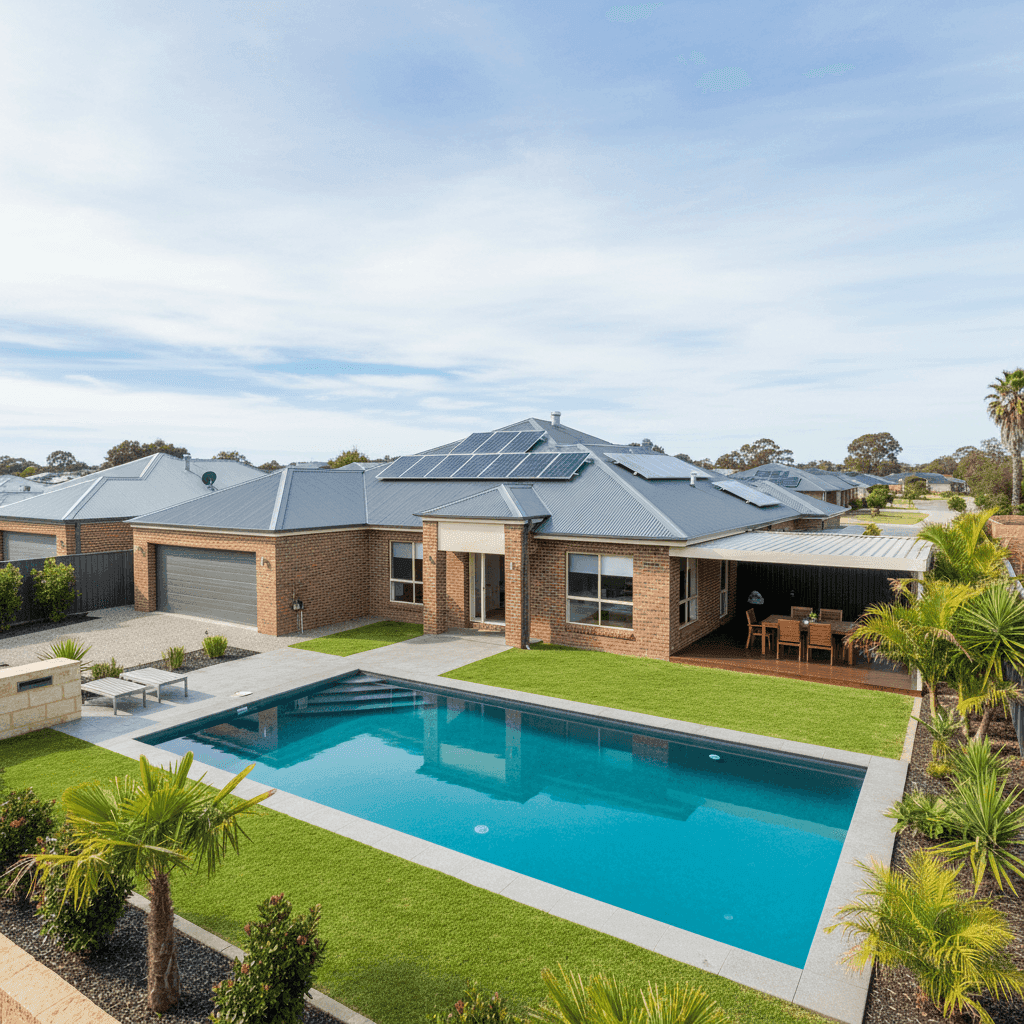
West Swan, nestled in the Swan Valley region of Perth's north-east, is a well-established suburb known for its spacious blocks, rural character, and proximity to the Swan River. For owners of a free standing home in this area, understanding what drives your home insurance premium — and whether your quote stacks up — is an important part of protecting what is likely your most valuable asset.
This article breaks down a real home and contents insurance quote for a five-bedroom, double brick home in West Swan (postcode 6055), and puts the numbers into context against local, state, and national benchmarks.
---
Is This Quote Fair?
The annual premium for this property came in at $2,675 per year (or approximately $256 per month), covering both building (sum insured: $1,005,000) and contents ($220,000), each with a $1,000 excess.
Our pricing engine has rated this quote as FAIR — Around Average. That's a reasonable outcome for a property of this size and specification. It's not the cheapest quote you'll find on the market, but it's also not overpriced given the level of cover provided. A "Fair" rating generally means the insurer is pricing the risk in line with market expectations, so while there may be room to shop around, you're not being significantly overcharged.
For a five-bedroom home with a pool, solar panels, and ducted climate control — all of which add to the replacement cost and risk profile — landing near the average is actually a solid result.
---
How West Swan Compares
Let's put the $2,675 annual premium into perspective using available benchmarks.
| Benchmark | Premium |
|---|---|
| This Quote | $2,675 / yr |
| LGA (Mundaring) Average | $2,563 / yr |
| WA State Average | $2,811 / yr |
| WA State Median | $2,127 / yr |
| National Average | $5,347 / yr |
| National Median | $2,764 / yr |
A few things stand out here:
- Below the WA state average: At $2,675, this quote sits $136 below the Western Australian average of $2,811. That's a modest but meaningful saving.
- Above the WA median: The WA median of $2,127 is notably lower, which suggests a significant portion of WA homeowners are insuring smaller or lower-value properties. A five-bedroom home with a $1,005,000 building sum insured naturally attracts a higher premium than the typical WA dwelling.
- Well below the national average: Compared to the national average of $5,347, this quote looks very competitive. Much of that national figure is driven by high-risk regions in Queensland and Northern Australia where cyclone and flood exposure pushes premiums dramatically higher.
- Slightly above the national median: At $2,764, the national median is just marginally higher than this quote — again reinforcing the "Fair" rating.
The LGA (Mundaring) average of $2,563 is worth noting. West Swan falls within the City of Swan local government area rather than Mundaring, but the comparison is still useful as a regional reference point. This quote sits modestly above that figure, which is consistent with the higher building sum insured and additional features on this property.
For suburb-level data and trends, visit the West Swan insurance stats page. You can also explore WA-wide home insurance data or review national home insurance statistics to see how your area compares across Australia.
---
Property Features That Affect Your Premium
Every home is different, and insurers assess a range of property characteristics when calculating your premium. Here's how the features of this particular West Swan home influence the price:
Double Brick Construction Double brick is one of the most favoured wall types in Western Australia, and for good reason. It offers excellent durability, thermal performance, and structural resilience. From an insurance perspective, double brick homes typically attract more competitive premiums because they're less susceptible to storm and wind damage compared to lightweight or timber-framed construction.
Steel/Colorbond Roof Colorbond roofing is a popular and practical choice in WA's climate. It's lightweight, resistant to corrosion, and performs well in high-wind conditions. Insurers generally view it favourably, though the cost to replace a large roof area does factor into the building sum insured.
Slab Foundation & Tile Flooring A concrete slab foundation is standard for homes of this era in Perth's suburbs, and it contributes to structural stability. Tiled flooring is similarly durable and low-maintenance, which can slightly reduce the risk of certain types of damage claims.
Swimming Pool A pool adds to both the replacement value of the property and the liability risk. Insurers factor in the cost of pool equipment, fencing, and associated structures, which contributes to a higher building sum insured and, consequently, a higher premium.
Solar Panels Solar panel systems are increasingly common in WA, but they do add to the insured value of the home. Panels can be damaged by hail, storms, or falling debris, and their replacement cost is typically included in the building sum insured. Make sure your policy explicitly covers solar panels.
Ducted Climate Control Ducted air conditioning is a significant fixed asset. As a built-in system, it forms part of the building sum insured and can be costly to repair or replace — particularly for a home of this size.
No Cyclone Risk West Swan is not classified as a cyclone risk area, which is a meaningful factor in keeping premiums lower compared to properties in northern WA or Queensland. Cyclone-rated premiums can be substantially higher, so this is a genuine advantage for Swan Valley homeowners.
---
Tips for Homeowners in West Swan
1. Review Your Building Sum Insured Regularly Construction costs in Perth have risen considerably over recent years. A sum insured of $1,005,000 for a 214 sqm home works out to roughly $4,700 per square metre — which is within a reasonable range for a double brick home with quality fittings, but it's worth validating this figure with a building cost calculator or a quantity surveyor to avoid being underinsured.
2. Check That Your Pool and Solar Are Explicitly Covered Not all policies automatically extend to pool equipment or solar panel systems. Read your Product Disclosure Statement (PDS) carefully to confirm these features are included, and that the coverage limits are adequate for replacement costs.
3. Consider Your Excess Carefully Both the building and contents excess on this policy are set at $1,000. Opting for a higher excess (say, $2,000 or $2,500) can reduce your annual premium, but only makes sense if you're comfortable covering more out of pocket in the event of a claim. Conversely, a lower excess provides greater protection for smaller claims.
4. Compare at Renewal, Not Just at Sign-Up Insurance markets shift, and the best deal today may not be the best deal in 12 months. Set a reminder to compare quotes at least four to six weeks before your renewal date. Even a "Fair" rated quote can often be improved with a bit of shopping around.
---
Ready to Compare?
Whether you're reviewing an existing policy or shopping for cover on a new property, CoverClub makes it easy to compare home and contents insurance quotes from multiple insurers in minutes. Get a quote today and see how your premium stacks up against the market — you might be surprised at what's available.