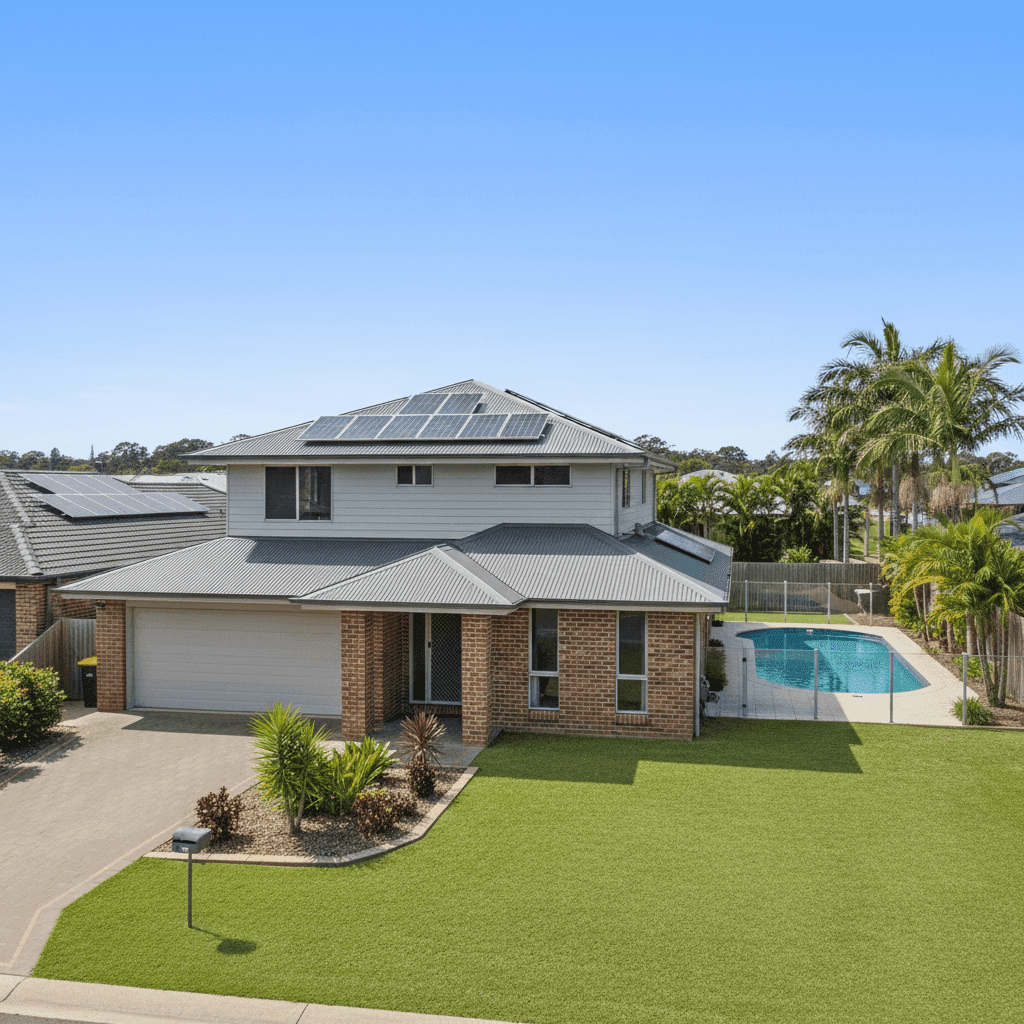
If you own a free standing home in Wondunna, QLD 4655, you already know that finding the right building insurance at a fair price takes a little homework. Situated in the Fraser Coast region, Wondunna is a well-established residential suburb where property values — and the cost to rebuild — have been steadily climbing. This article breaks down a real building-only insurance quote for a four-bedroom, two-bathroom brick veneer home in the area, comparing it against local, state, and national benchmarks so you know exactly where you stand.
---
Is This Quote Fair?
The quote in question comes in at $2,165 per year (or about $211 per month) for building-only cover on a 214 sqm free standing home with a sum insured of $880,000. Our pricing engine rates this as CHEAP — below the suburb average — which is genuinely good news for the homeowner.
To put that in perspective:
- The suburb average for Wondunna sits at $3,939/yr
- The suburb median is $3,392/yr
- Even the 25th percentile — meaning the cheapest quarter of quotes in the area — is $2,633/yr
This quote undercuts even the cheapest quarter of local premiums by nearly $470 a year. That's a meaningful saving, and it suggests either a very competitive insurer, a well-maintained property profile, or a combination of both. At $1,000 for the building excess, the policy sits within a standard range — not so high that a claim becomes painful, and not so low that it inflates the premium unnecessarily.
---
How Wondunna Compares
Zooming out beyond the suburb reveals just how varied home insurance pricing can be across Queensland and the country. You can explore the full data on our Wondunna suburb stats page, but here's a quick snapshot:
| Benchmark | Premium |
|---|---|
| This quote | $2,165/yr |
| Wondunna suburb average | $3,939/yr |
| Wondunna suburb median | $3,392/yr |
| QLD state average | $9,129/yr |
| QLD state median | $3,903/yr |
| National average | $5,347/yr |
| National median | $2,764/yr |
A few things stand out here. First, the Queensland state average of $9,129/yr is extraordinarily high — nearly double the national average of $5,347/yr. This is largely driven by the significant proportion of Queensland properties located in cyclone-prone coastal and northern regions, where insurers price risk heavily. You can see how QLD stacks up overall on our Queensland insurance stats page.
Second, while the QLD median of $3,903/yr is far more moderate than the average (a sign that extreme premiums are skewing the average upward), this quote still comes in well below that figure. Compared to the national median of $2,764/yr, the quote is only slightly below — which reinforces that this is a competitive result, not an outlier.
It's also worth noting that the suburb sample size of 11 quotes means the local data is directionally useful but not statistically deep. As more homeowners in Wondunna compare quotes through platforms like CoverClub, these benchmarks will sharpen.
---
Property Features That Affect Your Premium
Every home tells its own insurance story, and the features of this particular property help explain why the premium lands where it does.
Brick veneer construction is generally viewed favourably by insurers. It's more resistant to fire and structural damage than timber-framed cladding, and it tends to perform well in severe weather events — all of which can translate to lower risk in an insurer's eyes.
Steel/Colorbond roofing is another tick in the right column. Colorbond is lightweight, durable, and highly resistant to corrosion and wind uplift. In Queensland's climate, where storms and heavy rainfall are common, a quality roof is one of the most important factors in a building's risk profile.
The concrete slab foundation and tile flooring add further stability to the risk assessment. Slabs are less susceptible to moisture ingress and pest damage compared to raised timber floors, and tiles are durable and easy to repair after water damage.
On the other side of the ledger, a few features add complexity to the sum insured and potentially the premium:
- Swimming pool: Pools increase the rebuild cost and introduce liability considerations. They need to be correctly included in your sum insured calculation.
- Solar panels: Roof-mounted solar systems can be costly to replace and may need specific cover — always confirm with your insurer whether panels are included under your building policy.
- Ducted climate control: Ducted air conditioning systems are expensive to replace and are typically covered under building insurance, but it's worth verifying this with your provider.
The 2004 construction year puts this home in a relatively modern bracket — built after many of the updated Queensland building codes came into effect — which may also contribute to a more favourable risk profile.
---
Tips for Homeowners in Wondunna
Whether you're reviewing an existing policy or shopping for the first time, here are four practical steps to make sure you're getting the best outcome.
1. Double-check your sum insured At $880,000 for a 214 sqm home, the sum insured here is substantial — and rightly so, given construction costs in regional Queensland. Underinsurance is one of the most common and costly mistakes homeowners make. Use an independent building cost calculator to verify your figure annually, especially as labour and materials costs continue to rise.
2. Confirm what's included for your pool and solar Not all policies automatically cover pools and solar panels under a standard building policy. Ask your insurer specifically whether these are included, up to what value, and whether any exclusions apply (e.g., mechanical breakdown vs. storm damage).
3. Compare at renewal, every year Insurance markets shift. The fact that this quote is below the suburb average today doesn't mean your renewal price will stay competitive. Set a reminder to compare quotes at least 30 days before your policy renews — it only takes a few minutes and can save hundreds of dollars.
4. Review your excess settings A $1,000 excess is reasonable for most homeowners, but if you have strong emergency savings, increasing your excess can meaningfully reduce your annual premium. Conversely, if cash flow is a concern, a lower excess gives you more predictability at claim time.
---
Ready to Compare?
Whether this quote is for you or you're simply benchmarking your own policy, the best way to know if you're getting a fair deal is to compare. At [CoverClub](https://coverclub.com.au/?focus=address), you can enter your property details and see real quotes side by side — no jargon, no pressure, just transparent pricing so you can make a confident decision. Start comparing today and find out what your Wondunna home should really be costing you to insure.