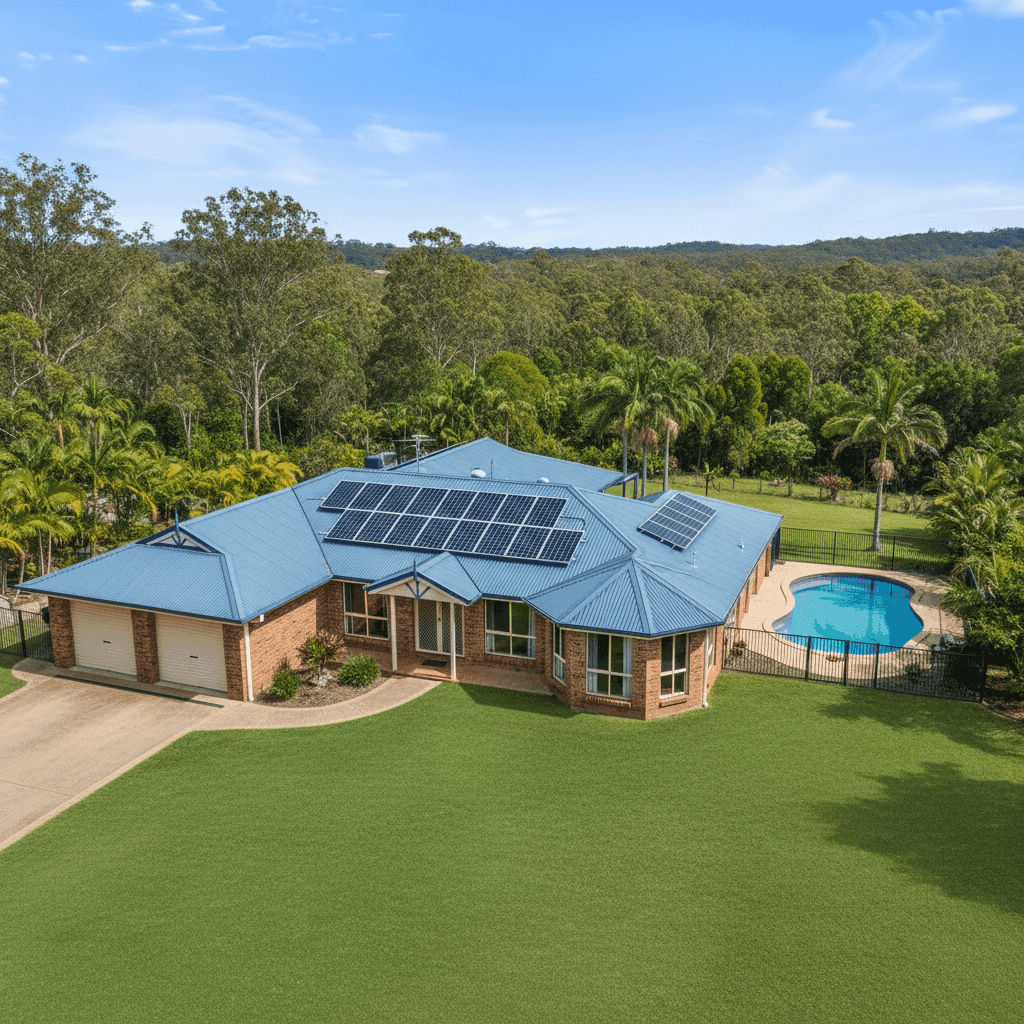
Worongary is a leafy, semi-rural suburb tucked into the hinterland of the Gold Coast — known for its generous block sizes, elevated terrain, and a relaxed lifestyle that sits comfortably between the coast and the ranges. It's the kind of suburb where large, well-appointed family homes are the norm, and protecting one of those homes with the right insurance cover is no small consideration. This article breaks down a recent home and contents insurance quote for a six-bedroom free standing home in Worongary (postcode 4213), examining whether the price is competitive and what factors are likely driving it.
---
Is This Quote Fair?
The quote in question comes in at $5,932 per year (or $568/month) for combined home and contents cover, with a building sum insured of $1,500,000 and contents valued at $150,000. Both the building and contents excess sit at $1,000.
Our pricing analysis rates this quote as Fair — Around Average, and the data supports that assessment. When benchmarked against the suburb-level data for Worongary, this premium sits just above the 25th percentile ($5,825/yr) and meaningfully below the suburb average of $7,358/yr and the suburb median of $7,804/yr. In plain terms: roughly three-quarters of comparable quotes in the area cost more.
That said, "fair" doesn't necessarily mean "the best available." The 25th percentile benchmark suggests there are cheaper options in the market for this postcode — though those quotes may differ in insurer, cover inclusions, or excess structure. It's always worth reading the fine print before chasing the lowest number.
---
How Worongary Compares
Context is everything when evaluating an insurance premium, so let's look at the broader picture.
| Benchmark | Premium |
|---|---|
| This Quote | $5,932/yr |
| Worongary Suburb Average | $7,358/yr |
| Worongary Suburb Median | $7,804/yr |
| Gold Coast LGA Average | $8,161/yr |
| QLD State Average | $9,129/yr |
| National Average | $5,347/yr |
A few things stand out here. First, Worongary premiums — even this relatively modest quote — sit well above the national average of $5,347/yr. Queensland as a whole is an expensive state to insure a home, and the QLD state average of $9,129/yr reflects the elevated risk profile across much of the state, driven largely by flood, storm, and cyclone exposure in many regions.
Interestingly, the QLD state median of $3,903/yr is far lower than the average — a sign that the distribution is skewed by high-risk postcodes pulling the average upward. Worongary, being a hinterland suburb without significant cyclone or flood exposure, benefits from a more moderate risk profile compared to coastal or low-lying parts of Queensland.
The Gold Coast LGA average of $8,161/yr also provides useful context. Many Gold Coast suburbs carry higher premiums due to storm surge and flood risk. Worongary's inland, elevated position helps keep costs more contained by comparison.
---
Property Features That Affect Your Premium
This is a substantial property, and several of its characteristics have a direct bearing on the premium.
Size and sum insured: At 429 sqm with six bedrooms and four bathrooms, this is a large home. The $1,500,000 building sum insured reflects the significant rebuild cost for a property of this scale. Larger homes cost more to insure simply because they cost more to rebuild — and getting the sum insured right is critical to avoiding underinsurance.
Construction materials: Brick veneer external walls and a steel/Colorbond roof are generally viewed favourably by insurers. Brick veneer offers solid fire resistance, and Colorbond roofing is durable and performs well in storm conditions. These materials typically attract lower premiums than timber-framed or older construction types.
Slab foundation and tile flooring: A concrete slab foundation is a stable, low-maintenance base that insurers tend to view positively. Tile flooring throughout is similarly low-risk — it's durable, resistant to water damage, and easy to replace if needed.
Above average fittings: The above-average quality of internal fittings — think stone benchtops, quality appliances, and premium fixtures — contributes to both the rebuild cost and the contents valuation. Higher-quality fittings increase replacement costs, which flows through to the premium.
Pool, solar panels, and ducted climate control: Each of these adds value to the property but also adds insurable risk. Swimming pools introduce liability considerations and can be expensive to repair or replace after storm or structural damage. Solar panel systems require specific cover and can be damaged by hail or high winds. Ducted climate control systems are costly to repair and are typically included in building cover — but it's worth confirming this with your insurer.
No cyclone risk: Worongary falls outside designated cyclone risk zones, which is a meaningful premium advantage compared to properties in North Queensland or coastal Far North QLD. This is one reason the quote sits below the state average.
---
Tips for Homeowners in Worongary
1. Review your building sum insured regularly. Construction costs have risen significantly in recent years. A $1,500,000 sum insured may have been accurate when the policy was first taken out, but it's worth having a quantity surveyor or using an online calculator to verify the current rebuild cost. Underinsurance is one of the most common — and costly — mistakes homeowners make.
2. Check that your pool and solar panels are explicitly covered. Not all standard home insurance policies automatically include swimming pools or solar panel systems in their building cover. Read your Product Disclosure Statement (PDS) carefully, or ask your insurer directly, to confirm these are included and that the coverage limits are adequate.
3. Consider your excess level strategically. Both the building and contents excess on this quote are set at $1,000. Opting for a higher excess (say, $2,000 or $2,500) can meaningfully reduce your annual premium — a worthwhile trade-off if you have the financial buffer to cover a larger out-of-pocket cost in the event of a claim.
4. Compare quotes at renewal time. Even a "fair" premium can become uncompetitive over time as insurers adjust their pricing models. The insurance market shifts regularly, and loyalty doesn't always pay. Running a fresh comparison at each renewal is one of the simplest ways to ensure you're not overpaying.
---
Ready to Compare?
Whether you're reviewing an existing policy or shopping for cover on a new home, comparing quotes is the most effective way to find value. Get a home insurance quote at CoverClub and see how your property stacks up — it takes just a few minutes and could save you hundreds each year. You can also explore more Worongary insurance data and suburb statistics to better understand what others in your area are paying.