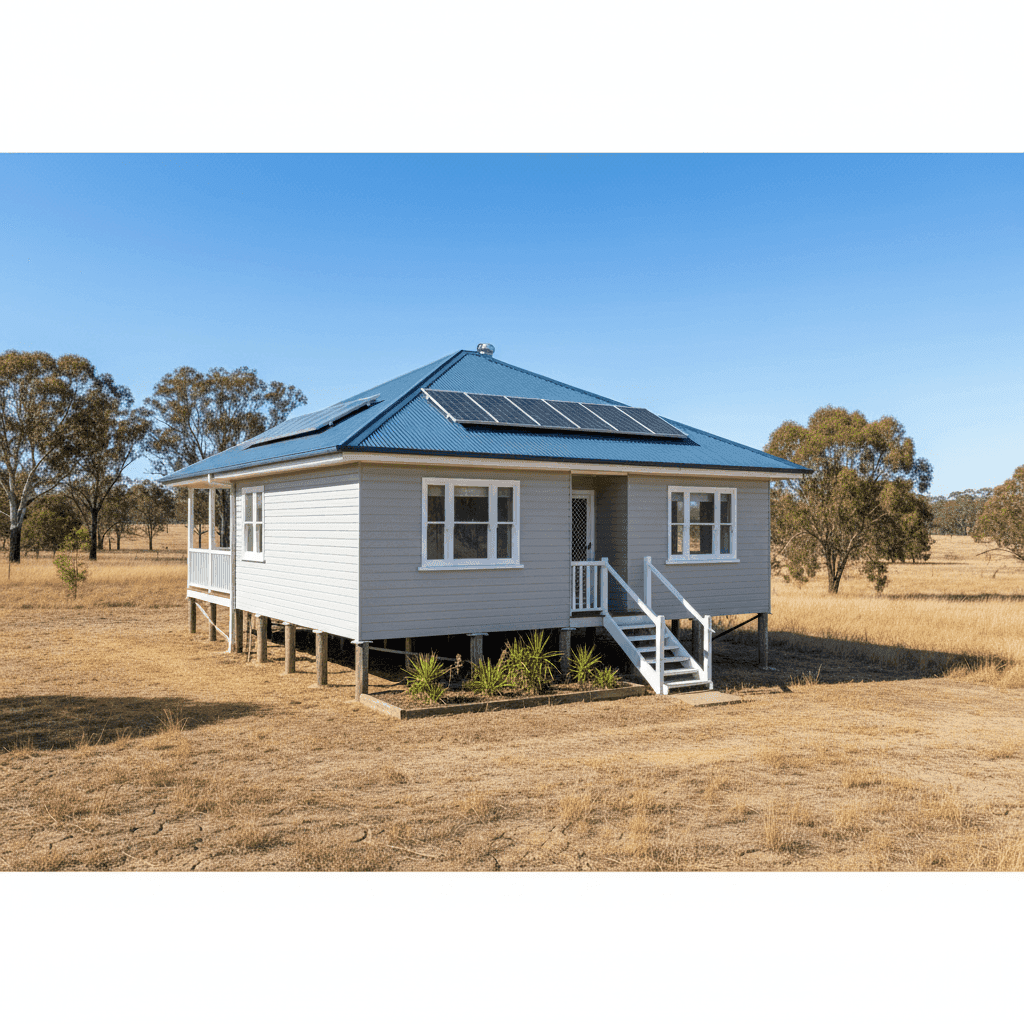
Yelarbon is a quiet rural township in Queensland's Goondiwindi region, sitting in the heart of some of the state's most productive agricultural land. Like many properties in this part of the world, free standing homes here tend to reflect a practical, hardworking character — and this three-bedroom, one-bathroom home is no exception. Built in 1985 and elevated on stumps in classic Queensland style, it carries a number of features that insurers look at closely when calculating a premium. So what does home and contents insurance actually cost for a property like this, and is the quoted price reasonable?
---
Is This Quote Fair?
The annual premium for this property comes in at $2,796 per year (or $261 per month), covering a building sum insured of $300,000 and $50,000 in contents. CoverClub's pricing analysis rates this quote as Fair — around average for the area.
That rating holds up well under scrutiny. The quote sits comfortably above the suburb's 25th percentile of $2,377 per year, meaning roughly a quarter of comparable properties in Yelarbon are quoted less — but the majority are quoted significantly more. In fact, the suburb's 75th percentile sits at $11,474 per year, which means this quote is well below what three-quarters of local homeowners are paying. That's a meaningful result.
It's also worth noting that the suburb average premium is a striking $80,740 per year — an outlier figure almost certainly skewed by a small number of very high-risk or high-value properties in the dataset (the sample includes just 11 quotes). The median of $8,606 per year is a far more representative benchmark, and against that figure, this quote looks quite competitive.
With a $1,000 building excess and $500 contents excess, the policy structure is fairly standard. Homeowners comfortable with a slightly higher excess in exchange for a lower premium may find room to negotiate further.
---
How Yelarbon Compares
Understanding where Yelarbon sits relative to broader benchmarks helps put this quote in context. Here's how the numbers line up:
| Benchmark | Average Premium | Median Premium |
|---|---|---|
| Yelarbon (4388) | $80,740/yr* | $8,606/yr |
| Queensland | $9,129/yr | $3,903/yr |
| National | $5,347/yr | $2,764/yr |
*Suburb average is heavily skewed by outliers in a small sample of 11 quotes.
The Goondiwindi LGA average sits at $6,634 per year, which offers a useful regional anchor. Against that figure, this quote of $2,796 per year looks genuinely competitive — coming in at less than half the LGA average.
Queensland as a whole carries some of the highest home insurance premiums in the country, largely due to the state's exposure to extreme weather events including flooding, severe storms, and cyclones. The Queensland state average of $9,129 per year is well above the national average of $5,347, reflecting that elevated risk environment. This property, however, benefits from not being in a designated cyclone risk area, which keeps the premium more manageable.
You can explore more local pricing data for Yelarbon and surrounds at the CoverClub suburb stats page for Yelarbon QLD 4388.
---
Property Features That Affect Your Premium
Several characteristics of this property directly influence what insurers charge. Understanding them can help you make smarter decisions at renewal time.
Hardiplank / Hardiflex External Walls Fibre cement cladding like Hardiplank is generally viewed favourably by insurers. It's durable, fire-resistant, and holds up well in harsh Australian conditions. Compared to older timber weatherboard homes, properties with fibre cement cladding often attract more competitive premiums.
Steel / Colorbond Roof Colorbond steel roofing is another positive signal for insurers. It's lightweight, resistant to corrosion, and performs well in high-wind conditions. For a rural Queensland property, this is a meaningful advantage.
Elevated on Stumps The property is elevated by at least one metre, which is a double-edged sword from an insurance perspective. On the positive side, elevation can significantly reduce flood risk — water is less likely to enter the living areas during a heavy rain event. On the other hand, elevated homes can be more exposed to wind damage and may require additional structural consideration. Overall, in flood-prone inland Queensland, the elevation benefit tends to outweigh the drawbacks.
Timber and Laminate Flooring Timber floors in elevated homes can be vulnerable to moisture and pest damage, which is worth keeping in mind when reviewing what your policy covers. Make sure your sum insured accounts for the cost of floor replacement if needed.
Solar Panels Solar panels are increasingly common on Australian homes, but they do add to replacement costs. Insurers treat them as fixtures of the building, so they should be factored into your building sum insured. At $300,000, it's worth confirming with your insurer that solar panels are explicitly covered and that your sum insured is adequate.
Ducted Climate Control Ducted air conditioning systems are a significant asset and add to the overall rebuild cost. Again, this is something to verify is captured in your building sum insured rather than left to assumption.
No Pool, Not in a Cyclone Risk Zone The absence of a pool removes a common liability concern, and sitting outside a designated cyclone risk area is a genuine premium advantage in Queensland.
---
Tips for Homeowners in Yelarbon
1. Review Your Building Sum Insured Regularly Construction costs have risen sharply across regional Queensland in recent years. A sum insured of $300,000 may have been appropriate when the policy was first taken out, but it's worth getting a current building replacement estimate — particularly given the solar panels and ducted climate control system that need to be included. Underinsurance is one of the most common and costly mistakes homeowners make.
2. Consider the Value of Your Excess This policy carries a $1,000 building excess. If you haven't made a claim in several years, it may be worth asking your insurer whether increasing the excess could reduce your annual premium. Conversely, if you'd struggle to cover a $1,000 outlay in an emergency, a lower excess might be worth the slightly higher premium.
3. Don't Overlook Contents Coverage $50,000 in contents cover is a reasonable starting point, but it's easy to underestimate the cumulative value of furniture, appliances, clothing, and personal items. Take the time to do a room-by-room inventory — many homeowners are surprised to find their contents are worth significantly more than they assumed.
4. Compare at Renewal Insurance loyalty doesn't always pay off. Premiums can shift significantly from year to year, and the market is competitive. Using a comparison tool at renewal time is one of the simplest ways to ensure you're not overpaying — especially in a regional market like Yelarbon where pricing can vary widely between providers.
---
Ready to Compare?
Whether you're renewing an existing policy or shopping for the first time, comparing quotes is the smartest move you can make. CoverClub makes it easy to see what multiple insurers would charge for your specific property — so you can make an informed decision rather than just accepting the first number you're given. Get a home insurance quote today and see how your premium stacks up.